How can I prevent false triggering in a monostable 555 timer circuit?

  • Thread starter Thread starter silentblackha
  • Start date Start date
  • Tags Tags
    555 timer Timer
Click For Summary

Discussion Overview

The discussion revolves around troubleshooting a monostable 555 timer circuit that is experiencing false triggering upon power-up. Participants explore various methods to prevent the timer from activating unintentionally when connected to a power supply, particularly in the context of automotive applications.

Discussion Character

  • Technical explanation
  • Debate/contested
  • Experimental/applied

Main Points Raised

  • One participant describes the issue of the timer activating upon connection to a 12V supply and seeks solutions to ensure it only activates with a trigger.
  • Another suggests adding a capacitor between the output and ground to snub transients, mentioning the importance of controlling the RC time constant with a resistor.
  • A participant advises connecting the RESET terminal to the supply voltage to prevent unintended low output during transients, although they express doubt about this being the root cause of the problem.
  • One suggestion involves tying a capacitor to the reset pin and connecting it to +12V through a resistor to hold the device in reset during power-up.
  • Concerns are raised about placing capacitors incorrectly on IC outputs, with a caution against using larger timing capacitors that could overload the 555 timer's discharge capabilities.
  • A participant recommends connecting pin 4 to 12V and replacing a specified capacitor with a smaller value, indicating personal success with this adjustment.
  • Another participant suggests using a diode (1N001) in series with the output pin to protect the 555 timer when driving a relay, although this advice is contested by others who question its necessity.
  • Clarifications are made regarding the capacitor values discussed, with one participant correcting a previous mention of a 30 microfarad capacitor to 30 nanofarads.

Areas of Agreement / Disagreement

Participants express multiple competing views on the best approach to prevent false triggering, with no consensus reached on a single solution. Various methods are proposed, but the effectiveness of each remains uncertain.

Contextual Notes

Participants note potential transient issues from the power supply and trigger input, indicating that these could contribute to the false triggering problem. There is also mention of design considerations regarding capacitor placement and values, which may affect circuit performance.

silentblackha
Messages
2
Reaction score
0
I am having trouble with a mono-stable 555 timer circuit.

When I connect this to a power supply (right now it is a 120VAC to 12VDC converter), the timer turns on and then off, like it would have if it was activated by the trigger. After this, when the trigger is used, everything works perfectly like it is supposed to.

I am trying to figure out how to stop the timer from triggering right when it is connected to a 12V supply; I only want it to turn on when the trigger is used.

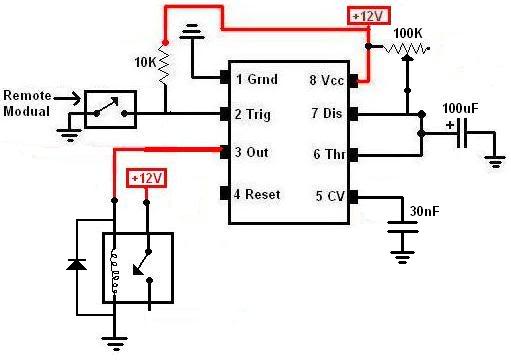
I apologize for the crude schematic that isn't drawn properly:
555schem4545.jpg

Things to note:
- This will be installed in an automobile; the Remote Module is the ground connection that the remote module makes to sound the horn; right now its on a work bench
- The charging resistor is a 100K variable resistor that only has one end and the wiper connected.

Any help is appreciated. Thank you for your time!
 
Engineering news on Phys.org
silentblackha said:
I am having trouble with a mono-stable 555 timer circuit.

When I connect this to a power supply (right now it is a 120VAC to 12VDC converter), the timer turns on and then off, like it would have if it was activated by the trigger. After this, when the trigger is used, everything works perfectly like it is supposed to.

I am trying to figure out how to stop the timer from triggering right when it is connected to a 12V supply; I only want it to turn on when the trigger is used.

I apologize for the crude schematic that isn't drawn properly:

Things to note:
- This will be installed in an automobile; the Remote Module is the ground connection that the remote module makes to sound the horn; right now its on a work bench
- The charging resistor is a 100K variable resistor that only has one end and the wiper connected.

Any help is appreciated. Thank you for your time!

You're probably getting some transient output on start-up. You could try to put a capacitor between the output and ground (in parallel with the relay) which should snub this transient. The RC constant will just be the capacitance and the coil resistance. You could also put a resistor in series with this capacitor to better control the RC time constant (if it's too short). Unfortunately, this'll also delay the remote sequence (but chances are that this transient is much shorter than the actual operating pulse).
 
I found this advice,

"When the "RESET" terminal is not going to be used it is normal practice to connect this input to the supply voltage. This is especially true of the CMOS version of these timers as the inputs of these devices are very sensitive."

Though a transient on reset would pull the output low, wouldn't it?
 
Phrak said:
Though a transient on reset would pull the output low, wouldn't it?

Thank you. Yes, it would pull the output to low. I will tie this to the supplied voltage to be proper but I don't think this is the problem.

I will try the decoupling capacitor from + to ground and see if that fixes the problem. Thanks so far!
 
Tie a capacitor to the reset pin, other cap lead to ground. Then, tie the reset pin to +12V through a resistor. This holds the device in reset during power up.

You could try to put a capacitor between the output and ground (in parallel with the relay) which should snub this transient.

I wouldn't advise tying a capacitor between ANY output on ANY IC and ground. I think there are more design flaws putting capacitors where they shouldn't be than not putting them where they should be.
-
I also avoid using a bigger timing cap than necessary. The transistor inside the 555 has to discharge that monster. The more capacity you hang on pin 7 the more current it has to sink out of the cap when the output (pin 3) goes low. If nothing else, stick a couple of hundred ohms in series with pin 7.
-
As far as transient in general go, look to where they could be coming from. The biggest is the power supply, next would be the trigger input. You should also consider transient suppression on the trigger input.
 
Last edited:
connect the pin 4 to 12v then replace your 30 micro farad by .01 micro farad. I've tried it...
 
one thing, you should put 1N001 in the output pin before connecting to a relay so that the flow of current is one directional only.
 
Pay attention Jamers. The thread is about 2.5 years old. There is no 30 micro farad in the circuit, you didn't read my suggestion about what to do with pin 4. Really can't see the point of a 1N001 in series...
 
i mean 30 nano farad capacitor in the circuit ( pin 5). the purpose of 1n001 or the extra diod is to protect the 555ic when connecting it in relay to drive higher voltage. I've been using monostable circuit in my water vending machine and i don't have any problem in false triggering.
 

Similar threads

Replies
16
Views
3K
  • · Replies 29 ·
Replies
29
Views
9K
  • · Replies 9 ·
Replies
9
Views
2K
  • · Replies 6 ·
Replies
6
Views
4K
  • · Replies 19 ·
Replies
19
Views
4K
  • · Replies 9 ·
Replies
9
Views
9K
Replies
5
Views
3K
  • · Replies 6 ·
Replies
6
Views
11K
Replies
12
Views
7K
Replies
2
Views
6K