How Can I Solve a System of Equations With Complex Numbers?

Click For Summary

Homework Help Overview

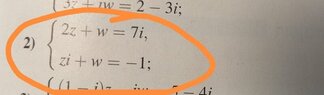
The discussion revolves around solving a system of equations involving complex numbers. The equations presented are 2z + w = 7i and zi + w = -1. Participants explore various methods of substitution and manipulation to find the values of z and w.

Discussion Character

  • Exploratory, Assumption checking, Mathematical reasoning

Approaches and Questions Raised

  • Participants discuss substituting z and w with expressions involving real and imaginary components, questioning the effectiveness of these methods. Some suggest manipulating the equations to eliminate variables, while others express confusion regarding the division of complex numbers.

Discussion Status

The conversation is ongoing, with participants offering different perspectives on how to approach the problem. Some guidance has been provided regarding the manipulation of complex numbers and the use of augmented matrices, but there is no explicit consensus on the best method to solve the system.

Contextual Notes

There is mention of constraints related to the chapter content, specifically that the task is expected to be completed without relying on complex division, which adds to the complexity of the discussion.

Callmelucky
Messages
144
Reaction score
30
Homework Statement
How can I solve a system of equations with complex numbers
2z+w=7i
zi+w=-1
Relevant Equations
z=a+bi
How can I solve a system of equations with complex numbers
2z+w=7i
zi+w=-1

I have tried substituting z with a+bi and I have tried substituting w=7i-2z but didn't get anything useful.

Edit: also, I've tried, multiplying lower eq. with -1 so that I can cancel w but I get stuck with 2z and zi and I can't figure out what I am supposed to do with that.

Edit2: also, I have tried replacing both z and w with a+bi but still nothing

Thank you
 
Physics news on Phys.org
Callmelucky said:
How can I solve a system of equations with complex numbers
2z+w=7i
zi+w=-1
Are you sure you've typed that correctly?
 
PeroK said:
Are you sure you've typed that correctly?
yes, and the solution should be z=-1+3i, w=2+i
 

Attachments

  • WhatsApp Image 2022-12-01 at 21.07.45.jpeg
    WhatsApp Image 2022-12-01 at 21.07.45.jpeg
    27 KB · Views: 156
  • Like
Likes   Reactions: PeroK
Callmelucky said:
Edit: also, I've tried, multiplying lower eq. with -1 so that I can cancel w but I get stuck with 2z and zi and I can't figure out what I am supposed to do with that.
You can manipulate complex numbers very much like you are used to with real numbers.
So what you tried should give you 2z-zi = 7i-1. Then you can factor the left side to get z(2-i)=7i-1
CORRECTION: z(2-i)=7i+1 and divide both sides by 2-i. z=(-1+7i)/(2-i). CORRECTION: z=(1+7i)/(2-i)
(Corrections thanks to @pasmith)
Callmelucky said:
Edit2: also, I have tried replacing both z and w with a+bi but still nothing
You can do that and work with all the reals and imaginary parts separately, but that is often the last resort.
 
Last edited:
Callmelucky said:
yes, and the solution should be z=-1+3i, w=2+i
I get these values.
You're making things harder than they need to be. Don't substitute a + ib for z. You can eliminate w by adding -1 times the second equation to the first. This gets you a simple equation involving only z. Then back-substitute to find w.
 
FactChecker said:
So what you tried should give you 2z-zi = 7i-1. Then you can factor the left side to get z(2-i)=7i-1 and divide both sides by 2-i. z=(-1+7i)/(2-i).
I do get that, but that is not what is in solutions.
 
FactChecker said:
You can manipulate complex numbers very much like you are used to with real numbers.
So what you tried should give you 2z-zi = 7i-1. Then you can factor the left side to get z(2-i)=7i-1 and divide both sides by 2-i. z=(-1+7i)/(2-i).

Callmelucky said:
I do get that, but that is not what is in solutions.

Subtracting iz + w = -1 from 2z + w = 7i should give <br /> \begin{split}<br /> (2 - i)z + (1 - 1)w &amp;= 7i - (-1) \\<br /> (2 - i)z &amp;= 1 + 7i.\end{split}
 
  • Like
Likes   Reactions: Callmelucky and FactChecker
Callmelucky said:
Okay, but that still isn't z=-1+3i
Yes, it is. You need to simplify it by multiplying both the numerator and denominator by 2+i
 
  • Like
Likes   Reactions: Callmelucky
I got it, that is why I deleted comment right after posting it lol :D.
Thanks everyone.
 
  • #10
But the problem is that I did not know how to divide complex numbers yesterday, I learned that like 10 minutes ago.
 
  • Like
Likes   Reactions: DaveE and PeroK
  • #11
Callmelucky said:
But the problem is that I did not know how to divide complex numbers yesterday, I learned that like 10 minutes ago.
That's the key here. If you proceed as I advised back in post #5, you get ##z = \frac{1 + 7i}{2 - i}##. If you don't know how to do division by complex numbers, you can't simplify the above to get ##z = -1 + 3i##.

If you're working from a textbook, did it cover complex number division, but you didn't catch on?
 
  • #12
Mark44 said:
That's the key here. If you proceed as I advised back in post #5, you get ##z = \frac{1 + 7i}{2 - i}##. If you don't know how to do division by complex numbers, you can't simplify the above to get ##z = -1 + 3i##.

If you're working from a textbook, did it cover complex number division, but you didn't catch on?
But this is a task in the chapter before division, in the chapter for addition and multiplication of complex numbers.
 
  • #13
When you get: z=(-1+7i)/(2-i).

multiply by (2+i)/(2+i)
 
  • #14
Callmelucky said:
But this is a task in the chapter before division, in the chapter for addition and multiplication of complex numbers.
That seems odd. You didn't show the complete problem as it appears in the book -- were you supposed to solve for z and w, or was it something simpler, like saying that there is a solution vs. saying that there is no solution?
 
  • #15
Callmelucky said:
Edit2: also, I have tried replacing both z and w with a+bi but still nothing
This works (although you can't replace both z and w with a + bi -- you need to replace w with a different complex number), but it entails knowing how to solve a system of four equations in four unknowns.
 
  • Like
Likes   Reactions: Callmelucky
  • #16
Callmelucky said:
But this is a task in the chapter before division, in the chapter for addition and multiplication of complex numbers.
Take the result @pasmith gave in Post#7, shown below.
pasmith said:
Subtracting iz + w = -1 from 2z + w = 7i should give <br /> \begin{split}<br /> (2 - i)z + (1 - 1)w &amp;= 7i - (-1) \\<br /> (2 - i)z &amp;= 1 + 7i.\end{split}
Now multiply both sides by the complex conjugate of ##(2-i)##.

You will need to be able to divide both sides by ##5## to arrive at the answer..
 
  • Like
Likes   Reactions: pbuk
  • #17
Mark44 said:
That seems odd. You didn't show the complete problem as it appears in the book -- were you supposed to solve for z and w, or was it something simpler, like saying that there is a solution vs. saying that there is no solution?
No, it says: solve systems of equations. And then 3 problems and that is it.
 
  • #18
Mark44 said:
This works (although you can't replace both z and w with a + bi -- you need to replace w with a different complex number), but it entails knowing how to solve a system of four equations in four unknowns.
I think this was expected to be done. Because I have already seen how it was supposed to be done just couldn't remember
 
  • #19
Callmelucky said:
I think this was expected to be done. Because I have already seen how it was supposed to be done just couldn't remember
Yeah, if you write the system as an augmented matrix -- 4 rows and 5 columns, and do reduced row-echelon reduction, the solution comes out pretty easily.
 
  • Like
Likes   Reactions: Callmelucky
  • #20
SammyS said:
Take the result @pasmith gave in Post#7, shown below.

Now multiply both sides by the complex conjugate of ##(2-i)##.
Yes that is one easy way without needing complex division - ISTR that multiplying by a complex conjugate was a common tool in solving exam questions at this stage.

It is also easy to solve by setting ## z = a + ib, w = c + id ## and solving for the real and imaginary parts separately: you should get to e.g. ## 2a + b = 1, 2b - a = 7 ## quickly and it is trivial from there.
 
  • Like
Likes   Reactions: Callmelucky

Similar threads

Replies
39
Views
6K
Replies
9
Views
2K
  • · Replies 5 ·
Replies
5
Views
2K
  • · Replies 12 ·
Replies
12
Views
3K
Replies
27
Views
5K
  • · Replies 4 ·
Replies
4
Views
3K
Replies
4
Views
2K
  • · Replies 8 ·
Replies
8
Views
3K
  • · Replies 2 ·
Replies
2
Views
8K
  • · Replies 4 ·
Replies
4
Views
2K