Discussion Overview
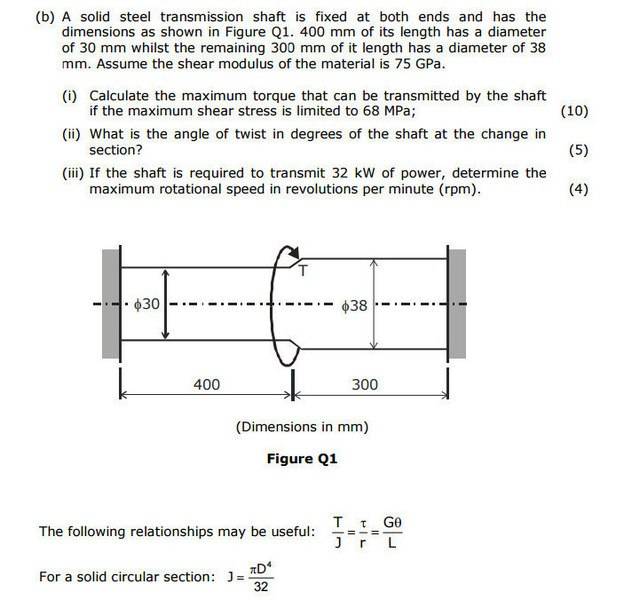
The discussion revolves around the calculation of the angle of twist in a shaft subjected to torque, specifically addressing the discrepancies in torque calculations and their implications for the angle of twist. Participants explore the concepts of torque distribution in shaft sections, the application of formulas, and the interpretation of results in the context of a mechanical engineering problem.
Discussion Character
- Technical explanation
- Mathematical reasoning
- Debate/contested
Main Points Raised
- One participant struggles with calculating the angle of twist using the formula TL/GJ and presents an initial answer that does not match the expected result.
- Another participant requests to see the working to identify errors in the calculations.
- There is a realization that the shaft should be treated as parallel rather than series, which affects the calculations.
- Some participants discuss the implications of treating shaft sections in series versus parallel, questioning which section would twist more under torque.
- One participant mentions the need to consider both sections of the shaft simultaneously and the constraints involved.
- There is a debate about whether the angle of twist is the same for both sections and how to incorporate the total length into the calculations.
- Participants share their individual calculations for the angle of twist for each section, leading to confusion about the consistency of results.
- One participant argues that the provided solution is incorrect, suggesting that the calculations for torque do not account for the requirement that both sections must twist the same angle.
- There is a comparison made to a parallel rope analogy to illustrate the need for simultaneous consideration of both sections under load.
Areas of Agreement / Disagreement
Participants express differing views on the treatment of the shaft sections (series vs. parallel) and the implications for torque calculations. There is no consensus on the correct approach to determining the angle of twist, as multiple interpretations and calculations lead to contradictory results.
Contextual Notes
Participants highlight limitations in their understanding of the problem, including assumptions about torque distribution and the need for simultaneous equations. There are unresolved mathematical steps and dependencies on definitions that affect the clarity of the discussion.
Who May Find This Useful
This discussion may be useful for students or professionals in mechanical engineering or related fields who are grappling with concepts of torque, angle of twist, and the behavior of materials under load.