hutchphd said:
It doesn't work because 50 Hz generates no appreciable current in the ferrite and so, even though it gets a large internal field , does not affect the field outside the bead according to maxwell. It doesn't work because it doesn't work. (?)
Inserting a ferrite into a single-turn wire is just like inserting a rod-shaped ferrite into a multi-turn air coil, so that the inductance increases. When the impedance or the working frequency is large enough to reduce the AC current to a certain extent, the clamp meter will show the reduction in current (assuming the clamp meter can respond to such high frequencies

).
A strong magnetic field is indeed generated inside the ferrite. However, even if we consider the strong magnetic field in the ferrite can be regarded as an equivalent circular current, but this equivalent circular current is confined inside the ferrite, regardless whatever its normal vector, it can not form a reverse current to cancel out the current in the wire, so the field outside is not affected.
Someone may ask a question, as the magnetic field can be redirected, can the field be redirected or shielded by wrapping up the entire wire loop with a very high magnetic permeability material, so that all the field is concentrated only inside the high magnetic permeability material ?
The answer is still negative in theory, and the reasons are similar as before : -
1. This violates Ampere's law
2. Again using the concept of magnetic circuit theory and modeling the wire as single-turn coil
The high magnetic permeability material path is only one branch of the parallel circuit , it can not eliminate the magnetic flux flowing in other parallel branches (including the branch of the clamp meter) because all of them are directly connected to the the single-turn coil magnetomotive force (MMF) source.
Just like electric circuit, if a resistor is connected across an ideal voltage source, we can not change its electric current by add another resistor in parallel with it.
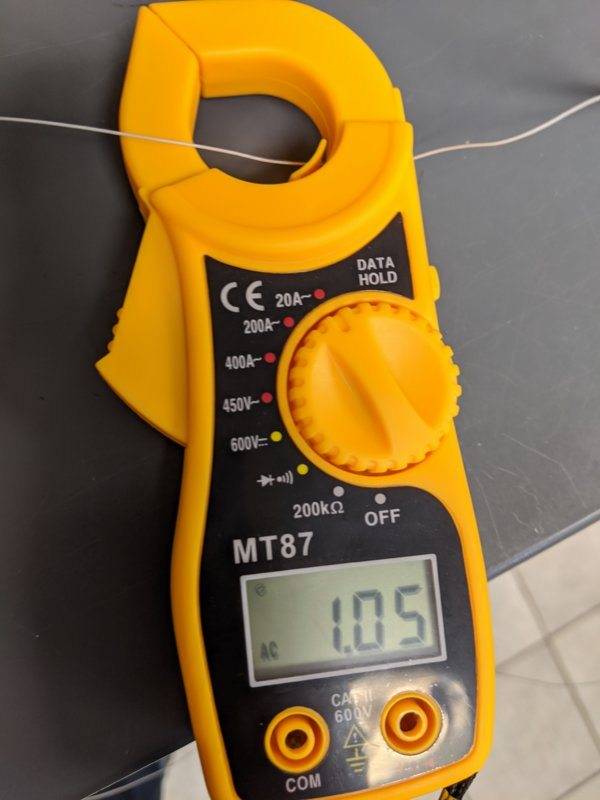
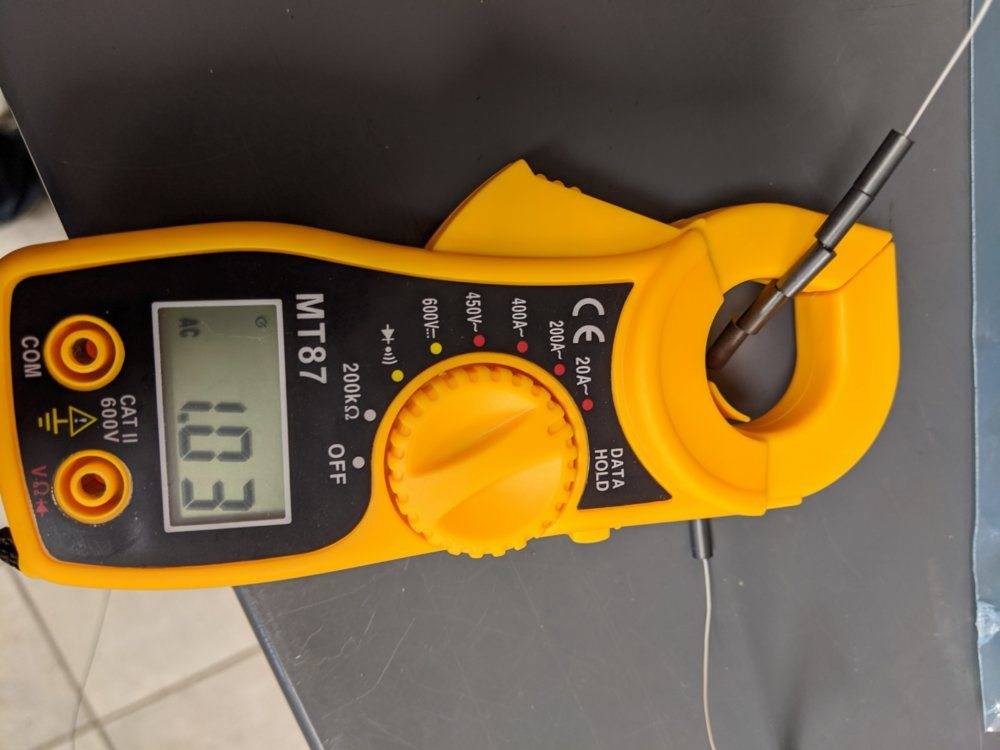
 ?
?