Why a steel plate can shield magnetic field?

Click For Summary

Discussion Overview

The discussion revolves around the phenomenon of magnetic shielding by a steel plate placed above a coil carrying direct current (DC). Participants explore the implications of magnetic domains in the steel plate and their interaction with the magnetic field generated by the coil, examining both theoretical and conceptual aspects of magnetic shielding.

Discussion Character

  • Exploratory
  • Technical explanation
  • Debate/contested
  • Mathematical reasoning

Main Points Raised

  • Some participants suggest that the magnetic domains in the steel plate align with the external magnetic field from the coil, which should contribute to the magnetic field above the plate.
  • Others argue that the magnetic domains actually align in the opposite direction to the external field, leading to a reduction in the magnetic field above the plate.
  • A participant expresses confusion over the apparent contradiction between the expected increase in magnetic field due to the domains and the observed decrease.
  • Some participants propose that the shielding effect occurs because the ferromagnetic material captures the magnetic flux lines, effectively internalizing them.
  • There is a suggestion that the geometry of the system alters the external magnetic field, which complicates the understanding of the shielding effect.
  • A later reply mentions that for alternating current (AC) fields, the concept of shielding may be more appropriate than for direct current (DC).
  • One participant proposes a mathematical approach to calculate the magnetic field in a simple geometry, suggesting the use of a spherical shell with specific magnetic permeability.
  • Another participant references classical texts to seek a more intuitive understanding of the phenomenon, indicating a desire for clarity beyond conventional theories.

Areas of Agreement / Disagreement

Participants express differing views on the alignment of magnetic domains and the nature of the shielding effect. There is no consensus on the explanation of the phenomenon, with multiple competing interpretations remaining unresolved.

Contextual Notes

Some participants note the complexity of the shielding effect and the potential for differing interpretations based on the type of magnetic field (DC vs. AC). There are references to established theories and textbooks, but no agreement on a singular explanation is reached.

Who May Find This Useful

This discussion may be of interest to those studying electromagnetism, materials science, or anyone seeking to understand the nuances of magnetic shielding and the behavior of magnetic domains in ferromagnetic materials.

w9537
Messages
7
Reaction score
1
If I put a very long steel plate above a coil with DC, the magnetic field above the plate will decrease because of the shielding of the steel plate.

However, from the perspective of magnetci domain, some domains will be magnetized to turn to the direction of the magnetic field from the coil.

Therefore, the magnetic field above should be from two source. One of them is the coil, the other is the magnetic domain in the steel plate. As a result, the magnetic field should increase rather than decreasing. But in fact, the magnetic field will decrease.

This question has puzzled me for a long time. I hope someone could help me figure it out! Thanks!
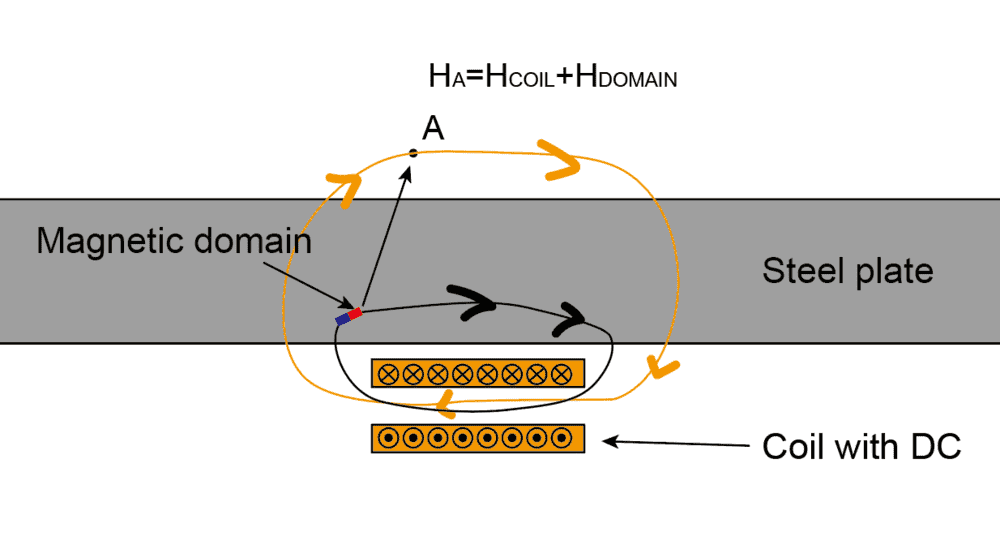
quora.png
 
Physics news on Phys.org
w9537 said:
Summary:: Since the magnetic domain in the steel plate will be aligned to the direction of the magnetization, they should contribute to the magnetic field above the plate. Why the steel plate can shield the magnetic field?
The magnetic domains align to the direction opposite the external magnetic field. Otherwise iron would be repelled from a magnet instead of attracted
 
  • Like
Likes   Reactions: w9537 and sysprog
Dale said:
The magnetic domains align to the direction opposite the external magnetic field. Otherwise iron would be repelled from a magnet instead of attracted
oh no! all my cute fridge magnets! noooo!
 
  • Sad
  • Haha
Likes   Reactions: vanhees71 and Dale
Dale said:
The magnetic domains align to the direction opposite the external magnetic field. Otherwise iron would be repelled from a magnet instead of attracted
Thank you for the reply! It should be a subtraction.

Reply
 
  • Like
Likes   Reactions: sysprog
Dale said:
The magnetic domains align to the direction opposite the external magnetic field. Otherwise iron would be repelled from a magnet instead of attracted
I do not believe that is correct. The magnetization of iron is parallel to the applied field.

Forces on the magnitized iron are dipole forces and couple to the field gradient.
The shielding is because the ferromagnet "grabs" all the available lines of flux and makes them internal
 
hutchphd said:
I do not believe that is correct. The magnetization of iron is parallel to the applied field.

Forces on the magnitized iron are dipole forces and couple to the field gradient.
The shielding is because the ferromagnet "grabs" all the available lines of flux and makes them internal
I used to understand the shielding effect by magnetic flux line. But the nature of this phenomenon is that the opposing magnetic field produced by the magnetic domain in the steel plate cancels the magnetic field produced by the coil.
2.png
 
How you choose to picture it is up to you, although I don't think it is a good one.. I am trying to correct some rather erroneous (or misleading to me at best) statements made previously.
The (linear) magnetization M of the iron is in the same direction as the field from the coil. It directly augments the field only inside the coil, although the geometry will alter the external field which provides the ill-named "shielding".
For AC fields the picture is quite different and shielding is an appropriate term.
 
hutchphd said:
How you choose to picture it is up to you, although I don't think it is a good one.. I am trying to correct some rather erroneous (or misleading to me at best) statements made previously.
The (linear) magnetization M of the iron is in the same direction as the field from the coil. It directly augments the field only inside the coil, although the geometry will alter the external field which provides the ill-named "shielding".
For AC fields the picture is quite different and shielding is an appropriate term.
Yes, I just find an explanation that seems plausible to me, and this explanation is better than magnetic-reluctance theory. If you can find a better version, please tell me! Thank you!
 
I don't know what a "better version" is. Presumably the version agreed upon by the general commmunity of physicists and taught to every undergrad as the "theory of e and m in materials" is a pretty well distilled essence. Your interpretation differs from this and I would recommend learning the conventional theory. Study Griffiths. The choice of course is yours.

I am still mystified by some of the previous explanations of the shielding.
 
  • #10
hutchphd said:
I don't know what a "better version" is. Presumably the version agreed upon by the general commmunity of physicists and taught to every undergrad as the "theory of e and m in materials" is a pretty well distilled essence. Your interpretation differs from this and I would recommend learning the conventional theory. Study Griffiths. The choice of course is yours.

I am still mystified by some of the previous explanations of the shielding.
Yes, I know almost everything can be solved and calculated by Maxwell equations. What I want is to understand this intuitively like the interpretation in the book <Introduction to magnetic materials> by B. D. Cullity.
微信图片_20200421141140.jpg
 
  • #11
Hm, shouldn't one be able to calculate this for a simple geometry?

My suggestion is to use a spherical shell of finite thickness of some material with a magnetic permeability ##\mu_r## and calculate how the magnetic field looks given a magnetic field ##\vec{B}_0=\text{const}## at infinity. That should be easy to calculate using a magnetic potential ##\psi## with ##\vec{H}=-\vec{\nabla} \psi## (in SI units). Then all you need is ##\vec{\nabla} \times \vec{H}=0## (which is already fulfilled by the potential ansatz) and ##\vec{\nabla} \cdot \vec{B}=0##, leading to the boundary conditions ##\vec{H}_{\parallel}## and ##\vec{B}_{\perp}## continuous at the boundaries of the shell and the constitutive relation ##\vec{B}=\mu_r \mu_0 \vec{H}## with (##\mu_r=1## outside of the shell of course).

From the symmetry I think inside one has ##\vec{B}=\text{const}## and otherwise a dipole ansatz should do the rest.
 
  • #12
vanhees71 said:
Hm, shouldn't one be able to calculate this for a simple geometry?

My suggestion is to use a spherical shell of finite thickness of some material with a magnetic permeability ##\mu_r## and calculate how the magnetic field looks given a magnetic field ##\vec{B}_0=\text{const}## at infinity. That should be easy to calculate using a magnetic potential ##\psi## with ##\vec{H}=-\vec{\nabla} \psi## (in SI units). Then all you need is ##\vec{\nabla} \times \vec{H}=0## (which is already fulfilled by the potential ansatz) and ##\vec{\nabla} \cdot \vec{B}=0##, leading to the boundary conditions ##\vec{H}_{\parallel}## and ##\vec{B}_{\perp}## continuous at the boundaries of the shell and the constitutive relation ##\vec{B}=\mu_r \mu_0 \vec{H}## with (##\mu_r=1## outside of the shell of course).

From the symmetry I think inside one has ##\vec{B}=\text{const}## and otherwise a dipole ansatz should do the rest.
👍 Yes, the magnetic field inside a spherical shell of finite thickness in a uniform field can be calculated as shown in the book <Classical Electrodynamics> by Jackson.
1587733100783.png

1587733120383.png

1587733132262.png
 
  • #13
Great! That saves a lot of boring equation-solving to fit the boundary conditions ;-)).
 

Similar threads

  • · Replies 1 ·
Replies
1
Views
1K
  • · Replies 7 ·
Replies
7
Views
2K
  • · Replies 12 ·
Replies
12
Views
2K
  • · Replies 14 ·
Replies
14
Views
2K
  • · Replies 6 ·
Replies
6
Views
2K
  • · Replies 2 ·
Replies
2
Views
2K
  • · Replies 12 ·
Replies
12
Views
1K
  • · Replies 0 ·
Replies
0
Views
1K
  • · Replies 42 ·
2
Replies
42
Views
4K
  • · Replies 5 ·
Replies
5
Views
3K