Dark85
- 32
- 5
- TL;DR
- I have a doubt regarding a paragraph on Wikipedia on the relation between force and jerk.
I was exploring how to find expressions for a changing force, hence I began with the simplest case where a body moves with a constant jerk and has a constant mass. Here is what I did:
The relation between force and momentum is given by:
$$
\vec{F} = \frac{d(m\vec{v})}{dt}
$$
So, as I understand, one can derive an expression for force in terms of jerk or higher derivatives. For constant jerk and constant mass, I derived an expression for jerk to be(if my understanding is correct):
$$
\vec{F}(t) = m\vec{a}(t)
$$
$$
\frac{d\vec{F}(t)}{dt} = m\frac{d\vec{a}(t)}{dt}
$$
Let constant jerk $ = j$
$$
d\vec{F}(t) = m\vec{j}dt
$$
integrating both sides
$$
\vec{F}(t) = m\vec{j}t
$$
However I found this statement on the Wikipedia article for [jerk](https://en.wikipedia.org/wiki/Jerk_(physics)#Force,_acceleration,_and_jerk) and it says that:
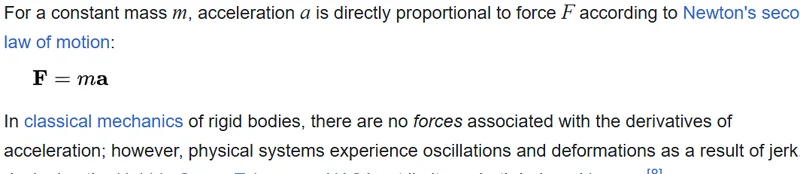
Which I did not quite understand. How are no forces associated with higher derivatives of acceleration? Does the expression for force in terms of momentum not allow this (i.e. not apply for higher derivatives) as such as this? If so, why?
The relation between force and momentum is given by:
$$
\vec{F} = \frac{d(m\vec{v})}{dt}
$$
So, as I understand, one can derive an expression for force in terms of jerk or higher derivatives. For constant jerk and constant mass, I derived an expression for jerk to be(if my understanding is correct):
$$
\vec{F}(t) = m\vec{a}(t)
$$
$$
\frac{d\vec{F}(t)}{dt} = m\frac{d\vec{a}(t)}{dt}
$$
Let constant jerk $ = j$
$$
d\vec{F}(t) = m\vec{j}dt
$$
integrating both sides
$$
\vec{F}(t) = m\vec{j}t
$$
However I found this statement on the Wikipedia article for [jerk](https://en.wikipedia.org/wiki/Jerk_(physics)#Force,_acceleration,_and_jerk) and it says that:
Which I did not quite understand. How are no forces associated with higher derivatives of acceleration? Does the expression for force in terms of momentum not allow this (i.e. not apply for higher derivatives) as such as this? If so, why?