How Can You Apply the Superposition Theorem Graphically?

  • Context: Undergrad 
  • Thread starter Thread starter Jhenrique
  • Start date Start date
  • Tags Tags
    Theorem
Click For Summary

Discussion Overview

The discussion revolves around the application of the superposition theorem in circuit analysis, specifically focusing on how to graphically represent the superposition of multiple voltage sources in a circuit. Participants explore the dynamics of the circuit without necessarily solving it numerically, emphasizing a conceptual understanding of the superposition principle.

Discussion Character

  • Exploratory
  • Technical explanation
  • Debate/contested

Main Points Raised

  • One participant expresses a desire to understand the dynamics of a circuit using the superposition theorem rather than solving it numerically.
  • Another participant questions the need for a second thread on the same problem, highlighting the different focus on graphical representation.
  • Some participants suggest following the Wikipedia instructions for applying the superposition theorem, which involves replacing voltage sources and solving for each case.
  • One participant argues that the absence of numerical values does not prevent circuit analysis and suggests that the circuit can be solved for unknown variables, despite potential complexity.
  • Another participant insists on the importance of applying the superposition principle graphically, rather than focusing on numerical solutions.
  • Concerns are raised about the utility of graphical representations without knowing nodal voltages, with one participant noting that negative voltages could complicate the analysis.

Areas of Agreement / Disagreement

Participants express differing views on the necessity of numerical values for circuit analysis and the validity of graphical representations. There is no consensus on how to effectively apply the superposition theorem graphically, and the discussion remains unresolved regarding the best approach.

Contextual Notes

Participants mention the complexity of circuit analysis without numerical values and the potential for negative voltages, indicating limitations in the graphical representation approach. The discussion also reflects varying interpretations of the superposition principle and its application.

Jhenrique
Messages
676
Reaction score
4
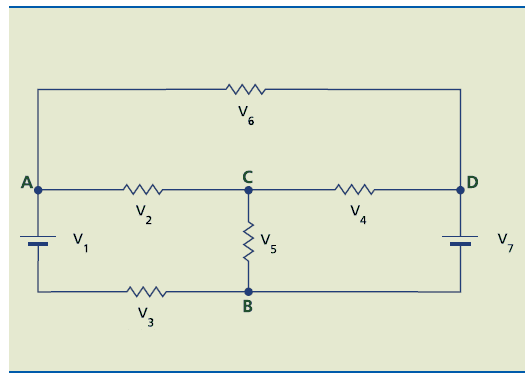
I'm trying solve this scheme:

attachment.php?attachmentid=70441&stc=1&d=1402248289.png


but not with the ideia of solve it but yes with the ideia of understand the dynamic of the thing...

aftwer watch this video:


and read about the superposition:
http://en.wikipedia.org/wiki/Superposition_theorem

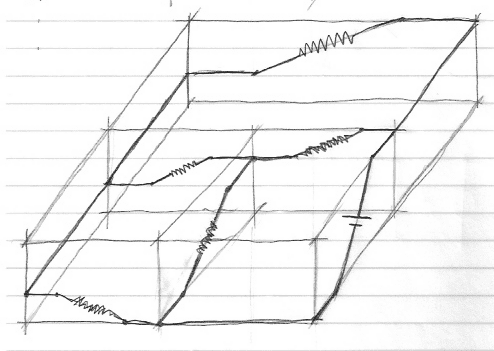
I did this scheme for solve the problem:
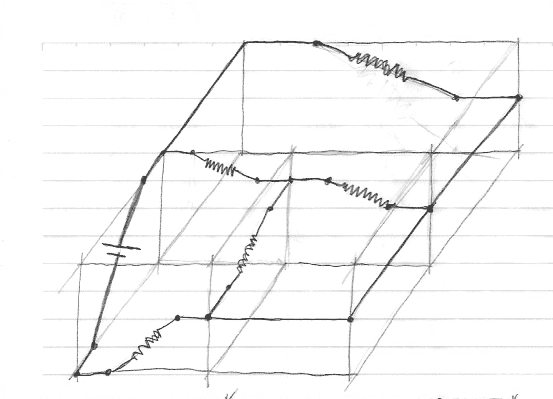
attachment.php?attachmentid=70470&stc=1&d=1402348364.png

attachment.php?attachmentid=70471&stc=1&d=1402348364.png


But, and now, how make the graphical superposition?
 

Attachments

  • 1.PNG
    1.PNG
    22.1 KB · Views: 554
  • 2.PNG
    2.PNG
    32.5 KB · Views: 679
Last edited by a moderator:
Physics news on Phys.org
Why did you start a second thread about the same problem?
 
dauto said:
Why did you start a second thread about the same problem?

The *same example*, but *different questions*. Here I'm asking about how to construct the equivalent superpostion from of two given. Can you help me?
 
Do what it says in Wikipedia. Replace all but one of the voltage sources with a short. Solve for the case of the solitary source. Repeat for the other source and then add the solutions together.
 
Born2bwire said:
Do what it says in Wikipedia. Replace all but one of the voltage sources with a short. Solve for the case of the solitary source. Repeat for the other source and then add the solutions together.

My friend, is not possbile to solve this problem cause it haven't none numerical value, the better interpretation possible is the which I drew and I'm asking how would the union those two drawings.
 
I have no idea what those drawings are trying to represent but any talk of their "union" is nonsensical. The circuit does not need numerical values to analyze. One could solve it explicitly for the unknown variables as messy as that would be. Actually, after a quick glance it is a simpler matter. In the first case, removing the source between BD results in shorting out R5 and R4, leaving you with a simple circuit of three resistors. Regretfully, the second case does not reduce the number of unknowns but it is a matter of bookkeeping.
 
You don't have ideia because you didn't watch the video... I don't want to solve the system, what I want is apply graphically the superposition principle!
 

Attachments

  • imagem.PNG
    imagem.PNG
    77.6 KB · Views: 495
Jhenrique said:
You don't have ideia because you didn't watch the video... I don't want to solve the system, what I want is apply graphically the superposition principle!


This isn't useful. You do not know the nodal voltages without solving the circuit. Heck, there is no reason why you can't have negative voltages too. As such, you have no way of knowing what the relative voltage "heights" are. There is no point in using this representation outside of trying to explain voltage with the classic pressure analogy.
 

Similar threads

Replies
4
Views
2K
  • · Replies 6 ·
Replies
6
Views
2K
  • · Replies 2 ·
Replies
2
Views
1K
  • · Replies 20 ·
Replies
20
Views
2K
  • · Replies 4 ·
Replies
4
Views
2K
Replies
2
Views
2K
  • · Replies 6 ·
Replies
6
Views
3K
  • · Replies 5 ·
Replies
5
Views
2K
  • · Replies 2 ·
Replies
2
Views
2K
  • · Replies 3 ·
Replies
3
Views
3K