How could electric susceptibilbility depend on position?

Join the discussion
Registration is free. Ask a follow-up in this thread, or start your own.
3 replies · 2K views · last reply
Ahmed1029
Messages
109
Reaction score
40
In the statement encircled, what does Griffiths actually mean?
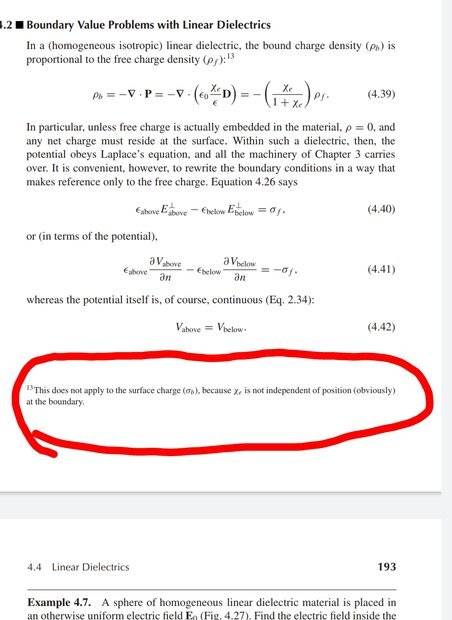
Textbook page showing Section 4.2, Boundary Value Problems with Linear Dielectrics, with equations 4.39 to 4.42 and a footnote 13 circled in red that reads: This does not apply to the surface charge, because chi_e is not independent of position (obviously) at the boundary.
 
Physics news on Phys.org
It's a bit "nebulous". I guess what he considers is the effective (bound) surface charge of a homogeneous and isotropic dielectric.

[edit: corrected in view of #3]
The bound-charge density within the dielectric is
$$\rho=-\vec{\nabla} \cdot \vec{P},$$
which is 0, for ##\vec{P}=\text{const}##, within the dielectric. Trivially it's also 0 outside the dielectric, where is vacuum, i.e., no charges at all.

At the surface you have, however bound-surface charges, which you get by taking the "surface divergence". Let ##\vec{n}## be the surface-normal unity vector pointing out of the material. Then with a Gaussian pillbox with two sides parallel to the boundary of the dielectric, you get
$$\sigma=-\mathrm{Div} \vec{P}=\vec{n} \cdot \vec{P}.$$
 
Last edited:
vanhees71 said:
which is, for P→=0, within the dielectric
You probably mean ##\vec{P}=\text{constant}## inside the dielectric because if it was zero then ##\vec{D}=\epsilon_0\vec{E}+\vec{P}=\epsilon_0\vec{E}## inside the dielectric which doesn't look right...
 
At the boundary the susceptibility has different values on the two sides of the boundary.
 
  • Like
Likes   Reactions: Ahmed1029 and vanhees71