How do charges redistribute in a conductive sphere with a charged object inside?

  • Context: Graduate 
  • Thread starter Thread starter iScience
  • Start date Start date
  • Tags Tags
    Electrostatics
Click For Summary
SUMMARY

The discussion focuses on the behavior of charges in a hollow conductive sphere with a charged object inside. It is established that charges will redistribute to maintain an electric field (E-field) of zero inside the conductor, regardless of the position of the internal charge Q. Additionally, when a straight conductor is oriented away from a van de Graaff generator, it develops a surface charge distribution that also ensures the E-field inside remains zero, despite potential differences (ΔV) at its ends. The charge distribution on the outer surface of the sphere becomes asymmetric when the internal charge is not centered, leading to a non-uniform E-field outside the sphere.

PREREQUISITES
  • Understanding of electrostatics and electric fields
  • Knowledge of conductive materials and their properties
  • Familiarity with charge distribution concepts
  • Basic principles of equipotential surfaces
NEXT STEPS
  • Study the principles of electrostatics in conductive materials
  • Learn about Gauss's Law and its applications in charge distribution
  • Explore the concept of equipotential surfaces in detail
  • Investigate the behavior of electric fields around non-uniform charge distributions
USEFUL FOR

This discussion is beneficial for physics students, electrical engineers, and anyone interested in understanding electrostatics and the behavior of charges in conductive materials.

iScience
Messages
466
Reaction score
5
Two questions:


1.) Consider a hollow conductive sphere that's initially charged. These charges will distribute themselves in such a way that the condition: E-field(inside)= zero is satisfied.


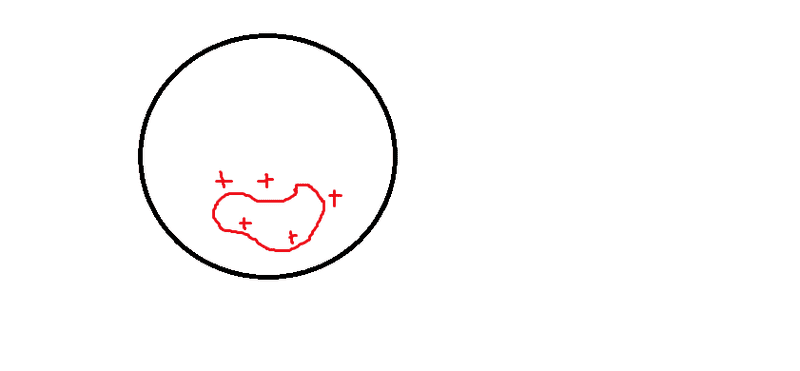
Now consider a hollow conductive sphere with a charged object inside
jlPh9hc.png


The charges on the conductive sphere will have a different distribution of course. Said another way, the charges will re-distribute from the original one. But, they will do so to satisfy what condition?


2.) You orient a straight piece of conductor on its long axis to point away from a van de graff generator (r hat)

everyone says that conductors maintain equipotential but the two ends of the conductor you are holding are at different equipotential lines. So is there a ΔV between the conductor ends or not?

intuition tells me that the ΔV induces an initial charge separation within the conductor.
But, it's just that "conductors always maintain an equipotential" thing that gets me wondering.


Thanks all
 
Physics news on Phys.org
1. Charges will reorient themselves keep the condition E=0 inside the conductor. If the net charge inside the cavity is Q, then a charge Q will move from the outer surface of the conductor to the inner surface.

2. The straight conductor will develop a surface charge distribution that will keep the electric field equal to 0 inside the conductor. This will modify the field in the region of the conductor.
 
Meir Achuz said:
1. Charges will reorient themselves keep the condition E=0 inside the conductor. If the net charge inside the cavity is Q, then a charge Q will move from the outer surface of the conductor to the inner surface.

If charge Q is present present inside, and Q is not at r=0 but rather shifted in position as shown in the drawing, please confirm the following

a.) The charges on the sphere will distribute in such a way that doesn't affect the E-field inside the conductive shell. ie, within the shell, the E-field will be solely due to Q(inside) as if the shell wasn't even there.

b.) Outside the sphere, the E-field will be non-uniform because the Q(inside) is not centered thereby making the charge distribution on the shell asymmetric.
 

Similar threads

  • · Replies 4 ·
Replies
4
Views
2K
  • · Replies 11 ·
Replies
11
Views
4K
  • · Replies 11 ·
Replies
11
Views
2K
  • · Replies 3 ·
Replies
3
Views
992
  • · Replies 16 ·
Replies
16
Views
2K
  • · Replies 27 ·
Replies
27
Views
3K
  • · Replies 1 ·
Replies
1
Views
10K
Replies
23
Views
5K
  • · Replies 4 ·
Replies
4
Views
4K
  • · Replies 4 ·
Replies
4
Views
2K