fengqiu said:
my lecturer gave me a brief problem and I think I'm missing some understanding of it
I don’t know why you are confused. It look to me that your lecturer did a reasonable job explaining the issue. So, I will try to fill in some fine details which may help you understand things better.
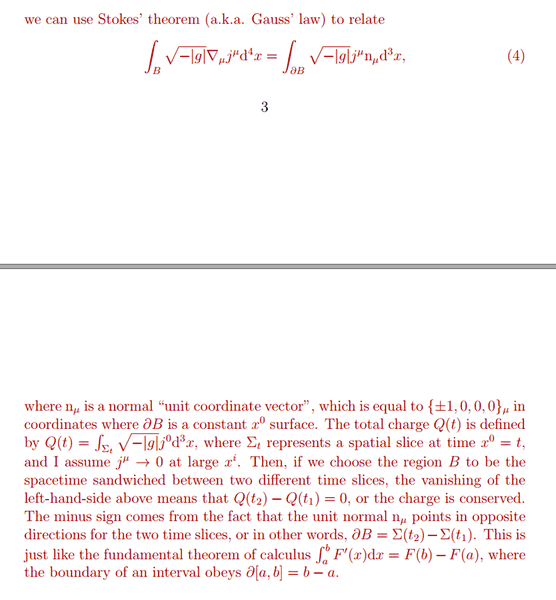
Okay, we start by writing the covariant divergence of the vector field [itex]J^{\mu}(x)[/itex] in the form
[tex]\sqrt{|g|} \nabla_{\mu} J^{\mu} = \partial_{\mu} \left(\sqrt{|g|} \ J^{\mu}\right) . \ \ \ \ \ \ \ \ \ (1)[/tex]
Integrating (1) over some
bounded, 4-dimensional, region [itex]B[/itex] of space-time, we get
[tex]\int_{B} d^{4}x \ \sqrt{|g|} \ \nabla_{\mu}J^{\mu} = \int_{B} d^{4}x \ \partial_{\mu} \left(\sqrt{|g|} \ J^{\mu}\right) . \ \ \ \ \ \ \ \ (2)[/tex]
Now, if the boundary, [itex]\partial B[/itex], of the region [itex]B[/itex] is
continuous,
piecewise differentiable and
orientable, we can apply the divergence theorem (Stokes/Gauss) to the RHS of (2) and obtain
[tex]\int_{B} d^{4}x \ \sqrt{|g|} \nabla_{\mu}J^{\mu}(x) = \int_{\partial B} dS_{\mu} \ \sqrt{|g^{(3)}|} \ J^{\mu} (x) = \int_{\partial B} d^{3}x \ \sqrt{|g^{(3)}|} \ n_{\mu}J^{\mu}(x) , \ \ \ \ (3)[/tex]
where the 4-vector differential at [itex]x[/itex], [itex]dS_{\mu}(x) = d^{3}x \ n_{\mu}[/itex], denotes a 3-dimensional hyper-surface element on [itex]\partial B[/itex], [itex]n_{\mu}[/itex] denotes the unit
outward pointing
normal vector on [itex]\partial B[/itex], and [itex]g^{(3)}[/itex] is the determinant of the
induced metric on [itex]\partial B[/itex].
Due to the covariant conservation, [itex]\nabla_{\mu}J^{\mu} = 0[/itex], equation (3) becomes
[tex]\int_{\partial B} d^{3}x \ \sqrt{|g^{(3)}|} \ n_{\mu}J^{\mu}(x) = 0 . \ \ \ \ \ \ \ \ \ \ \ (4)[/tex]
Assuming that the spacetime is foliated into (topologically same)
spacelike hypersurfaces [itex]\Sigma[/itex], defined by [itex]x^{0} = \mbox{const}[/itex], we can take [itex]\partial B[/itex] to be the union of two such surfaces [itex](\Sigma_{1} , \Sigma_{2})[/itex] with a
timelike surface [itex]\mathcal{T}[/itex] which connects them at spatial infinity: [tex]\partial B = \Sigma_{1} \cup \Sigma_{2} \cup \mathcal{T} .[/tex] This allows you to write (4) as [tex]\left( \int_{\Sigma_{1}} + \int_{\Sigma_{2}} + \int_{\mathcal{T}}\right) \left( d^{3}x \ \sqrt{|g^{(3)}|} \ n_{\mu}J^{\mu}(x^{0}, \vec{x}) \right) = 0 . \ \ \ (5)[/tex] Before we evaluate this equation, let us “picture” what we said as follows: the region [itex]B[/itex] is like a “fat” 4-dimensional world tube, [itex]\Sigma_{1}[/itex] and [itex]\Sigma_{2}[/itex] are 3-dimensional
cross-sections of the tube at [itex]x^{0} = t_{1}[/itex] and [itex]x^{0} = t_{2}[/itex] respectively, with
opposite orientations : [itex]n_{\mu}(\Sigma_{1}) = (-1, \vec{0})[/itex], [itex]n_{\mu}(\Sigma_{2}) = (+1, \vec{0})[/itex], and finally [itex]\mathcal{T} = [t_{1} , t_{2}] \times S^{2}_{\infty}[/itex] is the “cylindrical” wall of the tube, [itex]n_{\mu}(\mathcal{T}) = (0 , \vec{n})[/itex], that joins [itex]\Sigma_{1}[/itex] and [itex]\Sigma_{2}[/itex] at spatial infinity. Now, I hope, you can easily evaluate (5) as follows
[tex]\int_{\Sigma_{1}} d^{3} \vec{x} \sqrt{|g(\Sigma)|} J^{0}(t_{1}, \vec{x}) = \int_{\Sigma_{2}} d^{3} \vec{x} \sqrt{|g(\Sigma)|} J^{0}(t_{2}, \vec{x}) + \int_{t_{1}}^{t_{2}} dx^{0} \int_{S_{\infty}^{2}} d\Omega |\vec{x}|^{2} \sqrt{|g(\mathcal{T})|} \ n_{i}J^{i}(x).[/tex] If the spatial components of the current satisfy [itex]|\vec{x}|^{2} J^{i}(x) \to 0[/itex] as [itex]|\vec{x}| \to \infty[/itex], the third integral will give zero contribution, and you end up with
[tex]\int_{\Sigma_{1}} d^{3}\vec{x} \sqrt{|g(\Sigma)|} \ J^{0}(t_{1}, \vec{x}) = \int_{\Sigma_{2}} d^{3}\vec{x} \sqrt{|g(\Sigma)|} \ J^{0}(t_{2}, \vec{x}) ,[/tex] which is a time-independent (or charge conservation) statement [tex]Q(t_{2}) = Q(t_{1}) .[/tex]