How Do Doppler Effect and Spring Motion Influence Perceived Sound Frequencies?

Click For Summary
SUMMARY

The discussion focuses on calculating the perceived sound frequencies influenced by the Doppler Effect and spring motion. A speaker emitting sound at 440 Hz, attached to a spring with a constant of 20.0 N/m and a mass of 5.00 kg, experiences motion with an amplitude of 0.500 m. The highest and lowest frequencies heard by an observer 1.00 m away are determined using the formulas for kinetic and potential energy, along with the standard frequency formula for varying speeds. The maximum sound level perceived is 60.0 dB, while the minimum sound level is also discussed.

PREREQUISITES
  • Understanding of the Doppler Effect
  • Familiarity with spring motion and Hooke's Law
  • Knowledge of sound wave properties and decibel levels
  • Ability to apply kinetic and potential energy equations
NEXT STEPS
  • Study the Doppler Effect in detail, focusing on frequency shifts
  • Learn about Hooke's Law and its applications in oscillatory motion
  • Explore sound wave behavior and calculations involving decibels
  • Investigate the relationship between energy conservation and oscillatory systems
USEFUL FOR

Physics students, acoustics researchers, and engineers interested in sound wave behavior and the effects of motion on frequency perception.

Hitman6267
Messages
17
Reaction score
0
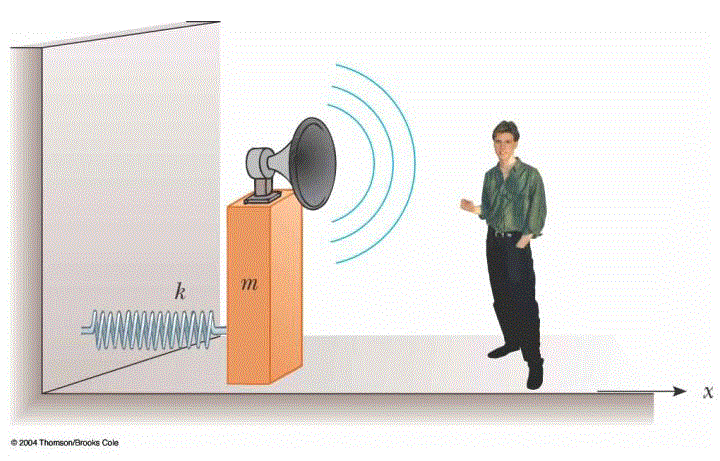
A block with a speaker bolted to it is connected to a spring having spring constant k= 20.0 N/m as in Figure P17.40. The total mass of the block and speaker is 5.00 kg, and the amplitude of this unit's motion is 0.500 m. (a) If the speaker emits sound waves of frequency 440 Hz, determine the highest and lowest frequencies heard by the person to the right of the speaker. (b) If the maximum sound level heard by the person is 60.0 dB when he is closest to the speaker, 1.00 m away, what is the minimum sound level heard by the observer? Assume that the speed of sound is 343 m/s.
2.gif


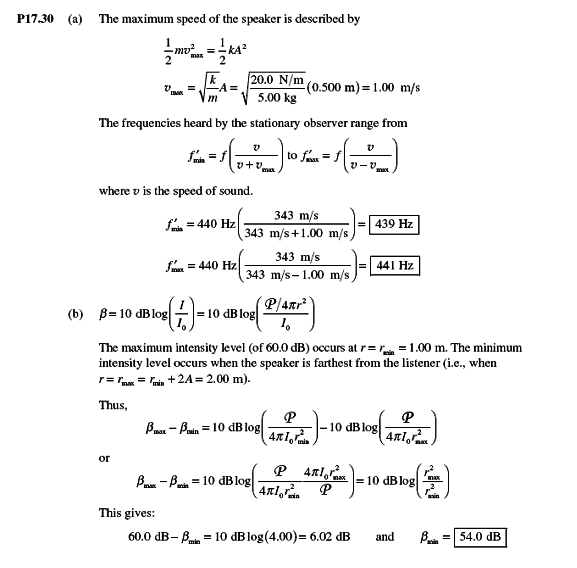
The solution
1.png


Can some one tell me what are the formulas they used in part a ? I can't find them in my book (Halliday, fundamentals of physics)
 
Physics news on Phys.org
Hitman6267 said:
Can some one tell me what are the formulas they used in part a ? I can't find them in my book (Halliday, fundamentals of physics)

Hi Hitman6267! :smile:

The first is KE + PE = constant (and PE = 1/2 kx2).

The second is the standard formula for frequency at different speeds.
 

Similar threads

  • · Replies 7 ·
Replies
7
Views
4K
  • · Replies 27 ·
Replies
27
Views
5K
Replies
7
Views
5K
  • · Replies 7 ·
Replies
7
Views
3K
  • · Replies 1 ·
Replies
1
Views
2K
  • · Replies 9 ·
Replies
9
Views
7K
Replies
2
Views
2K
  • · Replies 1 ·
Replies
1
Views
2K
Replies
3
Views
2K
  • · Replies 5 ·
Replies
5
Views
3K