How do I calculate the enthelpy of formation using combusion data

Click For Summary

Discussion Overview

The discussion revolves around calculating the enthalpy of formation of propan-1-ol using combustion data. Participants explore the appropriate equations and methods to derive the enthalpy values, including the use of Hess's law and combustion cycles.

Discussion Character

  • Technical explanation
  • Debate/contested
  • Mathematical reasoning

Main Points Raised

  • One participant presents an enthalpy of formation equation and a calculation that leads to a conflicting result compared to a mark scheme.
  • Another participant corrects the first by stating that the equations used are incorrect and emphasizes the importance of Hess's law in determining the enthalpy of formation.
  • Several participants discuss the need for properly balanced chemical formulas for combustion reactions.
  • Some participants express confusion over the application of the enthalpy of formation and combustion equations, questioning whether combustion data should be used for formation calculations.
  • Multiple participants provide different values for enthalpy changes in a Hess's law cycle, leading to further debate over the correct approach and values.
  • One participant mentions using an algebraic approach to derive the enthalpy of formation without relying on combustion cycles.
  • There are disagreements regarding the values assigned to various enthalpy changes in the Hess's law cycle, with some participants asserting different interpretations of the cycle's directionality.

Areas of Agreement / Disagreement

Participants do not reach consensus on the correct equations or values to use for calculating the enthalpy of formation. Multiple competing views and interpretations of Hess's law and combustion data remain unresolved.

Contextual Notes

Participants note that the enthalpy values provided may not correspond to standard enthalpies of formation, leading to confusion in calculations. There are also unresolved assumptions regarding the directionality of enthalpy changes in the Hess's law cycle.

Daniel2244
Messages
125
Reaction score
5
Thread moved from the technical forums, so no Homework Template is shown
The enthalpy of formation equation:
ΔHƒ°reaction=∑Δhƒ°(products)-ΣΔHƒ°(reactants)
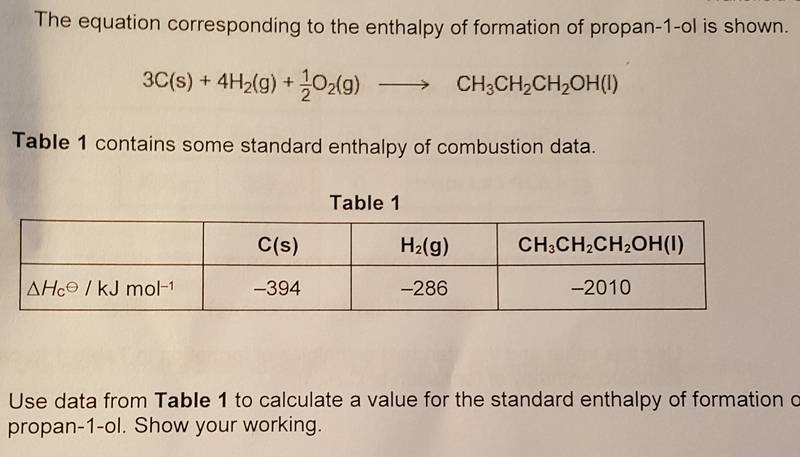
20190108_191530.jpg

When using the enthalpy of formation equation you get:
-2010-((-394x3)+(-286x4))= 316Kjmol-1
However, this answer is wrong. On the mark scheme, the answer is -316Kjmol-1.

So I used the enthalpy of combustion equation:
ΔHc°reaction=∑Δhc°(reactants)-ΣΔHc°(Products)
((-394x3)+(-286x4))--2010-= -316Kjmol-1

When using the enthalpy of combustion equation I got the correct answer. This is where I get confused as the question is asking for the enthalpy of formation of propan-1-ol, so shouldn't I use the enthalpy of formation equation? Or do I have to use the enthalpy of combustion equation as I am using combustion data?
 

Attachments

  • 20190108_191530.jpg
    20190108_191530.jpg
    38.6 KB · Views: 3,453
Physics news on Phys.org
Your "enthalpy of formation" and "enthalpy of combustion" equations are wrong. There is no enthalpy of formation or combustion of the reaction, only the enthalpy of reaction. Your equations should read
ΔHreaction = ΣΔHfproducts - ΣΔHfreactants
ΔHreaction = ΣΔHcreactants - ΣΔHcproducts
The enthalpy of formation of elements in their standard states is zero, so ΔHreaction = ΔHf(propan-1-ol), which is what you want to find.
Have you heard of a Hess's law cycle? Draw one involving the formation of propan-1-ol and the combustion of reactants and products. Then you should see how you get to the right answer, rather than using equations blindly.
 
Please write out properly balanced chemical formulas for the combustion reactions of C, H2, and CH3CH2CH2OH.
 
mjc123 said:
Your "enthalpy of formation" and "enthalpy of combustion" equations are wrong. There is no enthalpy of formation or combustion of the reaction, only the enthalpy of reaction. Your equations should read
ΔHreaction = ΣΔHfproducts - ΣΔHfreactants
ΔHreaction = ΣΔHcreactants - ΣΔHcproducts
My bad, I didn't realize I put ΔHƒ°reaction and ΔHc°reaction.

mjc123 said:
The enthalpy of formation of elements in their standard states is zero, so ΔHreaction = ΔHf(propan-1-ol), which is what you want to find.
Have you heard of a Hess's law cycle? Draw one involving the formation of propan-1-ol and the combustion of reactants and products. Then you should see how you get to the right answer, rather than using equations blindly.
Even when I draw the Hess cycle for formation I still get the equation ΔHreaction = ΣΔHfproducts - ΣΔHfreactants which gives the answer +316kjmol-1 which is incorrect.
 
I get $$4H^f_{H_2O}+3H^f_{CO_2}-\Delta H^c_{CH_3CH_2CH_2OH}=H^f_{CH_3CH_2CH_2OH}=-316\ kJ/mole$$
 
Daniel2244 said:
Even when I draw the Hess cycle for formation I still get the equation ΔHreaction = ΣΔHfproducts - ΣΔHfreactants which gives the answer +316kjmol-1 which is incorrect.
That is because the numbers given are not enthalpies of formation. It is wrong to use this equation. You don't know ΔHf products and ΔHf reactants = 0.
See the attached Hess's law cycle. What are ΔH1, ΔH2 and ΔH3?
 

Attachments

  • Hess's law cycle.png
    Hess's law cycle.png
    3.8 KB · Views: 743
Chestermiller said:
Please write out properly balanced chemical formulas for the combustion reactions of C, H2, and CH3CH2CH2OH.
Yes, I get the same when I use the combustion cycle.

mjc123 said:
See the attached Hess's law cycle. What are ΔH1, ΔH2 and ΔH3?
ΔH1=-4336, ΔH2=-2326 and ΔH3=-2010 because that cycle gives ΔH2+ΔH3=ΔH1 and -4336. You draw the cycle differently to me, but I get the correct answer when I do it.
 
I didn't use combustion cycles. I did it entirely algebraically:
$$4H^f_{H_2O}+3H^f_{CO_2}-H^f_{CH_3CH_2CH_2OH}=\Delta H^{c}_{{CH_3CH_2CH_2OH}}$$
with $$H^f_{CO_2}=H^c_{CO_2}$$
abd $$H^f_{H_2O}=H^c_{H_2O}$$
where the superscript f refers to heat of formation and the superscript c refers to heat of combustion.
 
Daniel2244 said:
ΔH1=-4336, ΔH2=-2326 and ΔH3=-2010 because that cycle gives ΔH2+ΔH3=ΔH1 and -4336. You draw the cycle differently to me, but I get the correct answer when I do it.
ΔH3 is not -2010. Look at the direction of the arrow. How is it related to the heat of combustion of propanol?
 
  • #10
mjc123 said:
ΔH3 is not -2010. Look at the direction of the arrow. How is it related to the heat of combustion of propanol?
When I do it I get:
d78ddbc86efd9bab690665137b630e1a.png
 

Attachments

  • d78ddbc86efd9bab690665137b630e1a.png
    d78ddbc86efd9bab690665137b630e1a.png
    3 KB · Views: 1,072

Similar threads

  • · Replies 3 ·
Replies
3
Views
3K
  • · Replies 5 ·
Replies
5
Views
3K
  • · Replies 9 ·
Replies
9
Views
3K
  • · Replies 1 ·
Replies
1
Views
2K
  • · Replies 6 ·
Replies
6
Views
14K
  • · Replies 2 ·
Replies
2
Views
2K
  • · Replies 3 ·
Replies
3
Views
2K
Replies
3
Views
3K
  • · Replies 1 ·
Replies
1
Views
10K
  • · Replies 1 ·
Replies
1
Views
5K