How do I compute the 3 individual line integrals for a given vector field?

Click For Summary

Homework Help Overview

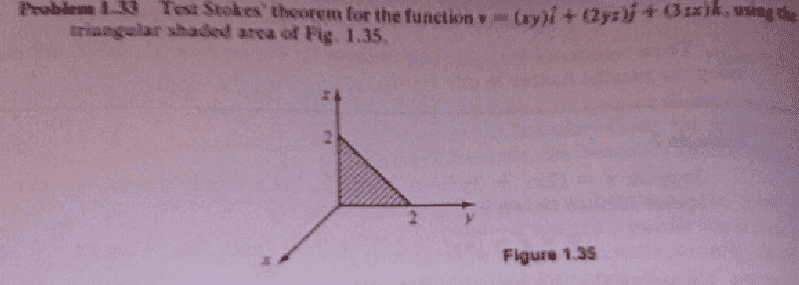
The discussion revolves around computing three individual line integrals for a given vector field defined as v=. The original poster has previously worked with surface integrals and is now attempting to evaluate the line integrals along the base, height, and hypotenuse of a triangle.

Discussion Character

  • Exploratory, Conceptual clarification, Mathematical reasoning

Approaches and Questions Raised

  • Participants discuss the need to parameterize the curves for integration and question the meaning of the integrals. There are attempts to clarify the relationships between variables along different segments of the triangle, particularly focusing on how to simplify the vector function for integration.

Discussion Status

Participants are exploring various interpretations of the problem, with some offering guidance on parameterization and the relationships between variables along the triangle's sides. There is no explicit consensus, but productive direction is being provided regarding the integration process.

Contextual Notes

Some participants express uncertainty about the bounds of integration and the parameterization of the curves, indicating a need for further clarification on these aspects. The triangle's geometry and the relationships between x, y, and z are under discussion.

Saladsamurai
Messages
3,009
Reaction score
7
Line Integrals (yayyy!)

Homework Statement


Picture2-12.png


Okay, so I have already done it using the surface integral; now I need to compute the 3 individual line integrals.


By definition, the integral (I will call it I since I am that creative) is given by:

[itex]I=\oint v\cdot\, dl[/itex]

[itex]v=<xy, 2yz, 3xz>[/itex]

[itex]dl=<dx, dy, dz>[/itex]

[itex]\Rightarrow v\dot dl=xydx+2yzdy+3xzdz[/itex]

So the three individual integrals are:

along the base of the triangle,

[itex]I_1=\int_o^2 xydx+2yzdy+3xzdz[/itex]

along the height of the triangle,

[itex]I_2=\int_o^2 xydx+2yzdy+3xzdz[/itex]

Now the hypoteneuse is what is getting me (I think),

I need to again evaluate [itex]\int xydx+2yzdy+3xzdz[/itex]

Are my bounds just from 0--->(2-y) ?

Casey
 
Physics news on Phys.org


I am looking at my work and now I think that I really do not know what I am doing.

I do not understand what these integrals even mean.

There are three lines i, ii, and iii that correspond to the base, height and hyp, respectively.

When I integrate along i, I am integrating v dot dl from y=0 to y=2 right?


Don't you have to parameterize the curve?


Let's start with the base (i): What can you say about the values of x and z all the way along the base? ...that should simplify your vector function a little. Now, what variable changes along the base? Clearly that will be your integration variable for that section of the path.

The same applies to the height (ii).

The hypotenuse is a little trickier: what can you say about the values of x and y along the hypoteneuse? :wink: ...So what is the relationship between dx and dy?... So dl=___?


JaWiB said:
Don't you have to parameterize the curve?

This sounds familiar.

gabbagabbahey said:
Let's start with the base (i): What can you say about the values of x and z all the way along the base? ...that should simplify your vector function a little. Now, what variable changes along the base? Clearly that will be your integration variable for that section of the path.

The same applies to the height (ii).

The hypotenuse is a little trickier: what can you say about the values of x and y along the hypoteneuse? :wink: ...So what is the relationship between dx and dy?... So dl=___?

I think I confused myself. I forgot that the triangle is (more or less) the domain of v ...NOT the function that is being integrated. Silly me.

So... let me review my Calc notes to see how we parameterize the curves. I realize that it is probably a simple problem, but I rather do it the hard way.


I wouldn't bother parameterizing such a simple curve. The hypotenuse is just a straight line segment that can be written either as [itex]z=m_1y+b_1[/itex] or [itex]y=m_2z+b_2[/itex] with y and z both going from 0 to 2. Hence, [itex]dz=m_1y[/itex] and [itex]dy=m_2z[/itex]. In this way, you can write both your vector function and your dl in terms of a single variable (y or z) and its differential and then integrate from 0 to*2.


Along the base line z= 0 (and, of course, dx= dz= 0) so the integral of 2zy dy is easy.

Along the vertical x= 0 (and dx= dy= 0) so the integral of 3xz dz is easy.

Along the hypotenuse of the triangle y+ z= 2 so dy+ dz= 0 and dx=0.
y= 2- z, x= 0 and dy= -dz so 2zy dy+ 3xz dz= 2z(2-z)(-dz)+ 3(0)zdz= (4z- 2z2)(-dz)= (2z2- 4z)dz. Integrate that from z= 0 to z= 2.
 

Similar threads

Replies
12
Views
5K
  • · Replies 3 ·
Replies
3
Views
2K
Replies
12
Views
2K
  • · Replies 2 ·
Replies
2
Views
1K
Replies
5
Views
2K
  • · Replies 9 ·
Replies
9
Views
3K
  • · Replies 20 ·
Replies
20
Views
3K
Replies
12
Views
3K
  • · Replies 1 ·
Replies
1
Views
1K
Replies
2
Views
2K