How do I convert 6.7 km/hr/sec to m/sec^2

  • Thread starter Thread starter Lia44
  • Start date Start date
  • Tags Tags
    Convert
Click For Summary

Homework Help Overview

The discussion revolves around converting a rate of 6.7 kilometers per hour per second to meters per second squared, focusing on unit conversion techniques and understanding the relationships between different units of measurement.

Discussion Character

  • Exploratory, Conceptual clarification, Mathematical reasoning

Approaches and Questions Raised

  • Participants discuss the method of unit conversion by multiplying by factors that equal one, questioning the understanding of how this process allows for unit cancellation. There is also a focus on the interpretation of the initial value's unit structure.

Discussion Status

Participants are actively engaging with the problem, offering hints and discussing unit conversion strategies. Some guidance has been provided regarding the multiplication of units and the cancellation process, though there is no explicit consensus on the final approach to the conversion.

Contextual Notes

There is mention of a video resource that the original poster followed, indicating that some information may be derived from external sources. The discussion also highlights the potential confusion around the notation and structure of the units involved.

Lia44
1. Convert 6.7 km/hr/sec to m/sec^2.
I was given the initial value and the units (kilometers/hour/seconds) to (meters/seconds squared).

2. image for clarification
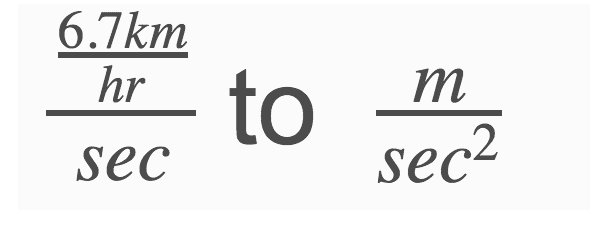
Image2.png


3.
The correct answer is 1.89 m/s^2. I watched a video on how to do it (and followed the video to get the following), but I don't understand why I can write the initial value as 6.7km/(hr*s), as shown in the following image.
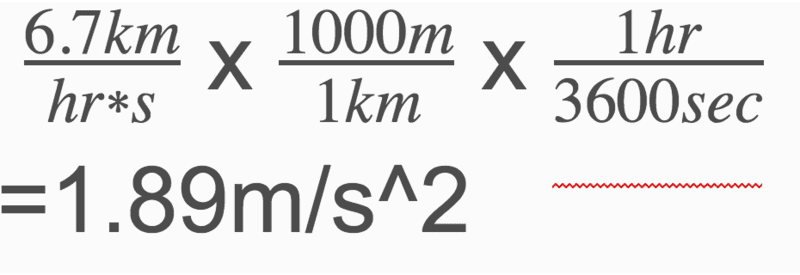
Image3.png
 
Physics news on Phys.org
Wowie! Giant images.

A good way to do unit conversions is to keep multiplying by "1" and cancelling units. Start by multiplying by 1=1hr/3600s.

Can you carry on from there?
 
Actually, that is shown in your post of the hint/solution. Do you understand how multiplying by "1" doesn't change the overall value, but gives you the opportunity to start cancelling units to make the conversions?
 
Hello @Lia44,

Welcome to Physics Forums! :welcome:

Another trick you'll want to memorize is when dividing two fractions, say \frac{a}{b} divided by \frac{c}{d},

\frac{\left( \frac{a}{b} \right) }{\left( \frac{c}{d} \right)} = \frac{a}{b} \cdot \frac{d}{c}

Notice how when \left( \frac{c}{d} \right) is brought to the top, the numerator and denominator are flipped to form \left( \frac{d}{c} \right). [Edit: Technically, this is accomplished by multiplying both the numerator and denominator of the big fraction by \frac{d}{c}. Then the denominator of the big fraction reduces to "1" and doesn't require notation.]

Now what happens if instead, there is no d? Suppose we just have \frac{a}{b} divided by c?

\frac{\left( \frac{a}{b} \right) }{c} = \ ?

Well, c is the same thing as \frac{c}{1}, so we have

\frac{\left( \frac{a}{b} \right) }{c} = \frac{\left( \frac{a}{b} \right) }{ \left( \frac{c}{1} \right)} = \frac{a}{b} \cdot \frac{1}{c} = \frac{a}{bc}
 
  • Like
Likes   Reactions: berkeman

Similar threads

Replies
7
Views
3K
Replies
1
Views
1K
  • · Replies 7 ·
Replies
7
Views
29K
Replies
15
Views
3K
  • · Replies 8 ·
Replies
8
Views
2K
  • · Replies 2 ·
Replies
2
Views
7K
  • · Replies 3 ·
Replies
3
Views
9K
  • · Replies 21 ·
Replies
21
Views
2K
  • · Replies 8 ·
Replies
8
Views
4K
  • · Replies 6 ·
Replies
6
Views
3K
