How do I determine the resultant vector R from R = A + B ?

Click For Summary

Homework Help Overview

The discussion revolves around determining the resultant vector R from the sum of two vectors A and B, specifically in the context of non-right angle triangles. Participants express confusion regarding the resolution of vectors into their components and the application of trigonometric principles.

Discussion Character

  • Exploratory, Conceptual clarification, Mathematical reasoning, Problem interpretation, Assumption checking

Approaches and Questions Raised

  • Participants discuss resolving vectors A and B into their x and y components, questioning the correct angles to use and the signs of the components based on their directions. There is an exploration of the Pythagorean theorem for finding the magnitude of the resultant vector and the use of trigonometric functions to determine the angle with the x-axis.

Discussion Status

The conversation includes attempts to clarify the components of the vectors and how to combine them. Some participants have provided guidance on resolving the vectors, while others express uncertainty about their calculations and the implications of their results. There is recognition of progress made in understanding the problem, but no explicit consensus on the final approach or solution.

Contextual Notes

Participants are navigating the complexities of vector addition, particularly in non-right angle scenarios, and are working within the constraints of homework guidelines that require them to show their reasoning and attempts without providing complete solutions.

osob
Messages
7
Reaction score
0
Hi everyone,
I need steps and some guidance on how to solve questions like this. I know how to do right triangle questions using the Pythagorean method, but when it comes to these non right angle triangles I get so confused. Help!

1. Homework Statement
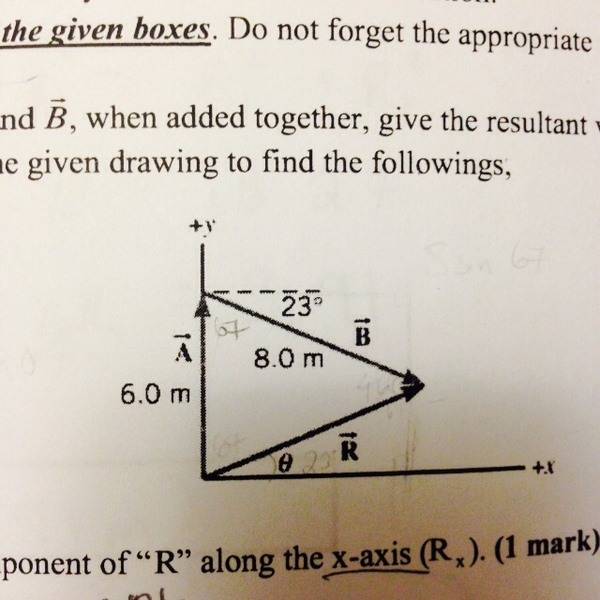
2cx9990.jpg


Homework Equations


a) The magnitude of the component "R" along the x-axis?
b) The magnitude of the component "R" along the y-axis?
c) The magnitude of the resultant "R" ?
d) The direction of the resultant "R" represented by the angle it makes with the x-axis?

The Attempt at a Solution


I don't know if I'm on the right track..

a) 8cos23= 7.36 m
b) 6sin23= 2.34 m
c) R^2 = a^2 + b^2 - 2abcos23 = 12.24 m
d) I have no clue where to begin ..
 
Last edited:
Physics news on Phys.org
Start by resolving A and B into components in the x and y directions. Even though the magnitudes of the vectors don't add algebraically, their components in each direction do. So when you are done adding their components, you will have the components of the resultant.

Chet
 
Chestermiller said:
Start by resolving A and B into components in the x and y directions. Even though the magnitudes of the vectors don't add algebraically, their components in each direction do. So when you are done adding their components, you will have the components of the resultant.

Chet
Hmm I'm not quite sure how to do that... Do I have to solve for the x and y-axis separately?

for x-axis do i have to do this:
8cos23 =
6cos23 =

and y axis:
8sin23 =
6sin23 =

And I'm also confusing myself because am I supposed to use 23 degrees or 67degrees? and why?
 
Well, first of all, the vector A, length 6, is pointing exclusively in the y direction. It doesn't have a component in the x direction. So, what are its components in the x and y directions?

Your components for vector B are more on target. But, there is something a little amiss with your y component. Which way is the y component of B pointing, up or down? What does that tell you about its sign?

Chet
 
Chestermiller said:
Well, first of all, the vector A, length 6, is pointing exclusively in the y direction. It doesn't have a component in the x direction. So, what are its components in the x and y directions?

Your components for vector B are more on target. But, there is something a little amiss with your y component. Which way is the y component of B pointing, up or down? What does that tell you about its sign?

Chet
magnitude of R on the x axis:
ax = 6cos90 = 0
bx = 8cos23 = 7.36

rx = ax + bx
rx = 7.36

along the y axis:
ay = 6sin90 = 6
by = -8sin23 = - 3.13

ry = ay + by
ry = 2.87

B is pointing down, meaning its negative... but I still don't know what I'm supposed to do with that information .. Am i going in the right direction?
 
osob said:
magnitude of R on the x axis:
ax = 6cos90 = 0
bx = 8cos23 = 7.36

rx = ax + bx
rx = 7.36

along the y axis:
ay = 6sin90 = 6
by = -8sin23 = - 3.13

ry = ay + by
ry = 2.87

B is pointing down, meaning its negative... but I still don't know what I'm supposed to do with that information .. Am i going in the right direction?
Yes. You've already correctly answered parts a and b. For part c, the resultant R is obtained from the pythagorean theorem using rx and ry. Do you see how rx and ry are the components of the vector R in the figure?
 
Chestermiller said:
Yes. You've already correctly answered parts a and b. For part c, the resultant R is obtained from the pythagorean theorem using rx and ry. Do you see how rx and ry are the components of the vector R in the figure?

Yes now I do. Phew I went a long way from my original thread, I appreciate the help Chestermiller.

So for part c,

R = rx^2 + ry^2
= (7.36)^2 + (2.87)^2
=7.89

As for part d,
I would have to use the sine law? I am totally stuck here.

R = 7.89
angle = 23 degrees

B = 8.0
angle = ?

angle R makes with the x-axis=
cos23/7.89 = cos(theta)/8
( cos23 x 8 )/ 7.89
= 21 degrees
 
Drop a normal from the tip of the vector R to the x axis. This produces a right triangle. One side of this triangle is rx, a second side is ry, and the hypotenuse is R. From this right triangle, what is tanθ?

Chet
 
Chestermiller said:
Drop a normal from the tip of the vector R to the x axis. This produces a right triangle. One side of this triangle is rx, a second side is ry, and the hypotenuse is R. From this right triangle, what is tanθ?

Chet

ok i created a right angle triangle...
tan(theta) = opp /adj
hypotenuse is 7.89
rx = 7.36
ry = 2.87

tan theta = 7.89 / 7.36
= 46.99 degrees

Does this look right? :nb)
 
  • #10
OR

tan theta = 2.87 / 7.36
= 21 degrees
 
  • #11
osob said:
ok i created a right angle triangle...
tan(theta) = opp /adj
hypotenuse is 7.89
rx = 7.36
ry = 2.87

tan theta = 7.89 / 7.36
= 46.99 degrees

Does this look right? :nb)
No. Opposite = 2.87, Adjacent = 7.36,

tanθ = (2.87)/(7.36)

Chet
 
  • #12
osob said:
OR

tan theta = 2.87 / 7.36
= 21 degrees
Yes.
 
  • #13
Chestermiller said:
Yes.
I believe I can now do these questions on my own. Through all the errors and trials, I appreciate your help so much Chestermiller.
 
  • #14
osob said:
I believe I can now do these questions on my own. Through all the errors and trials, I appreciate your help so much Chestermiller.
I like your aggressiveness, persistence, and determination. Great qualities.

Chet
 
  • Like
Likes   Reactions: osob

Similar threads

Replies
14
Views
2K
  • · Replies 20 ·
Replies
20
Views
12K
  • · Replies 5 ·
Replies
5
Views
3K
Replies
26
Views
4K
  • · Replies 4 ·
Replies
4
Views
6K
Replies
4
Views
2K
  • · Replies 5 ·
Replies
5
Views
2K
Replies
2
Views
2K
  • · Replies 2 ·
Replies
2
Views
2K
  • · Replies 4 ·
Replies
4
Views
14K