How do I get g(x) from this op-amp circuit?

  • Thread starter Thread starter Lasha
  • Start date Start date
  • Tags Tags
    Circuit Op-amp
Join the discussion
Registration is free. Ask a follow-up in this thread, or start your own.
10 replies · 2K views
Lasha
Messages
25
Reaction score
0
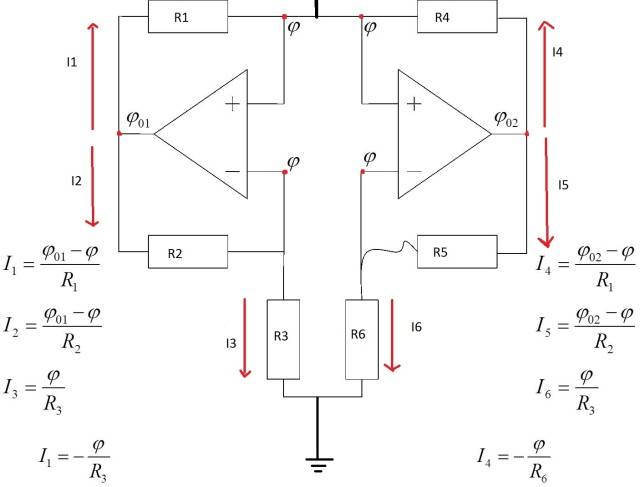
So this is the circuit(with equations which were written by me, so I don’t know if they’re correct)
2akefy8.jpg

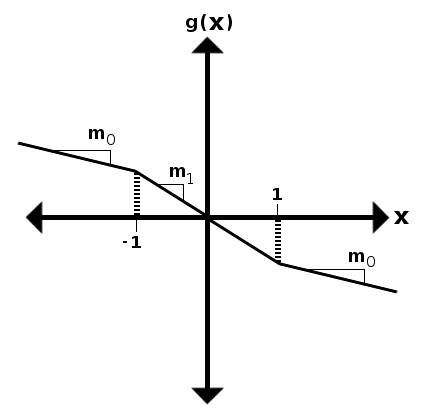
and this is the graph I should get, but I don’t know how.( g(x) is the current vs resistance)
fjnneb.jpg

I assume that those two equations collide somehow and I get that g(x), but I’m not sure.
So my question is: how do I get that g(x) with that circuit?
thanks
 
Engineering news on Phys.org
Lasha said:
So this is the circuit(with equations which were written by me, so I don’t know if they’re correct)
2akefy8.jpg

and this is the graph I should get, but I don’t know how.( g(x) is the current vs resistance)
fjnneb.jpg

I assume that those two equations collide somehow and I get that g(x), but I’m not sure.
So my question is: how do I get that g(x) with that circuit?
thanks

How are you setting the voltage ø in your circuit? I see a black line at the top of your diagram -- is that where you are putting in the input voltage ø?

And in your plot, what is x?
 
Yes.Input voltage is that sign.X is resistance.Oh and I forgot to mention R1=R2 and R4=R5
 
I'm sorry, but I'm having a really hard time tracking your post and whatever questions you have. Much of what you have posted is nonsense, IMO.

"X is resistance" -- *What* resistance? What are you trying to do with this circuit?

And your simplifications for I1 and I4 look wrong to me. Can you post your math in those derivations? But *only* after you clarify what you are trying to do with this circuit please.
 
I'm trying to put this circuit in parallel with two capacitors and the inductor so it should work like a negative resistance but with function like that
 
Lasha said:
I'm trying to put this circuit in parallel with two capacitors and the inductor so it should work like a negative resistance but with function like that

Still makes no sense to me. Please post your full circuit diagram with your circuit analysis...
 
  • Like
Likes   Reactions: 1 person
Lasha said:
So this is the circuit(with equations which were written by me, so I don’t know if they’re correct)
It is not clear to me why the circuit needs two identical blocks. Either one alone seems to be all that is needed. Do you know why it is constructed in duplicate?

and this is the graph I should get, but I don’t know how.( g(x) is the current vs resistance)
fjnneb.jpg

I assume that those two equations collide somehow and I get that g(x), but I’m not sure.
So my question is: how do I get that g(x) with that circuit?
You don't get that g(x). What you obtain with your circuit is a straight line without the bends in it. This means that, while your circuit is capable of oscillating when connected to an LC circuit, you have no control over the amplitude of the oscillations. You will have to build in some non-linearity if you want the oscillations to be predictable and sinusoidal. The g(x) in your figure shows such a non-linearity.

I suggest that you construct a one OP-AMP negative resistance, add a resistor in series with it so that overall it has a positive resistance, then run some tests to see how good its frequency response is, producing a plot of resistance vs. frequency.
 
  • Like
Likes   Reactions: 1 person
i'll use e instead of phi.

it's a safe bet
e = e1 X R3/(R2+R3) = e2 X R6/(R5+R6)

and algebra should take you to I1 and I4
 
  • Like
Likes   Reactions: 1 person
I've solved this.It turns out that g(x) ''breaks'' that way because of the fact that output voltage on the op-amp can't exceed supply voltage so the whole function changes.We need two op-amps in parallel so when whenever one of the output voltages reach their limits whole function doesn't become flat.Thanks anyways and sorry for not supplying enough details for it to make sense.
 
glad you got it solved.

Indeed, the other safe bet is e1 and e2 won't exceed Vsupply.

Everybody learns that one the hard way.