How Do I Tackle an Unfamiliar Challenge?

  • Context: MHB 
  • Thread starter Thread starter Needhelp2
  • Start date Start date
  • Tags Tags
    Challenge
Click For Summary

Discussion Overview

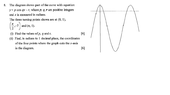
The discussion revolves around tackling a challenging question related to cosine curves, specifically focusing on determining the amplitude, period, and axis of oscillation of a sinusoidal function. Participants explore various aspects of the problem, including mathematical reasoning and the application of trigonometric principles.

Discussion Character

  • Exploratory
  • Mathematical reasoning
  • Homework-related
  • Debate/contested

Main Points Raised

  • Some participants propose that the amplitude of the curve is 4, while others express uncertainty about the definition of the line the curve oscillates around.
  • There is a suggestion that the period of the curve is π, with a later reply confirming this and stating that the value of q would be 2.
  • One participant questions the calculation of the axis of oscillation, suggesting it is y = -3 based on the lines joining the peaks and troughs, while another clarifies that r should be -3 in the equation.
  • Participants discuss the method for solving simultaneous equations formed by the maximum and minimum values of the curve, with some expressing confusion about the process.
  • There is a mention of a mark scheme that outlines a method for determining values for p, r, and q, but participants are still seeking clarification on the reasoning behind it.
  • One participant expresses that they find the problem easier once the values for p, r, and q are determined, indicating a shift in understanding.

Areas of Agreement / Disagreement

Participants do not reach a consensus on all aspects of the problem, as there are differing interpretations regarding the axis of oscillation and the definitions of certain terms. Some participants agree on the values for amplitude and period, while others remain uncertain or seek further clarification.

Contextual Notes

There are unresolved aspects regarding the definitions of terms related to the cosine curve, as well as the method for solving the equations. Participants express varying levels of understanding and confidence in their approaches.

Who May Find This Useful

Students preparing for exams in mathematics or those interested in understanding sinusoidal functions and their properties may find this discussion beneficial.
Needhelp2
Messages
17
Reaction score
0
I was wondering if anyone could help with this- I've never seen a question like this before and don't know exactly how to tackle it...(Sweating) any help would be greatly appreciated!
 

Attachments

  • new m.png
    new m.png
    8.5 KB · Views: 97
Mathematics news on Phys.org
Well, you should be familiar with cosine curves (Smile)

What is the amplitude of this curve? (p)
After how many radians does the cycle start repeating itself? (determines q)
About what line does the curve oscillate? (determines r)
 
surely the amplitude of the curve is 4? (1+7/2), and perhaps the period is π? although I am not too sure what you mean by the line the curve oscillates? thank you so much for the help by the way!

according to the markscheme this is the method to work it out-

1=p-r
-7=-p-r
and therefore p=4 and r=3

Not trying to be a pain, and I am so grateful for the help, but do possibly understand how this works and could explain it to me? My exam board marks very strictly.. (Worried)
 
Last edited:
Is this for a graded assessment?
 
Needhelp said:
surely the amplitude of the curve is 4? (1+7/2), and perhaps the period is π? although I am not too sure what you mean by the line the curve oscillates? thank you so much for the help by the way!

according to the markscheme this is the method to work it out-

1=p-r
-7=-p-r
and therefore p=4 and r=3

Not trying to be a pain, and I am so grateful for the help, but do possibly understand how this works and could explain it to me? My exam board marks very strictly.. (Worried)


The period is indeed \pi and from this, one can deduce that the value of q would be 2.

Usually, the period of the standard cos curve is 2\pi. The curve that you got completes 2 cycles in 2\pi, hence q = 2.For r, I forgot the technical name for it, sorry about that... but yes, that's one way that you can find it. If you join all the troughs together, you get a line. Joining the crests together gives you another line. The 'axis of oscillation' will be the line exactly between those two lines. You will notice that the curve never goes further than the amplitude from this axis.For the second part, you simply need to solve simultaneously. You have two intersecting graphs (the x-axis and the curve you now know the equation). I hope you know how to solve equations involving trigonometry :)
 
Haha yes it was really part 2 that was the problem :) If the line joining the peaks together is y=1 and the one joining the troughs together is y=-7, would that not mean that the axis of oscillation was y=-3? Sorry for all the questions- I am just quite confused!

And in response to SuperSonic4, no, just revision for my c2 exam that is in two weeks (Worried)
 
Needhelp said:
I was wondering if anyone could help with this- I've never seen a question like this before and don't know exactly how to tackle it...(Sweating) any help would be greatly appreciated!

Since this is a sinusoid the period is the interval between alternate turning pointts and so is \( \pi \), and so \(q \pi =2 \pi\), \(q=2\).

The maximum of \(y=p \cos(q x) +r\) is \(p+r\) and the minimum is \(-p+r\), you are given these which gives you a pair of simultaneous equations for \(p\) and \(q\) to solve.

CB
 
Needhelp said:
Haha yes it was really part 2 that was the problem :) If the line joining the peaks together is y=1 and the one joining the troughs together is y=-7, would that not mean that the axis of oscillation was y=-3? Sorry for all the questions- I am just quite confused!

And in response to SuperSonic4, no, just revision for my c2 exam that is in two weeks (Worried)

Yes, the line is y = -3, which means, r = 3, since in the given equation, you are given -r. Substituting r = -3 would result in y = pcos(qx) - (-3) = pcos(qx) + 3 which is not what the diagram is showing.

If you had been given y = p\cos(qx)+r, then r would be equal to -3.

In other words, whatever constant coming after the trigonometry part makes the entire curve go up or down. It goes up if the constant is positive and it goes down if negative.For part 2, it is a little less intuitive. Could you show us how you would solve the simultaneous equations formed? Don't worry if it's wrong, you learn better through mistakes (Wink)
 
I think it, once the values for p,r and q are found you can sub them into the equation,so it is now 4cos2x-3=0. cos2x= 3/4, so you get cos-1(3/4)=2x. therefore 2x= + or - 0.723,5.560 and 7.006. Hence x would equal half of each of these values? It seems a lot easier now I have all the values!
 
  • #10
Yup! You just need to know which ones are the ones shown in the diagram (Smile)
 

Similar threads

  • · Replies 1 ·
Replies
1
Views
2K
  • · Replies 3 ·
Replies
3
Views
1K
  • · Replies 2 ·
Replies
2
Views
2K
  • · Replies 6 ·
Replies
6
Views
1K
  • · Replies 5 ·
Replies
5
Views
2K
Replies
14
Views
2K
  • · Replies 18 ·
Replies
18
Views
1K
  • · Replies 4 ·
Replies
4
Views
3K
Replies
5
Views
2K
  • · Replies 2 ·
Replies
2
Views
1K