How do I use this equation? Estimating half-life of a decay

Click For Summary
SUMMARY

The discussion focuses on the application of equation 8.18 for estimating the half-life of decay processes, specifically for Th-220 decay into C-12 and Po-208. The user encountered difficulties reproducing the expected half-life of 2.3x10^6 years due to potential errors in unit conversions and calculations. Key points include the importance of using correct values for parameters such as the Q value (32.1 MeV) and the correct conversion of femtometers. The equation is confirmed to be applicable for alpha decay, with suggestions to calculate ln(t1/2) for verification.

PREREQUISITES
  • Understanding of nuclear decay processes and half-life calculations
  • Familiarity with equation 8.18 from nuclear physics literature
  • Proficiency in unit conversions, particularly between MeV and SI units
  • Knowledge of alpha decay mechanisms and related parameters
NEXT STEPS
  • Review the derivation and application of equation 8.18 in nuclear physics
  • Learn about unit conversions in nuclear physics, focusing on MeV and femtometers
  • Investigate the half-life calculations for various isotopes, particularly Th-220 and C-12
  • Explore the concept of ln(t1/2) and its significance in decay process analysis
USEFUL FOR

Students and researchers in nuclear physics, physicists working on decay processes, and anyone involved in calculating half-lives of isotopes.

llatosz
Messages
62
Reaction score
9
Moved from technical forums, missing template
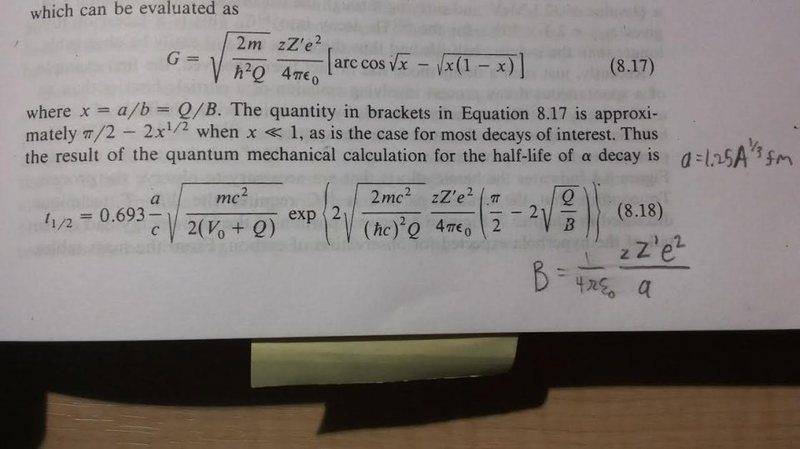
How should I go about using equation 8.18? Link can be found below. In the book, an example is used where
Th-220 --> C-12 + Po-208 with a Q value of 32.1 MeV is used, and it is said to yield
t1/2 = 2.3x10⁶ but for the life of me I cannot reproduce this result. This is what I did:
Going from left to right in the equation,
-for a/c i used (1.25*2201/3 x10^-12 m ) / (3x10^8 m/s)
-for V0 I used 35 MeV which was also given
-for mc^2 I used amu * 931.5 MeV/(amu * c^2)
-for h-bar * c i used ( 6.582x10^-10 MeV * s ) * (3x10^8 m/s)
-for z i used 6
-for Z' i used 84
-for 1/(4πε0) i used 8.988x10^9 Nm^2/c^2
half life equation.jpg


I used all SI units except for my MeV which cancel. But I keep getting an overflow error in my Ti-84 Plus. What could be wrong?
 
Physics news on Phys.org
llatosz said:
-for a/c i used (1.25*2201/3 x10^-12 m ) / (3x10^8 m/s)
Here's one problem (there may be others): 1 fm = 10-15 m, not 10-12 m. If you used the same value of a when calculating B, you need to fix it there, also; this might have a big effect because it's inside an exponential.
 
Ah you're right! But unfortunately it still didn't work. I calculated all the terms separately and that exponent is just way too high no matter what. I might just call this one a loss lol. I really appreciate your reply though!
 
llatosz said:
I used all SI units except for my MeV which cancel.
What about amu?
 
DrClaude said:
What about amu?
Yep, I used amu in order to be able to use the 931.5 MeV/(amu*c^2) too
 
Can you pin down which is the big number? For instance, the text above equation (8.18) indicates that x = Q/B should be << 1. Is it?
 
I just noticed that eq. (8.18) is for alpha-decay, not 12C decay; does that make a difference?
 
John Park said:
I just noticed that eq. (8.18) is for alpha-decay, not 12C decay; does that make a difference?
It shouldn't make a difference because this equation is flexible for any massive decay. For alpha decay, the difference between z and Z' would be 2, for 12C decay, z-Z' would be 6
 
John Park said:
Can you pin down which is the big number? For instance, the text above equation (8.18) indicates that x = Q/B should be << 1. Is it?
I remember the first multiplication term in the exponent was in the 8,000's. But I am afraid I lost my work for this equation and i really don't want to start again lol
 
  • #11
After a tiny bit of reading, I gather that 12C decay might be rather slow. What it look like if you just calculated ln (t1/2) ?

Edit: ignore this--you're trying to compare with a calculated result.
 
Last edited:
  • #12
After a bit more reading I find that the only listed decay processes for 220Th are electron capture, and alpha decay with a half-life of about 10 μs. See Wikpedia, "Isotopes of Thorium".

Edit: Not sure if the much slower 12C process would simply be ignored in the listings, if it''s real, or if there are grounds to question its reality.

Edit 2: See below.
 
Last edited:
  • #13
I found this useful:
/instruct/ch374/ch418518/Chapter%207%20Alpha%20Decay-rev.pdf

Equation (8.18) seems to give a reasonable answer for alpha decay (rough calculation, not checked). The factor in front of the exponential is very small and may reduce the product to the right level. I'd try finding ln(t1/2) and see if the result looks credible.
 

Similar threads

  • · Replies 5 ·
Replies
5
Views
6K
  • · Replies 3 ·
Replies
3
Views
3K
Replies
1
Views
3K
  • · Replies 4 ·
Replies
4
Views
4K
  • · Replies 16 ·
Replies
16
Views
3K
  • · Replies 4 ·
Replies
4
Views
3K
  • · Replies 10 ·
Replies
10
Views
7K
Replies
5
Views
2K
  • · Replies 9 ·
Replies
9
Views
2K
Replies
1
Views
9K