How do PI controllers achieve steady state?

Click For Summary

Discussion Overview

The discussion centers on the functioning of PI controllers in achieving steady state, particularly in relation to their mathematical representation and behavior under different conditions. Participants explore the implications of the integral component in eliminating error and the conditions under which steady state is defined.

Discussion Character

  • Technical explanation
  • Debate/contested
  • Mathematical reasoning

Main Points Raised

  • One participant questions how a PI controller can achieve steady state mathematically, suggesting that the integral term must balance with the system's dynamics.
  • Another participant explains that the integrator maintains output by remembering past errors, but challenges the notion that the system can perfectly track a setpoint under all conditions, particularly if the setpoint is changing.
  • There is a request for documentation on second order integrators in PID controllers, indicating a search for deeper understanding.
  • A participant clarifies that there is no second order integrator in PID controllers and emphasizes the use of Laplace Transforms and pole-zero analysis in modern control theory.
  • Another participant proposes that the modern approach involves developing a transfer function with specific poles and zeros to ensure stability, which is acknowledged by others.

Areas of Agreement / Disagreement

Participants express differing views on the tracking capabilities of PI controllers and the definition of steady state. There is no consensus on the implications of these concepts, particularly regarding the conditions under which steady state can be achieved.

Contextual Notes

The discussion includes assumptions about the nature of inputs (constant vs. changing) and the mathematical framework (Laplace Transforms) used in control theory, which may not be universally agreed upon.

OTSEngineer
Messages
10
Reaction score
5
Summary: A question about how PI controllers reach steady state

Hello PhysicsForums,

I need a little help understanding how a PI controller works when operating in steady state.

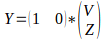
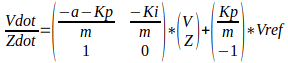
Here is the equation in State Space form:
1660340884594.png

1660340898698.png

Where
1660340906306.png


In standard form, the equation is:
1660340917201.png

Where
1660340926480.png
The question I’m working on asks for the stead state solution in comparison to both open loop and proportional steady state response. Because (in theory), the integral controller will eliminate all error (assuming no disturbances), all derivatives will equal 0. So, the system should track the setpoint Vref perfectly. I confirmed this by looking the the solutions provided for this question. However, I do not understand mathematically how this is possible unless -a*V is equal and opposite to Ki*Z. I thinking that even if this system had initial conditions where the V=Vref, there must be some deviation from Vref so that the integration of V-Vref over time can have a non-zero value that is equal to -a*V.

Is my conclusion correct?

Thank you.
 
Physics news on Phys.org
The integrator "remembers" the history of its inputs, so it doesn't need an error input to maintain the correct output, if it is at the correct output (meaning the output that eliminates the error). It probably does, however, need a historical error in order to settle to the correct output. In fact, in a stable system with constant inputs, the integrator will do what it needs to do to eliminate the error at it's input. This is all for a constant input, of course.

However, your statement that "the system should track the setpoint Vref perfectly" is problematic. Tracking implies changing conditions, which may not be steady state depending on how you are defining that. For example, if Vref is a ramp (i.e. ##\frac{dVref}{dt} \neq 0##) then a 1st order integrator can not eliminate the error.
 
Hello DaveE,
Would you happen to have any documentation on second order integrators in PID controllers?

Thank you for your explanation.
 
OTSEngineer said:
Hello DaveE,
Would you happen to have any documentation on second order integrators in PID controllers?

Thank you for your explanation.
No, at that level it's really just the modern controls textbooks.

There is no second order integrator in PID, by definition. PID isn't really a thing for control systems experts. It's all just Laplace Transforms, Bode plots, and such; the more generic feedback control problem. They would deal more with pole-zero locations as required for their design without the predefined PID format.

There may be documents out there that would help, but I never approached these problems that way.
 
I suppose then that the modern approach is to develop a transfer function with the poles and zeros needed to insure stability for the anticipated operating conditions. Is that correct?
 
OTSEngineer said:
I suppose then that the modern approach is to develop a transfer function with the poles and zeros needed to insure stability for the anticipated operating conditions. Is that correct?
Yes. Stability and other performance requirements. It might end up being a PID compensation, which is fine, but there's not really a good theoretical reason for predetermining that configuration; for constraining your solution in advance.
 
Thank you.
 
  • Like
Likes   Reactions: DaveE

Similar threads

  • · Replies 4 ·
Replies
4
Views
3K
Replies
1
Views
9K
Replies
1
Views
2K
  • · Replies 2 ·
Replies
2
Views
3K
  • · Replies 4 ·
Replies
4
Views
2K
  • · Replies 3 ·
Replies
3
Views
5K
Replies
12
Views
2K
  • · Replies 1 ·
Replies
1
Views
3K
  • · Replies 2 ·
Replies
2
Views
2K
Replies
10
Views
3K