ace214
- 28
- 0
[SOLVED] Resultant Velocity Vectors
Here is the problem:
The force exerted by the wind on a sailboat is approximately perpendicular to the sail and proportional to the component of the wind velocity perpendicular to the sail. For the 700 kg sailboat shown in Figure P4.54, the proportionality constant is given below.
Fsail = (550 N/(m/s))Vwind
Water exerts a force along the keel (bottom) of the boat that prevents it from moving sideways, as shown in the figure. Once the boat starts moving forward, water also exerts a drag force backwards on the boat, opposing the forward motion. If a 20 knot wind (1 knot = 0.514 m/s) is blowing to the east, and the sailboat is heading directly north at a speed of 23 knots, determine the magnitude and directions of the wind velocity as measured on the boat.
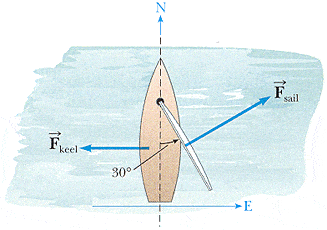
Answer boxes:
_____ knots at _____ degrees south of east
What is the component of the wind velocity in the direction parallel to the motion of the boat?
______ knots south
----------------
OK, I figured out the components of the wind vector to be 17 on the x and 10 on the y (Make a right triangle b/c of the perpendicular vector to the sail, other angle becomes 60 which is complementary to 30 in another right triangle that actually makes up the wind vector). so I tried putting in 10 for the second part of the question and it was wrong. I don't see at all how the anything in the wind velocity is south- it's going northeast.
I don't see how the velocity goes south of east either. It already gave you the velocity.
Also, the Force stuff doesn't seem to be useful at all.
Very confused. Thanks for any help. BTW, this is due by 8:30 Wednesday morning.
ADD: Ok, so I think I misinterpreted the wind: I guess it is going due east instead of into the sail- that is just the force. I will keep trying.
Here is the problem:
The force exerted by the wind on a sailboat is approximately perpendicular to the sail and proportional to the component of the wind velocity perpendicular to the sail. For the 700 kg sailboat shown in Figure P4.54, the proportionality constant is given below.
Fsail = (550 N/(m/s))Vwind
Water exerts a force along the keel (bottom) of the boat that prevents it from moving sideways, as shown in the figure. Once the boat starts moving forward, water also exerts a drag force backwards on the boat, opposing the forward motion. If a 20 knot wind (1 knot = 0.514 m/s) is blowing to the east, and the sailboat is heading directly north at a speed of 23 knots, determine the magnitude and directions of the wind velocity as measured on the boat.
Answer boxes:
_____ knots at _____ degrees south of east
What is the component of the wind velocity in the direction parallel to the motion of the boat?
______ knots south
----------------
OK, I figured out the components of the wind vector to be 17 on the x and 10 on the y (Make a right triangle b/c of the perpendicular vector to the sail, other angle becomes 60 which is complementary to 30 in another right triangle that actually makes up the wind vector). so I tried putting in 10 for the second part of the question and it was wrong. I don't see at all how the anything in the wind velocity is south- it's going northeast.
I don't see how the velocity goes south of east either. It already gave you the velocity.
Also, the Force stuff doesn't seem to be useful at all.
Very confused. Thanks for any help. BTW, this is due by 8:30 Wednesday morning.
ADD: Ok, so I think I misinterpreted the wind: I guess it is going due east instead of into the sail- that is just the force. I will keep trying.
Last edited: