How Do Strangely Aligned Capacitor Plates Affect Distance Calculations?

Click For Summary

Homework Help Overview

The discussion revolves around the geometry of capacitor plates that are aligned at an angle, specifically focusing on how this alignment affects distance calculations related to potential difference. The original poster is attempting to understand the relationship between various distances and angles in the context of a physics problem involving capacitors.

Discussion Character

  • Exploratory, Conceptual clarification, Mathematical reasoning

Approaches and Questions Raised

  • The original poster expresses confusion about the relationship between the distances d, a, and b, as well as how these relate to the angle theta. Some participants discuss the use of trigonometric relationships in triangles formed by the capacitor setup.

Discussion Status

Participants are exploring geometric relationships and trigonometric functions to clarify the problem. The original poster has indicated a specific point of confusion, and others are providing insights into the geometry involved, though no consensus has been reached on the overall solution.

Contextual Notes

The problem involves an unspecified angle and distances that are not clearly defined, which may contribute to the confusion. The original poster mentions being stumped by the text's conclusions, indicating potential gaps in understanding the setup or assumptions made in the problem.

mateomy
Messages
305
Reaction score
0
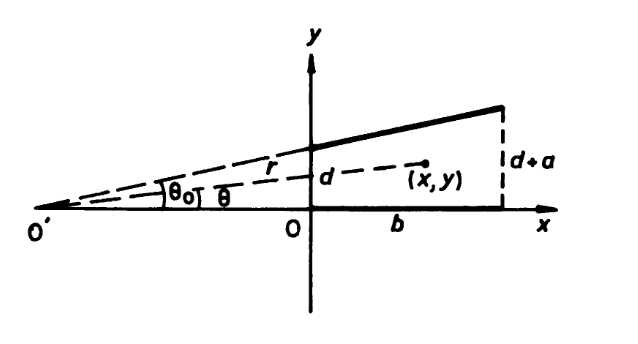
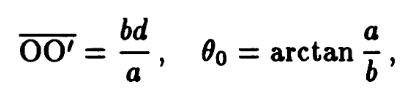
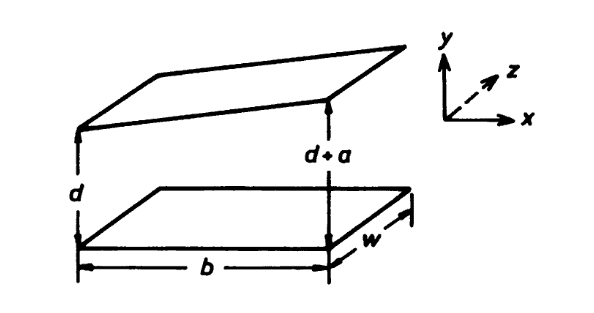
Working along step-by-step with a text and I'm stumped as to how they reached a conclusion. In the first picture you see two plates aligned at an unspecified angle, theta. One plate is at a potential V and the other is grounded. The distance between the plates at one end is d, and at the other end d+a. You can see in the second picture how they've set it up with respect to a two dimensional coordinate system. Maybe it's late and I'm braindead or maybe not in any even I can't see how they've formed the relationship between b,d and a to determine the distance between the actual origin and the intersection of the plates (dotted lines in picture three). Can anybody enlighten me?

Thanks.
ScreenShot2012-05-18at11434AM.png


ScreenShot2012-05-18at11722AM.png


ScreenShot2012-05-18at11714AM.png
 
Physics news on Phys.org
P.S. the whole point is to find the potential, but this is where I'm hung up.
 
In the triangle (in x<0) with base OO' and the height d, you have
tan(theta_0)=d/(OO').

In the trapezoid (in x>0), draw the horizontal at height d to form a similar triangle,
with base b and height a. Thus
tan(theta_0)=a/b.
 
Truly geometry is my weakest link. Thank you.
 

Similar threads

Replies
1
Views
2K
  • · Replies 5 ·
Replies
5
Views
3K
Replies
1
Views
3K
  • · Replies 6 ·
Replies
6
Views
8K
Replies
3
Views
2K
Replies
5
Views
1K
  • · Replies 7 ·
Replies
7
Views
5K
  • · Replies 7 ·
Replies
7
Views
3K
  • · Replies 7 ·
Replies
7
Views
20K
Replies
3
Views
2K