Discussion Overview
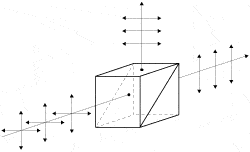
The discussion centers around the behavior of intensities when using a polarization beam splitter (PBS) in an experimental setup. Participants explore the implications of splitting unpolarized light into polarized beams and the resulting intensity changes at the input and output ports of the PBS.
Discussion Character
- Technical explanation
- Experimental/applied
- Debate/contested
Main Points Raised
- One participant states that a PBS splits an unpolarized beam into two beams with opposite polarization states, raising questions about the resulting intensities at the output ports.
- Another participant notes that the answer to the intensity distribution depends on factors such as the splitting ratio of the PBS and the wavelength of the light used.
- A participant suggests that if minimizing losses is a priority, using a PBS with antireflection coatings is advisable, although they mention that losses are typically not dramatic.
- One participant proposes that the intensities at the two output ports will be half of the input intensity, indicating a specific calculation method involving decibels.
- Another participant suggests that the intensity at the input port, when combining the two output beams, will be twice the intensity of the combined beams at the output ports, also using a decibel calculation.
Areas of Agreement / Disagreement
Participants have not reached a consensus on the exact intensity values at the output ports or the input port when combining beams. There are multiple competing views regarding the effects of various factors on intensity changes.
Contextual Notes
Participants express uncertainty about their assumptions and calculations, indicating that the discussion involves unresolved mathematical steps and dependencies on specific conditions.
Who May Find This Useful
This discussion may be useful for researchers and practitioners working with polarization beam splitters in experimental setups, particularly those interested in the effects of polarization on light intensity and loss calculations.