How Do You Apply the Chain Rule in This Multivariable Calculus Problem?

Click For Summary

Homework Help Overview

The discussion revolves around applying the chain rule in a multivariable calculus context, specifically related to a function defined in terms of multiple variables. Participants are exploring how to set up the problem correctly to utilize the chain rule effectively.

Discussion Character

  • Exploratory, Conceptual clarification, Mathematical reasoning

Approaches and Questions Raised

  • The original poster attempts to understand how to set up the chain rule for the given function but expresses uncertainty about the process. Some participants provide a generalized proof and suggest applying specific substitutions to derive results. Others question the application of these substitutions and seek clarification on the steps involved.

Discussion Status

Participants are actively engaging with the problem, offering insights and suggestions for applying the chain rule. There is a mix of attempts to clarify the setup and explore different interpretations of the function's behavior under transformation. While some guidance has been provided, there is no explicit consensus on the correct approach yet.

Contextual Notes

Participants are working under the constraints of homework rules, which may limit the extent of assistance they can provide to one another. There is also an indication of potential confusion regarding the application of substitutions in the context of the problem.

dakota1234
Messages
3
Reaction score
1
Moved from a technical forum, so homework template missing
I've been working on this one for a little bit, and I know I really just need to use the chain rule to solve it, but I can't seem to figure out how to set it up properly. Probably a dumb question, but I could really use some help on this!
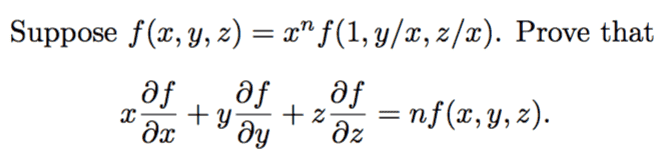
Screen Shot 2018-11-26 at 4.57.55 PM.png
 

Attachments

  • Screen Shot 2018-11-26 at 4.57.55 PM.png
    Screen Shot 2018-11-26 at 4.57.55 PM.png
    10.4 KB · Views: 659
Physics news on Phys.org
I was able to work out a more generalized version of the proof, but I'm not sure how to apply it
Screen Shot 2018-11-26 at 5.03.55 PM.png
 

Attachments

  • Screen Shot 2018-11-26 at 5.03.55 PM.png
    Screen Shot 2018-11-26 at 5.03.55 PM.png
    84.7 KB · Views: 464
  • Like
Likes   Reactions: Delta2
you are given that ##f(x,y,z)=x^nf(1,y/x,z/x)## (1). If from (1) you can prove that ##f(tx,ty,tz)=t^nf(x,y,z)## (2) then together with the work already done by you , you ll be finished.

Now if you apply (1) for ##x=tx,y=ty,z=tz## what do you get? if you apply it correctly you ll get a result that if you apply (1) again (as it is directly, without substitution) you ll be able to prove (2).
 
Last edited:
Delta2 said:
you are given that ##f(x,y,z)=x^nf(1,y/x,z/x)## (1). If from (1) you can prove that ##f(tx,ty,tz)=t^nf(x,y,z)## (2) then together with the work already done by you , you ll be finished.

Now if you apply (1) for ##x=tx,y=ty,z=tz## what do you get? if you apply it correctly you ll get a result that if you apply (1) again (as it is directly, without substitution) you ll be able to prove (2).
I may just be really tired, but can you explain in more detail how "to apply it correctly"? I've tried plugging in the substitutions for x,y,z, since before I even posted on this forum, and I don't understand what I'm doing wrong.
 
Ok, let's say that ##f(u,v,w)=u^nf(1,v/u,w/u)## (1)

Applying (1) for ##u=tx,v=ty,w=tz## we get that ##f(tx,ty,tz)=(tx)^nf(1,\frac{ty}{tx},\frac{tz}{tx})=t^nx^nf(1,y/x,z/x)##

Now i have helped too much i think you must be able to see the last step, what is ##x^nf(1,y/x,z/x)## equal to?
 

Similar threads

  • · Replies 4 ·
Replies
4
Views
1K
  • · Replies 3 ·
Replies
3
Views
2K
Replies
2
Views
2K
  • · Replies 4 ·
Replies
4
Views
2K
Replies
2
Views
3K
Replies
4
Views
2K
  • · Replies 17 ·
Replies
17
Views
12K
  • · Replies 9 ·
Replies
9
Views
6K
  • · Replies 1 ·
Replies
1
Views
3K
  • · Replies 3 ·
Replies
3
Views
2K