How do you calculate binding energy for part c)ii?

9 replies · 2K views · last reply
Bolter
Messages
262
Reaction score
31
Homework Statement
Working out how to calculate binding energy
Relevant Equations
l = 1/2Nne
Here is the question:

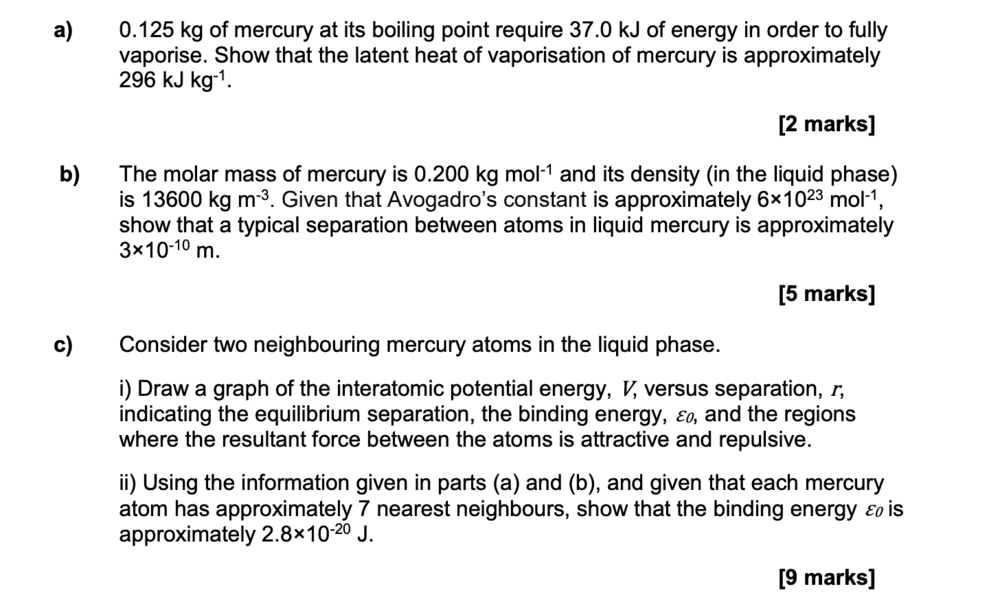
Printed exam question with parts a), b) and c) on mercury: latent heat of vaporisation from 0.125 kg and 37.0 kJ, separation between atoms from molar mass, density and Avogadro's constant, and a potential energy graph plus binding energy derivation.

Stuck on how to complete part c)ii

Here is what I have done so far as well as trying to answer part c)ii
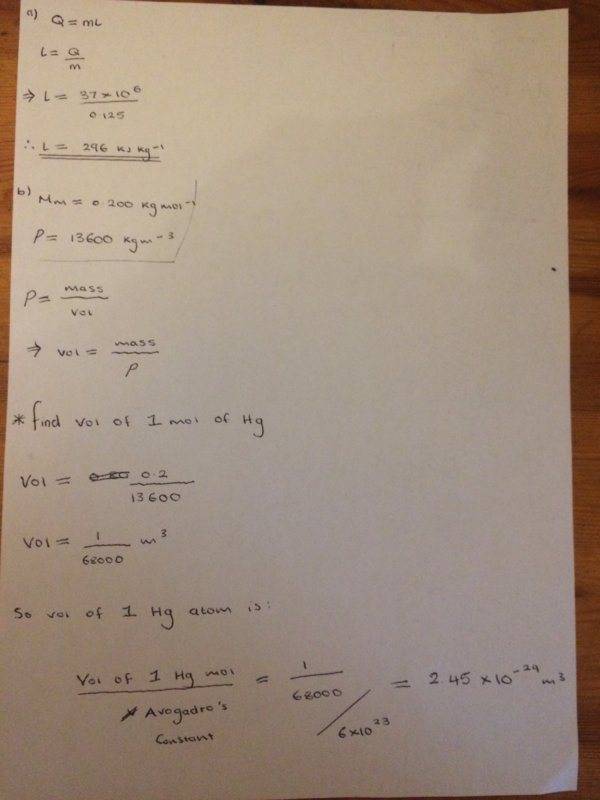
Handwritten working on lined paper: Q = mL, then L = Q/m, L = 37 x 10^6 / 0.125, L = 296 kJ/kg; part b with molar mass 0.200 kg/mol and density 13600 kg/m^3, vol = mass/rho, then vol of 1 mol of Hg = 0.2/13600 = 1/68000 m^3, and vol of one Hg atom = 1/68000 divided by Avogadro's constant 6 x 10^23 = 2.45 x 10^-24 m^3.


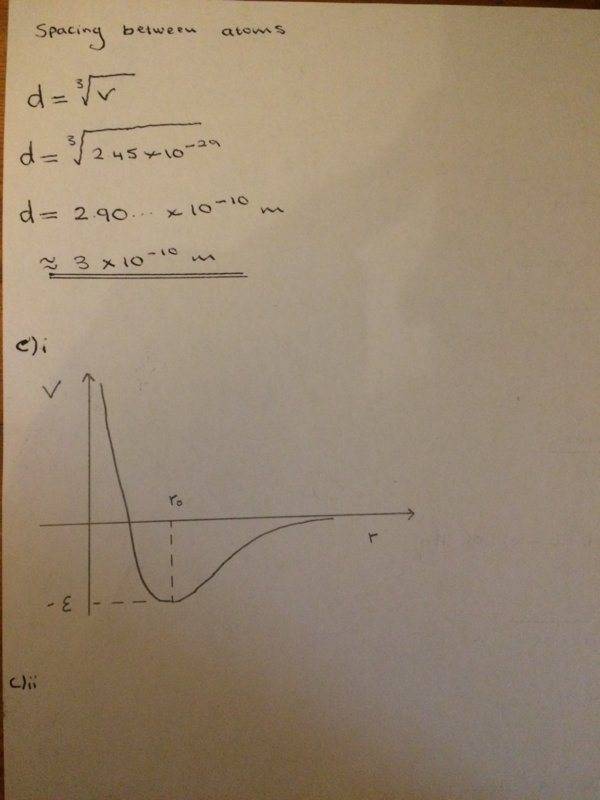
Handwritten working titled Spacing between atoms: d equals cube root of V, then d equals cube root of 2.45 x 10^-29, giving d = 2.90 x 10^-10 m, approximately 3 x 10^-10 m. Below, part c)i shows a potential energy curve V against r with a minimum at r0 of depth -epsilon, and part c)ii is blank.
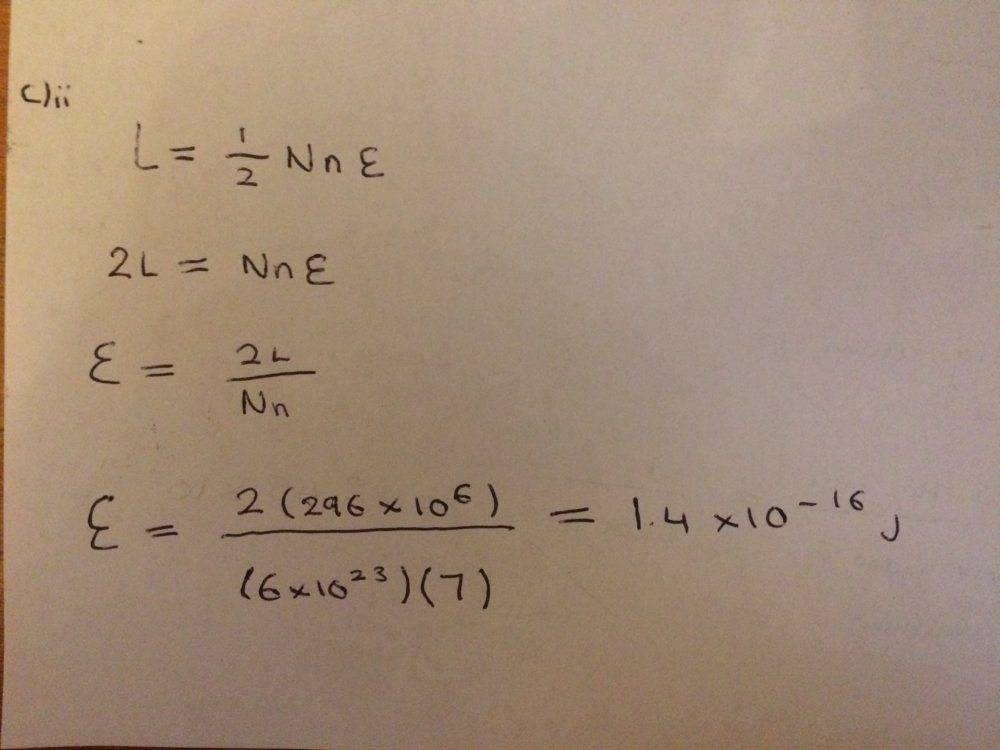
Handwritten derivation labelled c)ii: L = 1/2 Nn E, rearranged to 2L = Nn E and E = 2L/Nn, then E = 2(296 x 10^6) / ((6 x 10^23)(7)) = 1.4 x 10^-16 J.


Any help would be appreciated! Thanks
 
kuruman said:
37 kJ = 37x103 J.

Oh shoot yes you’re right. I don’t know why I processed it at as mega joules

So doing the following calculation again gives

Binding energy = (2 * 293000) / (6x10^23 * 7) = 1.41x10^-19 J which is closer to the answer but still not right
 
mjc123 said:
296 kJ/kg. You need kJ/mol.

So to convert from kJ/kg to kJ/mol, I must multiply kJ/kg by the molar mass?

I did this and got the following

Binding energy = 2(293000 * 0.20)/(6x10^23)(7) = 2.79... x10^-20 J which is roughly equal to 2.8x10^-20 J

I also got another part that I need help with if you don’t mind

Not entirely sure how to approach part d)ii but I suppose I had done part d) i right
 
Attachments
  • Printed exam question part d) on monatomic neon gas in a discharge lamp: molar mass 0.020 kg/mol, pressure 1.3 kPa, 20°C, volume 2.0x10^-4 m^3; asks to show neon mass is about 2.1 mg and atom separation is about 1.5x10^-8 m; [9 marks].
    45E42987-83A2-40FD-8286-350436D8924D.jpeg
    21.5 KB · Views: 251
  • Handwritten working labelled d)i: PV = nRT rearranged to n = PV/RT, substituted as (1.3 x 10^3)(2 x 10^-4) / (8.3 x 293), giving n = 1.069... x 10^-4 mol; mass = molar mass x mol = 0.020 x 1.069... x 10^-4 = 2.138... x 10^-6 kg ≈ 2.1 mg. Label d)ii is written below, with no working.
    674B5D6B-EE06-47E7-8A17-4296C2649997.jpeg
    37.1 KB · Views: 218
di is right. Not sure what the problem is for dii - find the volume per atom, as you did for Hg.
 
mjc123 said:
di is right. Not sure what the problem is for dii - find the volume per atom, as you did for Hg.

To find volume per atom. I know that 1.0691... x10^-4 moles of Hg is contained in 2x10^-4 m^3.

So to firstly get the volume per mole of Hg, I do ' 2x10^-4 / 1.0691...x10^-4 ' which gives 1.870... volume per mole

Dividing 1.870... by avogrado's constant is '1.870... / 6.022x10^23 = 3.106... x 10^-24 volume per atom
Cube rooting volume per atom number should give the spacing which comes out to be '1.459... x10^-8 m'

Would you agree that these steps are the right way of doing this?
 
Yes, except that you're talking about neon, not mercury.
 
  • Like
Likes   Reactions: Bolter
mjc123 said:
Yes, except that you're talking about neon, not mercury.

Yes, sorry I got mixed up with the wording somehow
 
The other thing is that I would be more explicit about tracking units through the calculation. So rather than say "1.870 volume per mole" I would say "1.870 m3 volume per mole"; likewise "3.106 x 10⁻²⁴ m3 volume per atom". In this case, as you're dealing in m all the time, it's not so critical, but if you're switching between e.g. m and cm, or J and kJ, you can easily make mistakes if you don't keep track of units.
 
  • Like
Likes   Reactions: Bolter