How Do You Calculate Static Pressure Drop in a Laminar Flow Channel?

Darcy30
Messages
1
Reaction score
1
Hallo. Since I'm new in this field, I hope someone can help me.
I have a laminar, steady state, incompressible flow in a channel (a fully developed).
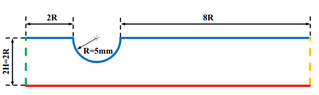
Geometry of the channel is on the photo.
How should I calculate the drop of static pressure across the channel?
Since I have Re, I did calculate a inlet velocity, but now I'm stuck.
Thanks
 

Attachments
  • channel.png
    channel.png
    2.7 KB · Views: 282
  • Like
Likes   Reactions: FluidDroog
on Phys.org
To do this, you need to solve the Naiver Stokes equations, probably numerically. To get a lower bound to the pressure drop, you can at least solve analytically for the case where you remove the constriction and have rectilinear flow between parallel plates.
 
  • Like
Likes   Reactions: FluidDroog
Hi Darcy30,

Was it intentional that your username would hint at the solution?

I understand the problem as follows:
  • Assume laminar, steady state, constant density (incompressible), fully developed flow.
  • Channel Geometry and Fluid Properties are known (I will assume the channel is circular)
  • The inlet velocity is known
Goal:
  • Find the pressure drop across a channel.
Solution Hint:
Darcy Friction Factor, Moody Diagram

Solution:

The pressure drop down a pipe is related to the friction factor.
For Laminar flow,
$$ f_D = \frac{64}{Re} $$
If not, then you will need to assume smooth walls or know the surface roughness.

The pressure drop is related to the following.
$$ dP = f_D * \frac{\rho*V^2*L}{2*D} $$
Break the problem into 3 sections. Inlet straight pipe, the circular restriction, and the outlet straight pipe. The inlet and outlet is straight forward. You will add up the dP for each section to find your answer.

The tricky part of this problem is that you need to integrate the friction factor (hence pressure drop) over the circular restriction. You need a formula for the relationship of Pipe Diameter, D, to length across the channel, x. Something like this:
$$ Dtube = 2 * R - R*sin(acos(R/x)) $$
Additionally, the velocity changes based on cross-sectional area. Use the conservation of mass to find that
$$ mdot = \rho*Area*Velocity $$
There is symmetry, so we only need to consider a 1/4 circle and multiply the friction factor by 2. Integrate from x = 0 to R. Or solve it numerically in a spreadsheet program with small steps of x.

PS: If the channel is indeed non-circular, then use the hydraulic diameter Dh in place of D.
$$ Dh = \frac {4*Area}{Perimeter} $$


References:
[1] Moody Diagram https://en.wikipedia.org/wiki/Moody_chart?msclkid=7b62d23aaee911ec823e165de974644a
[2] Hydraulic Diameter https://en.wikipedia.org/wiki/Hydraulic_diameter?msclkid=0899a52baef711ec890e442c37cca7b6
 
What is the exact statement of the problem?
 

Similar threads

  • · Replies 0 ·
Replies
0
Views
1K
  • · Replies 2 ·
Replies
2
Views
2K
  • · Replies 5 ·
Replies
5
Views
3K
Replies
4
Views
2K
Replies
1
Views
4K
  • · Replies 3 ·
Replies
3
Views
2K
  • · Replies 10 ·
Replies
10
Views
6K
  • · Replies 4 ·
Replies
4
Views
3K
  • · Replies 3 ·
Replies
3
Views
3K