How Do You Calculate the Cross Product for Torque in a Physics Problem?

  • Thread starter Thread starter whynot314
  • Start date Start date
Click For Summary

Homework Help Overview

The discussion revolves around calculating the cross product for torque in a physics problem, specifically focusing on the vectors involved and their components. The original poster is working on a problem related to torque and force vectors, with a particular emphasis on the correct setup for the cross product.

Discussion Character

  • Exploratory, Mathematical reasoning, Assumption checking

Approaches and Questions Raised

  • The original poster attempts to establish the vectors for torque and force but expresses uncertainty about the force vector's components. Some participants suggest evaluating the magnitude of the cross product and question the correctness of the vector setup for OA.

Discussion Status

Participants have provided feedback on the vector setup and the calculation process. There is acknowledgment of a mistake in the original poster's vector resolution, and some guidance has been offered regarding the correct approach to the cross product. However, multiple interpretations of the vectors and their components are still being explored.

Contextual Notes

The original poster converted measurements from inches to feet and is working under the constraints of a specific problem setup, including the use of angles in the force vector. There is an indication that the diagram referenced may influence the understanding of the vectors involved.

whynot314
Messages
76
Reaction score
0
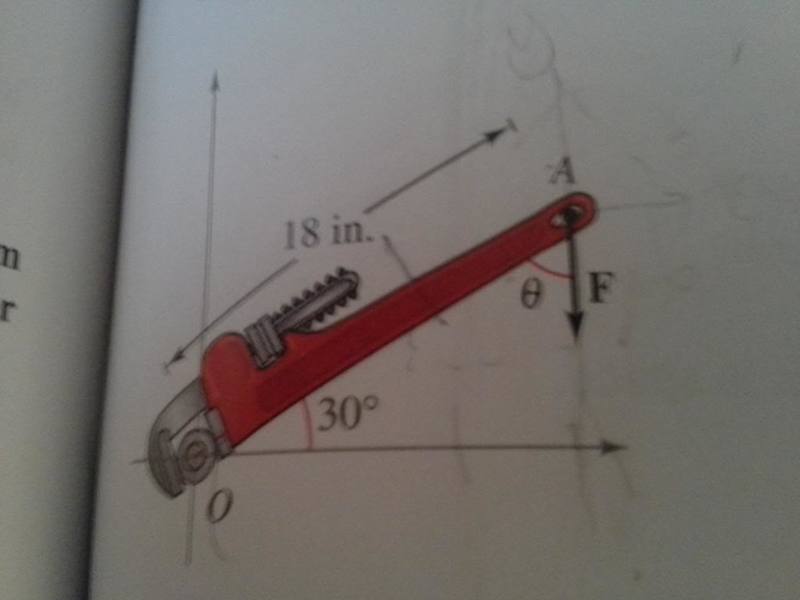
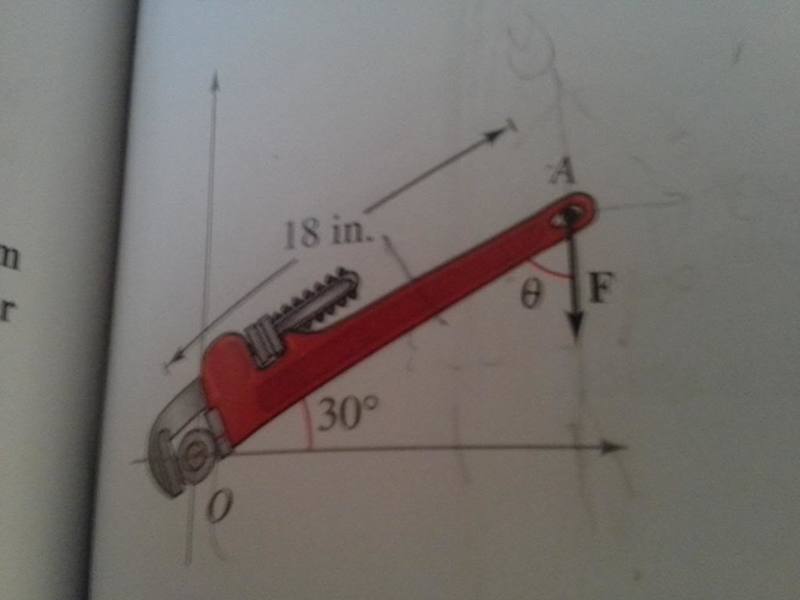
I just need help on 39 part a.
The answer to part a is 84sinθ
I first converted inches into feet.
I know how to set up the vector for the wrench which is simply OA= \frac{3\sqrt{3}}{4}i+\frac{3}{4}j
now as for the force vector I am kind of stuck because I know that Fsinθ is the only component to the force to cause rotation about O. so for F I get 0i and -56sinθ, when I do the cross product i get 42\sqrt{3}sinθ. I know i have the force part wrong I just can't see it.

[URL=http://s1341.photobucket.com/user/nebula-314/media/20130514_192552_zpsd6a49a82.jpg.html][PLAIN]http://i1341.photobucket.com/albums/o745/nebula-314/20130514_192552_zpsd6a49a82.jpg[/URL][/PLAIN]
20130514_192628_zps1dc1e90a.jpg
"]
20130514_192628_zps1dc1e90a.jpg
 
Physics news on Phys.org
You can evaluate | OA x F| as this is equal to

|OA x F| = |OA|*|F|*sinθ


Otherwise, I think you may have made a mistake in the vector for OA.
 
Yup that worked, with my OA.

I really wanted to know how to set up the cross product on this one, but that worked.


Thanks,
 
whynot314 said:
Yup that worked, with my OA.

I really wanted to know how to set up the cross product on this one, but that worked.


Thanks,

In that case, the reason you did not get the 84sinθ was due to the fact that you resolved your vectors in different directions (meaning that you used different coordinates).

As the diagram was |OA| = 1.5 ft and your unit vector would have been (sinθi+cosθj). Multiplying these two would have given your vector OA

Your vector F would have simply been F=-56j
 

Similar threads

  • · Replies 5 ·
Replies
5
Views
1K
  • · Replies 4 ·
Replies
4
Views
2K
Replies
2
Views
2K
Replies
9
Views
2K
Replies
3
Views
3K
  • · Replies 2 ·
Replies
2
Views
2K
  • · Replies 2 ·
Replies
2
Views
3K
Replies
1
Views
2K
  • · Replies 3 ·
Replies
3
Views
2K
  • · Replies 4 ·
Replies
4
Views
1K