How Do You Calculate Torque Around Point D in a Lever Setup?

Click For Summary

Discussion Overview

The discussion revolves around calculating torque around point D in a lever setup, specifically focusing on the forces acting at points A and B, and their relationship to the torque produced at the fulcrum. The scope includes conceptual understanding and mathematical reasoning related to torque in a mechanical system.

Discussion Character

  • Technical explanation
  • Mathematical reasoning
  • Debate/contested

Main Points Raised

  • One participant expresses uncertainty about calculating torque and questions whether the force at point A is also reflected in the BC member.
  • Another participant seeks clarification on whether member AB is fixed at the fulcrum or can slide, indicating a potential variable in the setup.
  • A later reply confirms that member AB is fixed on the pivot, which may influence the calculations of torque.
  • One participant proposes that the force in BC acts as a reaction force from the force at A, suggesting this is the force that creates torque at point D.

Areas of Agreement / Disagreement

Participants do not reach a consensus on the calculations or the implications of the setup, as there are varying interpretations of the forces involved and their effects on torque.

Contextual Notes

There are limitations regarding the assumptions made about the fixed nature of member AB and the specific conditions under which the torque is calculated, which remain unresolved.

Who May Find This Useful

This discussion may be useful for individuals interested in mechanical engineering, physics students studying torque and lever systems, or anyone looking to understand the dynamics of forces in a lever setup.

BatsDude
Messages
14
Reaction score
0
Hi guys,

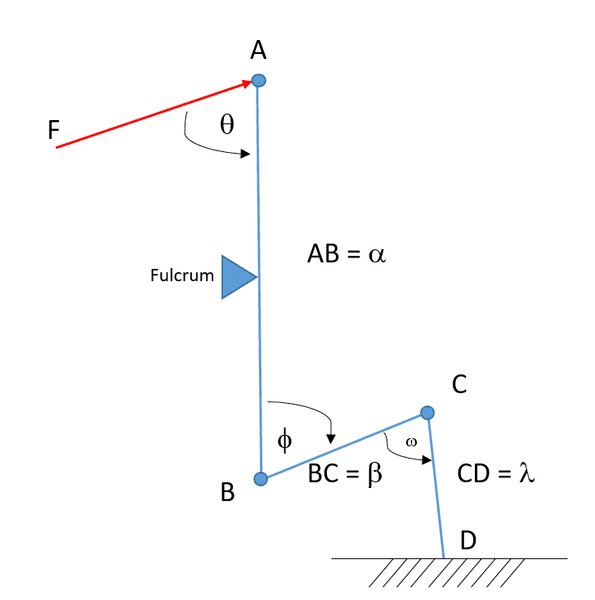
It's been a while since I've done much resolving forces stuff, and I'm struggling to make sure what I'm doing is right. I have a setup like below, and I want to find the torque around point D due to the force acting at point A.

I've had a couple attempts but I feel like I'm just guessing and I'm not sure if I'm correct.
I know the force acting at A produces a torque at the fulcrum of F*(alpha/2)*sin(theta) but is this the force that's also seen in the BC member? From what I understand, if I can find the force acting in the BC member, it should be easy to find the torque around point D.

Any help would be good! Thanks
SWs7w.png
 
Engineering news on Phys.org
This is a question about the problem: is AB fixed on the fulcrum (just pivot), or can it also slide up and down in relation to the fulcrum? It has been a little while for me, as well.
 
Hi,

It's fixed on the pivot. Apologies for the lack of detail!
 
For anyone playing along, I've got a solution.
The force in BC is the reaction force from F in a simple lever setup.
Then this is the force acting at the top of member CD which creates the torque.
 

Similar threads

  • · Replies 9 ·
Replies
9
Views
2K
Replies
7
Views
3K
  • · Replies 1 ·
Replies
1
Views
2K
  • · Replies 46 ·
2
Replies
46
Views
6K
Replies
2
Views
2K
  • · Replies 7 ·
Replies
7
Views
3K
Replies
5
Views
3K
Replies
2
Views
3K
  • · Replies 9 ·
Replies
9
Views
2K
Replies
3
Views
2K