How Do You Calculate Velocities from a Potential-Energy Diagram?

  • Thread starter Thread starter fsm
  • Start date Start date
  • Tags Tags
    Diagram
Click For Summary

Homework Help Overview

The discussion revolves around calculating velocities from a potential-energy diagram, specifically focusing on points labeled b, c, and d. The subject area is related to energy conservation principles in physics, particularly potential and kinetic energy.

Discussion Character

  • Exploratory, Conceptual clarification, Assumption checking

Approaches and Questions Raised

  • Participants discuss the interpretation of potential-energy diagrams and the application of conservation of mechanical energy. Questions arise regarding the nature of potential energy and its sources, as well as the implications of different scenarios, such as rolling objects.

Discussion Status

Some participants have provided guidance on interpreting energy changes and suggested using kinetic energy equations to find velocities. However, there are also questions about the completeness of the information provided and the potential variations in scenarios that could affect the calculations.

Contextual Notes

There is a mention of the mass of the particle and initial energy values, but the exact problem statement and context are not fully detailed. Participants express the need for more information to clarify the situation.

fsm
Messages
88
Reaction score
0
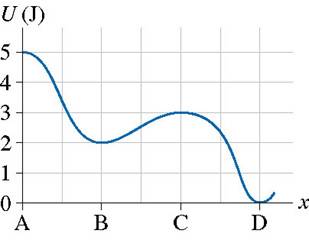
I am given a potential-energy diagram with the vertical axis is potential-energy and the horizontal axis is x. The mass of the particle is 500g.
knight_Figure_10_30.jpg


They are asking the velocities of b, c, and d. I am completely lost. I can't even find an example in the book. This isn't good :(
 
Physics news on Phys.org
The Homework Posting Template asks you to list what equations and principles apply to your problem. What can you say about changes in PE? What is the PE of a mass that is raised some height against the force of gravity?
 
If its not potential then what is it?
 
If what's not potential?

There are several different sources of PE, right? It can come from compression of a spring, or storing compressed air, or the form that I think the OP problem is referring to. But without the exact problem statement and context, it's hard to say.

fsm -- can you please post the exact text of the question, and maybe say what you are studying at the moment. And then offer some ideas about how to solve the problem.
 
Hi fsm,

U need to know how to interpret graphs and the conservation of mechanical energy to do this. Ok, initially, the total energy of the particle is 5J. At point B, it has lost some P.E. and what's left is 2J. Some of the P.E. has been converted into K.E. which is 3J. U know the mass of the particle (500g). U can use the equation K.E. = 1/2 mv² and solve for v. Do the same for points C and D. U should get the answers pretty fast.

Hope that helps.
 
NTUENG said:
Hi fsm,

U need to know how to interpret graphs and the conservation of mechanical energy to do this. Ok, initially, the total energy of the particle is 5J. At point B, it has lost some P.E. and what's left is 2J. Some of the P.E. has been converted into K.E. which is 3J. U know the mass of the particle (500g). U can use the equation K.E. = 1/2 mv² and solve for v. Do the same for points C and D. U should get the answers pretty fast.

Hope that helps.

Except, what if it's a ball rolling down an incline without slipping -- how does that change the velocity answer? And what would be different if it were a cylinder instead of a ball? We aren't given enough information by the OP to just say use 1/2mv^2.
 

Similar threads

  • · Replies 2 ·
Replies
2
Views
1K
  • · Replies 3 ·
Replies
3
Views
1K
Replies
1
Views
1K
  • · Replies 13 ·
Replies
13
Views
1K
  • · Replies 5 ·
Replies
5
Views
1K
  • · Replies 3 ·
Replies
3
Views
2K
  • · Replies 13 ·
Replies
13
Views
3K
  • · Replies 7 ·
Replies
7
Views
1K
  • · Replies 3 ·
Replies
3
Views
1K