Homework Help Overview
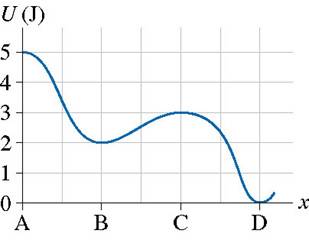
The discussion revolves around calculating velocities from a potential-energy diagram, specifically focusing on points labeled b, c, and d. The subject area is related to energy conservation principles in physics, particularly potential and kinetic energy.
Discussion Character
- Exploratory, Conceptual clarification, Assumption checking
Approaches and Questions Raised
- Participants discuss the interpretation of potential-energy diagrams and the application of conservation of mechanical energy. Questions arise regarding the nature of potential energy and its sources, as well as the implications of different scenarios, such as rolling objects.
Discussion Status
Some participants have provided guidance on interpreting energy changes and suggested using kinetic energy equations to find velocities. However, there are also questions about the completeness of the information provided and the potential variations in scenarios that could affect the calculations.
Contextual Notes
There is a mention of the mass of the particle and initial energy values, but the exact problem statement and context are not fully detailed. Participants express the need for more information to clarify the situation.