How Do You Compare Resistance in a Carbon Resistor and an LED Using a V-I Graph?

Click For Summary

Homework Help Overview

The discussion revolves around comparing the resistance of a carbon resistor and a light-emitting diode (LED) using their voltage-current (V-I) characteristics as represented in a graph. The original poster seeks to understand the resistance values and the relationship between the two components based on their graphical representation.

Discussion Character

  • Exploratory, Conceptual clarification, Mathematical reasoning

Approaches and Questions Raised

  • Participants discuss the linear behavior of the carbon resistor versus the non-ohmic behavior of the LED. There are attempts to calculate resistance values and questions about how to determine when the LED's resistance matches that of the carbon resistor. Some participants suggest using graphical methods, such as drawing tangents on the V-I curve, to analyze resistance at specific points.

Discussion Status

The discussion is ongoing, with participants providing insights into the nature of resistance in both components. There is mention of the need to clarify whether the resistance being referred to is static or dynamic, particularly for the LED. Suggestions for graphical analysis and the use of equations to find instantaneous resistance have been offered, but no consensus has been reached on the approach for part B of the problem.

Contextual Notes

There is a noted ambiguity regarding the definition of resistance for the LED, as participants question whether to consider static or dynamic resistance. Additionally, the original poster's approach to using a ruler and triangle on the graph indicates a reliance on graphical interpretation, which may be constrained by the information available in the diagram.

P1nkButt3rflys
Messages
16
Reaction score
0
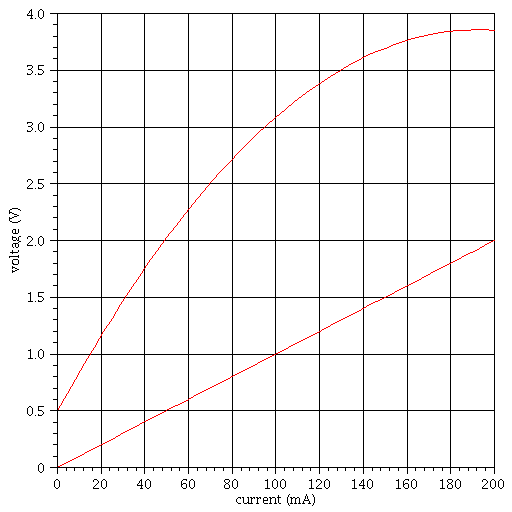
A) The graph shows V-I curves for two conductors. One is measured for a carbon resistor and obeys Ohm's law; the other is for a light-emitting diode (LED) and shows non-ohmic behaviour. What is the resistance of the carbon resistor?

B) For what value of current is the resistance of the LED the same as that of the carbon resistor? (Use a ruler and a triangle to draw on the diagram.)

I got the first portion. The carbon resistor is the linear line and the LED is the curved line. Using the graph I found R = 10 ohm for A. But cannot figure out how to solve B, any suggestions?
LED8.gif
 
Physics news on Phys.org
For the LED, you can find the resistance at a particular value of current and voltage with the equation ## R = \frac{V}{I} ## (note that this isn't the same as Ohm's Law -- it can only be used to find the the instantaneous resistance, and does not describe the resistance of the conductor at all values of the voltage).

Graphically, ## \frac{V}{I} ## is the slope of the graph, which you can find with tangent lines.
 
The slope of the curve defines its resistance at that region of operation. So draw tangents everywhere, to see how the slope changes.

For the carbon resistor, the tangents everywhere are the same, its resistance does not vary.
 
The prblem in (b) should have asked specifically for dynamic resistance. The LED "resistance" could equally well mean static resistance in which case the LED always has a larger resistance than the resistor. For example, an ohmmeter would measure static resistance = V/i at whatever the meter current i happens to be.
 

Similar threads

Replies
3
Views
2K
  • · Replies 3 ·
Replies
3
Views
1K
  • · Replies 10 ·
Replies
10
Views
3K
  • · Replies 60 ·
3
Replies
60
Views
10K
  • · Replies 5 ·
Replies
5
Views
3K
  • · Replies 7 ·
Replies
7
Views
7K
  • · Replies 9 ·
Replies
9
Views
3K
  • · Replies 12 ·
Replies
12
Views
7K
Replies
1
Views
2K
Replies
4
Views
2K