How Do You Derive the Full Energy Momentum Relation Using Lorentz Factor?

Click For Summary

Discussion Overview

The discussion revolves around the derivation of the full energy-momentum relation using the Lorentz factor. Participants are exploring the steps involved in manipulating expressions related to velocity, momentum, and the Lorentz factor, with a focus on resolving the terms correctly to arrive at the desired relation.

Discussion Character

  • Exploratory
  • Mathematical reasoning
  • Homework-related

Main Points Raised

  • One participant expresses difficulty in deriving the full energy-momentum relation, specifically in solving for (u/c)^2 and substituting it into the Lorentz factor.
  • Another participant points out that having a 'u' in the expression indicates that the participant has not fully solved for (u/c)^2.
  • Further clarification is provided that the participant needs to isolate u^2/c^2 in their calculations.
  • Hints are offered to guide the participants toward the correct manipulation of the equations, including a suggestion to solve for u^2 directly.
  • One participant acknowledges the complexity of the derivation and expresses intent to simplify their approach.
  • A later reply indicates a sense of accomplishment upon finally understanding the derivation process.

Areas of Agreement / Disagreement

Participants generally agree on the need to correctly isolate (u/c)^2 in the derivation process, but there is no consensus on the specific steps or methods to achieve this, as multiple approaches are discussed.

Contextual Notes

Some participants express confusion regarding the presence of 'u' in their expressions, indicating potential misunderstandings in the derivation steps. The discussion reflects varying levels of familiarity with the mathematical manipulations required.

Who May Find This Useful

Students and enthusiasts of physics, particularly those interested in special relativity and the mathematical foundations of energy-momentum relations.

Glenn G
Messages
113
Reaction score
12
Hi community,
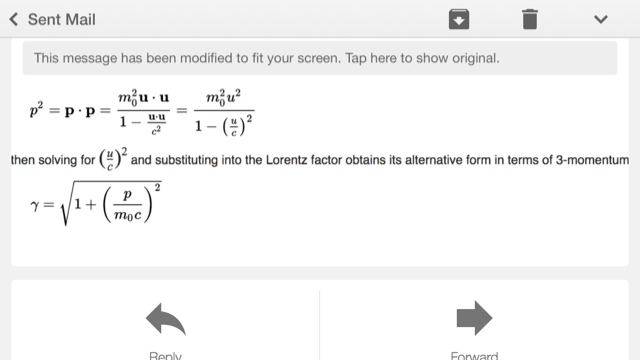
There is a step on the wiki page about a derivation.
IMG_1485326064.992430.jpg

I don't seem to get the same thing when I try and solve for (u/c)^2 and then plug into Lorentz factor to get the new Lorentz factor so you can get the full energy momentum relation

My gamma term looks more like 1/ ((mo^2u^2/p^2))^-1/2 when I've subbed for (u/c)^2??

Can anyone help or any other resources to show easy as poss how to derive the full equation?
Thanks
G.
 
Physics news on Phys.org
If you have a u left in your expression you have not solved for (u/c)^2 ...
 
I rearranged the top expression and made (u/c)^2 the subject but then you still have the u^2 that was in the numerator of the momentum expression? Confused.
 
Yes, so you have not solved for u^2/c^2. You need to actually solve for u^2/c^2.

Edit: Hint: Solve for u^2. The speed of light is just a constant.
 
IMG_1485332435.532491.jpg

I got this far and became a bit convoluted. Will try for u^2 then.
Thanks.
G.
 
Hint:
$$
1 = \frac{m^2 c^2 + p^2}{m^2 c^2 + p^2}
$$
...
 
  • Like
Likes   Reactions: Glenn G
Ooh, that's cheeky. I'll have another play this evening, thanks Orodruin.
 
Got it finally, quite satisfying ...
 

Similar threads

  • · Replies 8 ·
Replies
8
Views
2K
  • · Replies 31 ·
2
Replies
31
Views
3K
  • · Replies 6 ·
Replies
6
Views
1K
  • · Replies 18 ·
Replies
18
Views
2K
  • · Replies 13 ·
Replies
13
Views
1K
  • · Replies 19 ·
Replies
19
Views
3K
  • · Replies 33 ·
2
Replies
33
Views
3K
  • · Replies 22 ·
Replies
22
Views
3K
  • · Replies 1 ·
Replies
1
Views
1K
  • · Replies 36 ·
2
Replies
36
Views
5K