How Do You Determine if Resistors Are in Parallel or Series?

  • Thread starter Thread starter devcat
  • Start date Start date
  • Tags Tags
    Resistor
Click For Summary

Homework Help Overview

The discussion revolves around determining whether resistors in a circuit are connected in series or parallel. Participants explore the definitions and characteristics of nodes in electrical circuits, as well as the implications of current flow and voltage across resistors.

Discussion Character

  • Conceptual clarification, Assumption checking, Problem interpretation

Approaches and Questions Raised

  • Participants discuss the criteria for identifying series and parallel connections, including the role of nodes and current flow. Questions arise about the meaning of nodes and how they relate to resistor configurations.

Discussion Status

There is an ongoing exploration of the definitions of nodes and their significance in determining resistor connections. Some participants provide clarifications and examples, while others question the assumptions made about the circuit configurations presented.

Contextual Notes

Participants are working with specific circuit diagrams, and there is mention of potential confusion regarding the arrangement of resistors. The discussion includes references to images and the need for accurate representation of the circuit to understand the relationships between resistors.

devcat
Messages
4
Reaction score
0
How can i determine resistors are connected in parallel or in series?
By current or potential.difference?
The following are some complicated example..
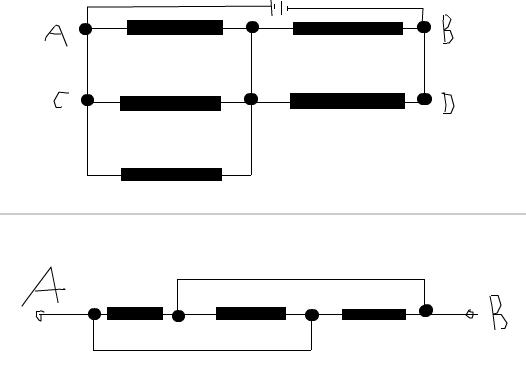
2855463590_10a0ba3e0e_o.jpg
 
Physics news on Phys.org
Resistors are in parallel when they share the same nodes. They are in series when the same current flows through each.
 
Hey thanks! What's the meaning of nodes?
 
its a branching point
 
A node is where two or more circuit elements meet, so the voltage at every point in a node will be the same.

Ive taken this image from wikipedia, but its a pretty good image for describing what nodes are:

http://upload.wikimedia.org/wikipedia/en/thumb/9/95/Nodes2.svg/427px-Nodes2.svg.png

Basically, each of the three colours form a node each.

In your first image, can you see how there are three nodes? Each resistor is connected to two nodes, one at each terminal. If two resistors are in parallel, then they are both connected to the same two nodes.
 
Last edited by a moderator:
danago said:
A node is where two or more circuit elements meet, so the voltage at every point in a node will be the same.

Ive taken this image from wikipedia, but its a pretty good image for describing what nodes are:

Basically, each of the three colours form a node each.

In your first image, can you see how there are three nodes? Each resistor is connected to two nodes, one at each terminal. If two resistors are in parallel, then they are both connected to the same two nodes.
2854681353_0df17c6ff8_o.jpg

In the picture above
R3 & R4 are in parallel
R1 & R2 are in series
When resistor are not in parallel, Are they must be in series?
Thanks so much!
 
Last edited by a moderator:
devcat said:
2854681353_0df17c6ff8_o.jpg

In the picture above
R3 & R4 are in parallel
R1 & R2 are in series
When resistor are not in parallel, Are they must be in series?
Thanks so much!

Yep R3 and R4 are in parallel.

If resistors are not in parallel, it does not necessarily mean they must be in series. R1 and R2 are not in series. If there was a current coming out of the left of R2, it would split up at that junction, so not all of the current through R2 would go through R1, some would go through the voltage source.
 
danago said:
Yep R3 and R4 are in parallel.

If resistors are not in parallel, it does not necessarily mean they must be in series. R1 and R2 are not in series. If there was a current coming out of the left of R2, it would split up at that junction, so not all of the current through R2 would go through R1, some would go through the voltage source.
R3 and R4 are in parallel , do their Voltage equals to the cell?
Or the voltage of RED and BLUE nodes are the same?
2855573854_6697668f95_o.jpg

Secondly,In picture above, it seem current would split up in Junction X and Y
however the answer is two resistor in series.Why?
 
The red and blue nodes are at different voltages.

Have you drawn the diagram correctly? I wouldn't have thought there were any in series.
 
  • #10
He meant to say there the problem may be reduced to 2 equivalent resistors in series, which is correct. For the second one, I suggest you denote one node by VA and the other by VB. Then trace out all the possible paths between VB and VA. You'll find that it reduces to a single configuration.

EDIT: danago, I think you're looking at the wrong circuit. He was referring to his, not the Wikipedia one.
 

Similar threads

  • · Replies 3 ·
Replies
3
Views
940
Replies
10
Views
2K
Replies
20
Views
2K
  • · Replies 1 ·
Replies
1
Views
2K
Replies
2
Views
2K
Replies
3
Views
2K
Replies
2
Views
1K
  • · Replies 4 ·
Replies
4
Views
2K
  • · Replies 3 ·
Replies
3
Views
1K
Replies
5
Views
2K