How Do You Determine Net Charge Through a Wire Over Time?

  • Thread starter Thread starter snoggerT
  • Start date Start date
  • Tags Tags
    Charge Net Wire
Click For Summary
SUMMARY

The discussion centers on determining the net charge passing through a wire over time by analyzing current plots. The relationship between current (i) and charge (dq) is defined by the equation i = dq/dt. Participants conclude that to find the net charge for each time period, one must integrate the current over the respective time intervals. This method provides a definitive ranking of net charge for the specified periods.

PREREQUISITES
  • Understanding of basic electrical concepts, specifically current and charge.
  • Familiarity with calculus, particularly integration techniques.
  • Knowledge of the relationship between current and charge as expressed in the equation i = dq/dt.
  • Ability to interpret graphical data representing current over time.
NEXT STEPS
  • Study the fundamentals of electrical charge and current in circuits.
  • Learn integration techniques for calculating area under curves in physics.
  • Explore practical applications of current and charge in electrical engineering.
  • Review examples of integrating current functions to determine total charge over time.
USEFUL FOR

Students in physics or electrical engineering, educators teaching circuit theory, and professionals analyzing electrical systems.

snoggerT
Messages
183
Reaction score
0
The figure below shows plots of the current i through a certain cross section of a wire over four different time periods. Rank the periods according to the net charge that passes through the cross section during the period, greatest first. (Use only the symbols > or =, for example a>b=c>d.)
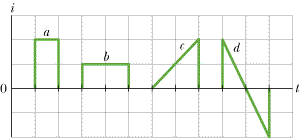
hrw7_26-16.gif


i=dq/dt


The Attempt at a Solution


- I'm really not sure how to start this problem. I tried taking the charge and dividing it by the time for each one, but that didn't work. Would you have to do the integrals for them? Seems like this should be a very simple problem.
 
Physics news on Phys.org
Sure. Integrate current over time. That's charge.
 

Similar threads

  • · Replies 1 ·
Replies
1
Views
1K
  • · Replies 1 ·
Replies
1
Views
2K
Replies
8
Views
2K
Replies
2
Views
4K
  • · Replies 36 ·
2
Replies
36
Views
7K
Replies
3
Views
3K
  • · Replies 15 ·
Replies
15
Views
2K
Replies
3
Views
4K
Replies
5
Views
6K
  • · Replies 4 ·
Replies
4
Views
2K