chwala
Gold Member
- 2,842
- 428
- Homework Statement
- See attached.
- Relevant Equations
- Limits
Consider the series below;
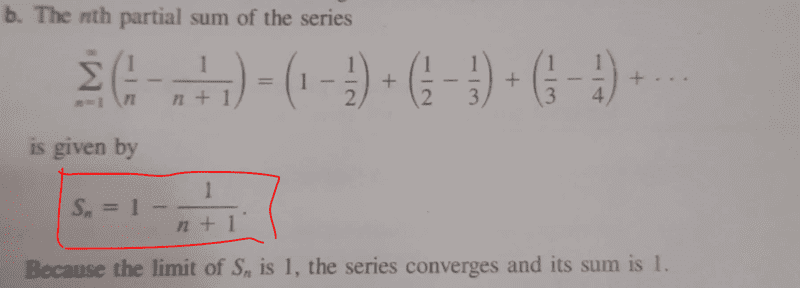
From my own calculations, i noted that this series can also be written as ##S_n##=##\dfrac {3}{8}##⋅##\dfrac {4^n}{3^n}##. If indeed that is the case then how do we find the limit of my series to realize the required solution of ##1## as indicated on the textbook? I tried taking limits...L Hopital's rule... and still got ##∞## implying divergence. Are we required to solely maintain the series in the pattern indicated on the text and not any other way?
In other words, if one was given a specific question to find the limit of my series ##S_n##=##\dfrac {3}{8}##⋅##\dfrac {4^n}{3^n}##in an exam, then would it be correct to state ##∞##?
From my own calculations, i noted that this series can also be written as ##S_n##=##\dfrac {3}{8}##⋅##\dfrac {4^n}{3^n}##. If indeed that is the case then how do we find the limit of my series to realize the required solution of ##1## as indicated on the textbook? I tried taking limits...L Hopital's rule... and still got ##∞## implying divergence. Are we required to solely maintain the series in the pattern indicated on the text and not any other way?
In other words, if one was given a specific question to find the limit of my series ##S_n##=##\dfrac {3}{8}##⋅##\dfrac {4^n}{3^n}##in an exam, then would it be correct to state ##∞##?
Last edited:
