How Do You Find the Sum of Moments at an Angle?

  • Thread starter Thread starter k31453
  • Start date Start date
  • Tags Tags
    Moments Sum
Click For Summary
SUMMARY

The discussion focuses on calculating the sum of moments at an angle in static equilibrium exercises. Participants emphasize the importance of understanding how to find the moment contributed by a force, which involves multiplying the force by the perpendicular distance to its line of action. Key assumptions include the weight of the boom being located at its midpoint and the need for trigonometric skills to resolve angles. The conversation highlights the necessity of having complete problem statements and diagrams to facilitate accurate calculations.

PREREQUISITES
  • Static equilibrium principles
  • Understanding of moments and torque
  • Basic trigonometry
  • Ability to interpret diagrams in physics problems
NEXT STEPS
  • Study the concept of torque in static equilibrium
  • Learn how to resolve forces into components using trigonometry
  • Practice problems involving moments with varying angles
  • Explore the role of assumptions in physics problem-solving
USEFUL FOR

Students studying physics, particularly those focusing on static equilibrium and mechanics, as well as educators looking for teaching resources on moments and torque calculations.

k31453
Messages
58
Reaction score
0
How to Take the sum of moments !

Homework Statement


Hi i am doing static equilibrium exercises in textbook.


Homework Equations


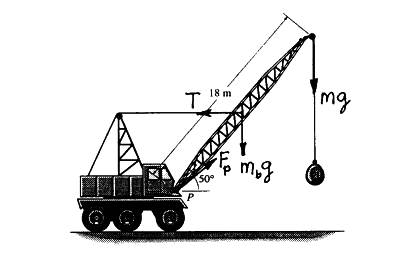
But I don't know how to find sum of moments at P when its come to angle.
This is a drawing
Untitled.png


The Attempt at a Solution


I have No idea ! I was trying to get my head around But still can't Do it !
 
Physics news on Phys.org
Well, the diagram attached to the OP doesn't contain enough information anyway. Is there problem text which accompanies the diagram which you haven't supplied? Or are you to assume that the weight of the boom is located at half its length from point P?
 
A couple of reasonable assumptions seem in order here.

To find the moment that a force contributes, you multiply the force by the perpendicular distance to the line of action of that force. So you have the opportunity to demonstrate your skill with trigonometry here. :wink:
 
Last edited:
What Nascent said.

Making reasonable assumptions it seems possible to calculate T. For example T appears to be connected roughly half way up the boom. There is enough info to calculate the perpendicular distances that Nascent refers to. I would assume the boom is very light weight compared to the wrecking ball.
 
Yes, the centre of mass at mid weight and pivot at p.
 
Are you still stuck?
 

Similar threads

Replies
19
Views
1K
Replies
9
Views
2K
Replies
4
Views
2K
  • · Replies 4 ·
Replies
4
Views
1K
Replies
1
Views
2K
  • · Replies 6 ·
Replies
6
Views
2K
Replies
3
Views
2K
Replies
3
Views
1K
Replies
8
Views
3K