How do you indicate transient terms when y just equals 1 ?

  • Level: Undergrad 
  • Thread starter Jeff12341234
  • Start date
  • Tags Tags
    Terms Transient
2 replies · 2K views · last reply
Jeff12341234
Messages
179
Reaction score
0
how do you "indicate transient terms" when y just equals 1 ?

t is the dependent variable in this problem and I'm told to "indicate transient terms". Well, t=1 so is this a trick question or did I do something wrong?
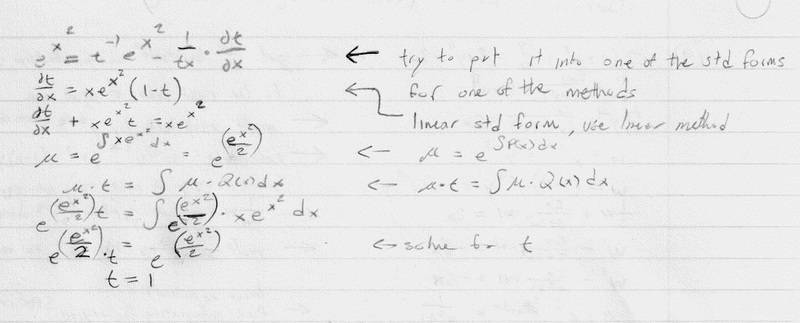
Handwritten derivation solving a first-order ODE: dt/dx = xe^(x^2)(1-t) rearranged to linear form, integrating factor mu = e^(x^2/2), mu·t = integral of mu·2x e^(x^2) dx, ending with t = 1.
 
Last edited:


You seem to have forgotten the "constant of integration". t= 1 is one function satisfying this equation. There are others, involving terms that go to 0 as t goes to infinity.


ok, so t = 1 + c
or t = 1 + c/μ ?
Because the c term should've actually been introduced on the 2nd to last line. If that's true, that e^((e^x^2)/2) function should've also been divided by c when solving for t.
 
Last edited: