How Do You Solve a Complex Energy Pulley Problem?

Join the discussion
Ask a follow-up here, or get your own question answered by working scientists, mathematicians and engineers — people, not an autocomplete.
Real named experts · corrections over time · the nuance an AI answer skips
9 replies · 2K views
Cade Kingston
Messages
6
Reaction score
0
Member advised to use the homework template for posts in the homework sections of PF.
1.
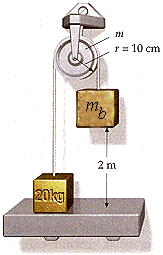
9_47alt.gif

The mb = 25 kg block is 2 m above the ledge. The pulley is a uniform disk with a radius of 10 cm and mass m = 4 kg.

2. (a) Find the speed of the 25 kg block just before it hits the ledge.
(b) Find the angular speed of the pulley at that time.
(c) Find the tensions in the strings.
(d) Find the time it takes for the 25 kg block to reach the ledge. Assume that the string does not slip on the pulley.


3. I know that you are supposed to set up a system of equations with net force and net torque:
20a = T1-20(9.8)
25a = 25(9.8)-T2
.5(4)a=T
 
on Phys.org
Cade Kingston said:
1.
9_47alt.gif

The mb = 25 kg block is 2 m above the ledge. The pulley is a uniform disk with a radius of 10 cm and mass m = 4 kg.

2. (a) Find the speed of the 25 kg block just before it hits the ledge.
(b) Find the angular speed of the pulley at that time.
(c) Find the tensions in the strings.
(d) Find the time it takes for the 25 kg block to reach the ledge. Assume that the string does not slip on the pulley.


3. I know that you are supposed to set up a system of equations with net force and net torque:
20a = T1-20(9.8)
25a = 25(9.8)-T2
.5(4)a=T
I just don't know how to get a without knowing T
 
vela said:
What's T supposed to represent? I figure T1 and T2 are the tensions in the strings, but what's T? Could you also explain how you got the last equation?
Net Torque equation is Force*radius=Inertia*alpha
Inertia for a disk is 1/2MR^2 and because there is no slipping a=r*alpha which means alpha=a/r, so:
1/2MR^2*a/R=T*R
The R's cancel out leaving 1/2Ma=T
Plug the info in and you have .5*4*a=T
That is how I got that but I created this thread because I'm not sure that is right.
I don't know if T1 and T2 are supposed to be equal.
T is supposed to be tension force exerted perpendicular to the pulley, but I don't know if it is supposed to be equal to both T1 and T2
 
vela said:
T1 and T2 aren't equal because the pulley has mass. I'm still not sure what T is supposed to represent other than it's some force.

The two tensions act on the pulley. What are the torques exerted by them?
T is supposed to be the Tension force exerted perpendicularly to the pulley, but I don't know how to find it
 
vela said:
That phrase doesn't have much meaning. Can you answer my question about the torques exerted by T1 and T2? That might answer your question.
I think I know what you are saying now.
Net Torque=T2*R-T1*R
Right?
But I have no idea how to find the force of each tension so I don't know how to find their respective torques
 
vela said:
Looks good. (I'm assuming you're using the right sign convention.) That's what you set equal to ##I\alpha##. It looks like you should be on your way to an answer.
I ended up with the right answers. Thanks for the quick responses. You really helped me reason through it. Appreciate it.