Homework Help Overview
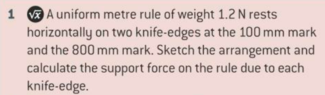
The discussion revolves around solving equilibrium problems using moments, specifically focusing on the application of forces and the balance of moments in a static system.
Discussion Character
- Exploratory, Conceptual clarification, Mathematical reasoning
Approaches and Questions Raised
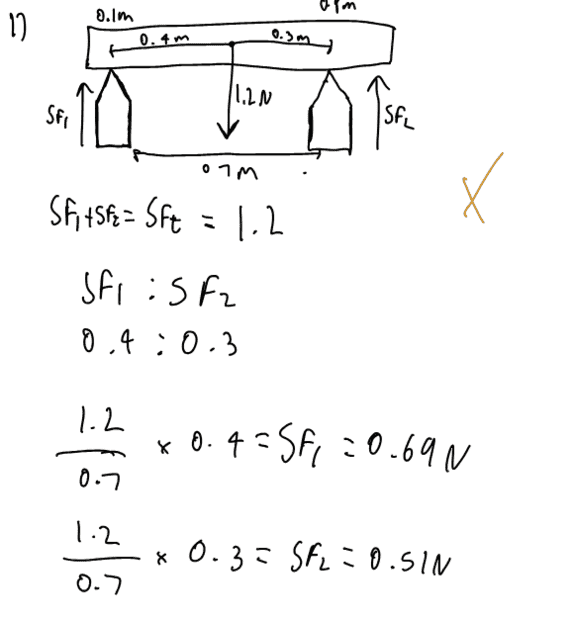
- Participants explore the relationship between support forces and distances, questioning the proportionality of ratios involved. There are discussions about the need for multiple equations to solve for unknown forces and the significance of choosing reference points for moments.
Discussion Status
Participants have shared insights and clarifications regarding the setup of the problem, including the importance of the sum of moments being zero in equilibrium situations. Some guidance has been provided on how to approach the problem, particularly regarding the use of reference points to simplify calculations.
Contextual Notes
There is an emphasis on the necessity of two equations to solve for the two unknown support forces, and participants are reflecting on their understanding of the concepts involved in static equilibrium.