How does a magnetic field induce an electric current?

Click For Summary
SUMMARY

The discussion centers on the phenomenon of electromagnetic induction, specifically how a magnetic field induces an electric current in a wire. When a wire moves through a magnetic field, the magnetic force acts on the charges within the wire, causing them to move. The right-hand rule is applied to determine the direction of this force. Additionally, the conversation highlights the concept of Eddy Currents, which occur in alternating magnetic fields and can lead to inefficiencies in certain applications, such as in induction heating where circular paths of current are formed.

PREREQUISITES
  • Understanding of electromagnetic induction principles
  • Familiarity with the right-hand rule in physics
  • Knowledge of Eddy Currents and their implications
  • Basic concepts of electric current and charge movement
NEXT STEPS
  • Research the principles of electromagnetic induction in detail
  • Study the right-hand rule and its applications in electromagnetism
  • Explore the effects and management of Eddy Currents in electrical systems
  • Investigate the applications of induction heating and its efficiency challenges
USEFUL FOR

Students of physics, electrical engineers, and anyone interested in understanding the principles of electromagnetic induction and its practical applications in technology.

Biker
Messages
416
Reaction score
52
Trying to understand how a magnetic field induces an electric current

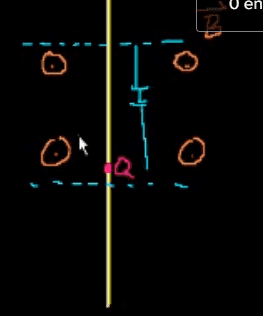
Suppose you have a wire in the magnetic field like this:
f9a41f03929f4964a30fe4895ffcb5e1.png

If you move the wire with a velocity of V to the left. Then the magnetic field should exert a force on the wire which ultimately on the charges in the wire. According to the right hand rule, It should be to the top of the page.

From what I learned particles in magnetic field move in circular or spiral path ( not sure if there is more).. So let's go back to our case. The charges should have a circular path not in a straight line. So how is a current produced with a circular motion moving charges?
 
Physics news on Phys.org
There are many diagrams about this (http://www.electrical4u.com/fleming-left-hand-rule-and-fleming-right-hand-rule/).
Biker said:
Then the magnetic field should exert a force on the wire which ultimately on the charges in the wire.
This is the wrong way round, actually. The movement and the field primarily cause the charges to be deflected. Because the wire is the only path they can take, they go in a straight line but they would move on a circular path if they were free to move.
The Eddy Currents that occur when an alternating field is applied to a metal (saucepan over an induction hob, for instance) do actually go in circular paths. In most other instances, this is a disadvantage and lumps of metal are often split up into laminations to suppress the formation of these eddy currents.
 
  • Like
Likes   Reactions: Biker

Similar threads

  • · Replies 6 ·
Replies
6
Views
2K
  • · Replies 7 ·
Replies
7
Views
2K
  • · Replies 4 ·
Replies
4
Views
2K
  • · Replies 22 ·
Replies
22
Views
2K
  • · Replies 2 ·
Replies
2
Views
2K
  • · Replies 9 ·
Replies
9
Views
4K
  • · Replies 1 ·
Replies
1
Views
2K
  • · Replies 11 ·
Replies
11
Views
3K
  • · Replies 3 ·
Replies
3
Views
2K
  • · Replies 6 ·
Replies
6
Views
2K