How Does Angular Momentum Remain Conserved in a Merry-Go-Round System?

  • Thread starter Thread starter Benjamin_harsh
  • Start date Start date
Join the discussion
Ask a follow-up here, or get your own question answered by working scientists, mathematicians and engineers — people, not an autocomplete.
Real named experts · corrections over time · the nuance an AI answer skips
8 replies · 3K views
Benjamin_harsh
Messages
211
Reaction score
5
Homework Statement
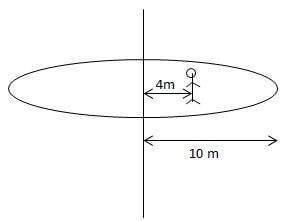
A 500kg merry go round with a radius of 10m is moving at a speed of 0.5 rad\sec. A 40kg child jumps on the merry-go-round at a position of 4m away from the center of rotation. (a) What is the inertia of the merry-go-round? (b) What is the inertia of the child on the merry-go-round? (c) What is the final speed of the merry-go-round when the child jumps on it?
Relevant Equations
##L_{0} = L_{f}##
Sol:
246243


a) inertia of the merry-go-round(disc) = ##\large\frac{1}{2} \normalsize MR^{2} = \large\frac{1}{2}\normalsize(500)(10^{2}) = 25000 kgm^{2}##
b) inertia of the child who jumped on the merry-go-round = ##MR^{2} = (40)42 = 640 kgm^{2}##
c) final speed of the merry-go-round when the child jumps on it: ##L_{0} = L_{f}##
##I_{M}ω_{0} = I_{C+M}ω_{F}##
##25000(0.5) = 25640.ω_{F}##
##ω_{F} = 0.488 rad\sec##

How ##L_{0} = L_{f}##?
 
on Phys.org
Orodruin said:
Regardless, as long as there is no external torque, angular momentum is conserved.

How can you tell external torque didn't exist ?
 
Benjamin_harsh said:
How can you tell external torque didn't exist ?
Children's merry-go-rounds are designed to be able to spin for a while with no one pushing. The event of the child landing on the merry-go-round will be have a brief duration. Brief enough that any external torque will not have time to significantly change the angular momentum.

There is also an assumption that the bearings are good -- that the momentary load of a child landing on the merry-go-round will not cause them to seize up. In my experience with merry-go-rounds, that assumption is justified.
 
jbriggs444 said:
Brief enough that any external torque will not have time to significantly change the angular momentum.

If external torque have time to significantly change the angular momentum. Then what formula should I use?
Will parallel axis theorem taken into consideration?
 
Benjamin_harsh said:
If external torque have time to significantly change the angular momentum. Then what formula should I use?
Will parallel axis theorem taken into consideration?
Start with Newton's second law for angular acceleration:
$$\tau=I\alpha$$ Where ##\tau## is the total external torque, ## I## is the moment of inertia of the object subject to that torque. and ##\alpha## is the resulting angular acceleration in radians per second squared.

Then time figures in because, for a constant external torque:
$$\omega=\omega_0+\alpha t$$ Where ##\omega_0## is the initial angular velocity in radians per second, ##\alpha## is the angular acceleration, ##t## is the elapsed time and ##\omega## is the resulting angular velocity.

If the interval under consideration is sufficiently brief, ##t## is nearly zero and the resulting change in angular velocity is negligible.
 
What is the meaning of this line "If the interval under consideration is sufficiently brief "?
 
jbriggs444 said:
The event of the child landing on the merry-go-round will be have a brief duration. Brief enough that any external torque will not have time to significantly change the angular momentum.
Since the child jumps on, the child's momentum is all that matters, regardless of how the momentum transfer spreads over time.
Yes, the question should have specified that the child jumped on radially.
 
Benjamin_harsh said:
What is the meaning of this line "If the interval under consideration is sufficiently brief "?
It depends on the accuracy you care about.

A typical child's merry-go round will spin down from a reasonable speed to a dead stop over a period of perhaps sixty seconds. A typical child will land on a merry-go-round and come to a relative stop in perhaps one quarter of a second. [Or less. In one personally memorable incident I think the merry-go-round was spinning at nearly 2pi radians per second with myself standing/walking in the center. The ensuing interaction was brief but educational]

We are working with inputs that have one significant figure. Roughly speaking, the external torque on the merry-go-round would need to increase about ten-fold before becoming significant.

In any case, this is a homework problem. We have not been given any information with which to quantify an external torque and we have good reason to expect it to be irrelevant. So accounting for a hypothetical external torque must not be expected of us.
 
Last edited: