How Does Euler's Theorem Apply to Complex Eigenvalues in Differential Equations?

  • Thread starter Thread starter FocusedWolf
  • Start date Start date
  • Tags Tags
    Theorem
Click For Summary
SUMMARY

The discussion focuses on the application of Euler's Theorem to complex eigenvalues in differential equations, specifically addressing the substitution of -t for t in the context of eigenvectors. The author references two images that illustrate the theorem's application, emphasizing the identity sin(-t) = -sin(t) as a critical component. The term "Euler's theorem with -t substituted for t" is proposed for this specific application, raising the question of whether it requires a distinct name. The conversation highlights the importance of understanding these substitutions in solving differential equations involving complex eigenvalues.

PREREQUISITES
  • Understanding of differential equations
  • Familiarity with eigenvalues and eigenvectors
  • Knowledge of Euler's Theorem
  • Basic trigonometric identities, particularly sin(-t) = -sin(t)
NEXT STEPS
  • Study the implications of Euler's Theorem in complex analysis
  • Explore the derivation and applications of eigenvectors in differential equations
  • Learn about the role of trigonometric identities in solving differential equations
  • Investigate advanced topics in linear algebra related to complex eigenvalues
USEFUL FOR

Students and professionals in mathematics, particularly those studying differential equations, linear algebra, and complex analysis, will benefit from this discussion.

FocusedWolf
Messages
81
Reaction score
0
Ok, in my differential equation book, we're doing work on getting eigenvectors to complex eigenvalues.

anyway the author of the book only mentions Euler's Theorem as: http://rogercortesi.com/eqn/tempimagedir/eqn5095.png
and so he perfers to work with http://rogercortesi.com/eqn/tempimagedir/eqn7868.png when the roots are

eqn3362.png


So my question:

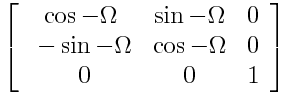
What is this called then?:

eqn9909.png

and can i use in place for
eqn4478.png
and still call it Euler's Theorem?
 
Last edited by a moderator:
Physics news on Phys.org
It's called "Euler's theorem with -t substituted for t after applying the identity sin(-t)=-sin(t)". Does it really need a name?
 
Thx for that. I was sort of expecting some kind of identity to do that.
 
Last edited:

Similar threads

  • · Replies 2 ·
Replies
2
Views
2K
  • · Replies 1 ·
Replies
1
Views
2K
  • · Replies 27 ·
Replies
27
Views
2K
  • · Replies 7 ·
Replies
7
Views
2K
Replies
3
Views
2K
Replies
4
Views
4K
  • · Replies 7 ·
Replies
7
Views
3K
  • · Replies 21 ·
Replies
21
Views
4K
  • · Replies 3 ·
Replies
3
Views
2K