Friction Questions: How Does a Car Turn?

  • Context: Undergrad 
  • Thread starter Thread starter gracy
  • Start date Start date
  • Tags Tags
    Car Friction
Click For Summary

Discussion Overview

The discussion revolves around the concepts of friction and motion, particularly in the context of how a car turns and the forces involved. Participants explore the dynamics of friction when objects are in motion, the conditions under which different types of friction occur, and the implications of applied forces on the direction of motion.

Discussion Character

  • Exploratory
  • Technical explanation
  • Conceptual clarification
  • Debate/contested

Main Points Raised

  • One participant expresses confusion over the relationship between the direction of applied forces and the direction of friction, suggesting a contradiction in the explanation provided in a previous post.
  • Another participant emphasizes the importance of accurately depicting the path of motion to determine the direction of dynamic friction, indicating that the diagram may not represent the situation correctly.
  • A participant questions if their diagram would be correct if it illustrated the moment when the applied force becomes significant enough to affect motion.
  • There is a discussion about friction, with one participant stating that if two blocks are moving with the same velocity, there should be no relative motion and thus no friction, while others clarify that static friction may still exist in this scenario.
  • Participants discuss the distinction between dynamic (kinetic) friction and static friction, noting that static friction can occur even when objects are moving together without relative motion.
  • One participant provides an example involving two blocks, explaining that static friction can exist if one block is accelerating while the other moves along with it, despite both blocks having the same speed.

Areas of Agreement / Disagreement

Participants do not reach a consensus on the interpretation of friction in the context of moving objects. Multiple viewpoints are presented regarding the conditions under which different types of friction apply, and the discussion remains unresolved.

Contextual Notes

There are limitations in the clarity of diagrams and descriptions provided by participants, which may affect the understanding of the dynamics involved. The discussion also highlights the dependence on definitions of friction and relative motion.

gracy
Messages
2,486
Reaction score
83
https://www.physicsforums.com/threads/friction-questions-how-does-a-car-turn.150321/
I have a doubt regarding the following line of post 6 of the above particular thread According to below lines of the mentioned post
The applied force will accelerate the box towards the north, so it will move in a curve. The friction force is always along the tangent to that curve and opposite to the direction the box is moving. So the component of friction force in the south direction will increase and the component in the west direction will decrease.
the diagram would be
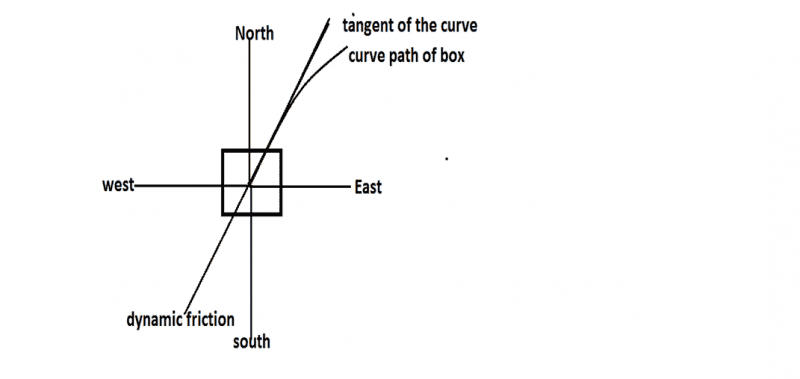
upload_2015-3-25_0-16-27.png


But the below lines of the very same post
If your box is moving east, the dynamic friction force is towards the west. If you suddenly apply a force towards the north at time t=0, the dynamic friction force at t=0 will still be towards the west.
Are contradictory of my diagram this is my opinion ,I think I am wrong I am missing something.Please guide me.
 

Attachments

  • upload_2015-3-25_0-11-5.png
    upload_2015-3-25_0-11-5.png
    9.4 KB · Views: 485
  • upload_2015-3-25_0-15-13.png
    upload_2015-3-25_0-15-13.png
    47.4 KB · Views: 576
Physics news on Phys.org
gracy said:
the diagram would be
upload_2015-3-25_0-16-27-png.80917.png
Not sure what you are drawing here. To find the direction of the dynamic friction, you must draw the path of the box. It starts out moving east, then begins to curve towards the north as the northern force is applied. Your diagram seems to show the path instantly changing when the force is applied.
 
If I say I have drawn the diagram of that instant when the applied force in north direction has become large enough,will my diagram be correct?
 
One more query friction is
Friction is the force resisting the relative motion of solid surfaces, fluid layers, and material elements sliding against each other.
So ,let's take the two blocks which are in contact are moving with same velocity.That means there is not an relative motion between them so no friction?
 
gracy said:
If I say I have drawn the diagram of that instant when the applied force in north direction has become large enough,will my diagram be correct?
It doesn't seem right to me, but I'm not sure what you are trying to illustrate.
 
gracy said:
So ,let's take the two blocks which are in contact are moving with same velocity.That means there is not an relative motion between them so no friction?
If there's no relative motion between the blocks, then there is no dynamic (kinetic) friction between them. There may well be static friction between them.
 
One typo is here .I meant .That means there is not any relative motion between them ,so no friction?
 
gracy said:
So ,let's take the two blocks which are in contact are moving with same velocity
Doc Al said:
There may well be static friction between them.
As they are moving,will there be static friction?
 
gracy said:
One typo is here .I meant .That means there is not any relative motion between them ,so no friction?
If there is no relative motion, there is no dynamic friction.
 
  • #10
gracy said:
As they are moving,will there be static friction?
Just because they are moving with respect to some frame does not mean there cannot be static friction between the surfaces. Depends on the situation.

For example: Say one block is sitting on top of the other. And the bottom block is being pulled along (accelerating) while the top block comes along for the ride. In this case, both blocks are moving at the same speed, yet there is static friction between them.
 
  • Like
Likes   Reactions: gracy

Similar threads

  • · Replies 10 ·
Replies
10
Views
3K
  • · Replies 8 ·
Replies
8
Views
3K
  • · Replies 45 ·
2
Replies
45
Views
5K
  • · Replies 6 ·
Replies
6
Views
3K
  • · Replies 4 ·
Replies
4
Views
2K
  • · Replies 16 ·
Replies
16
Views
2K
  • · Replies 73 ·
3
Replies
73
Views
11K
  • · Replies 17 ·
Replies
17
Views
5K
  • · Replies 1 ·
Replies
1
Views
2K
  • · Replies 12 ·
Replies
12
Views
5K