How does Lanchester's transporter work in a curved manifold?

  • Context: Graduate 
  • Thread starter Thread starter rbwang1225
  • Start date Start date
Click For Summary
SUMMARY

The Lanchester's transporter, as described in "A Short Course in General Relativity" by Forster and Nightingale, operates by utilizing two wheels to achieve accurate parallel transport of a vector over a curved manifold. When the transporter navigates a right-hand bend, the pointer rotates counterclockwise due to the differential speeds of the wheels, which is a result of the geometry of the turn. The expression for the angle of rotation includes a factor of one half because it averages the motion of the two wheels, ensuring precise directional indication.

PREREQUISITES
  • Understanding of general relativity concepts
  • Familiarity with differential geometry
  • Knowledge of vector transport in curved manifolds
  • Basic mechanics of rotational motion
NEXT STEPS
  • Study the mechanics of Lanchester's transporters in detail
  • Explore parallel transport in differential geometry
  • Investigate the implications of curvature on vector fields
  • Review the principles of rotational motion and angular velocity
USEFUL FOR

Students and professionals in physics, particularly those focused on general relativity, differential geometry, and mechanical systems involving rotational dynamics.

rbwang1225
Messages
112
Reaction score
0
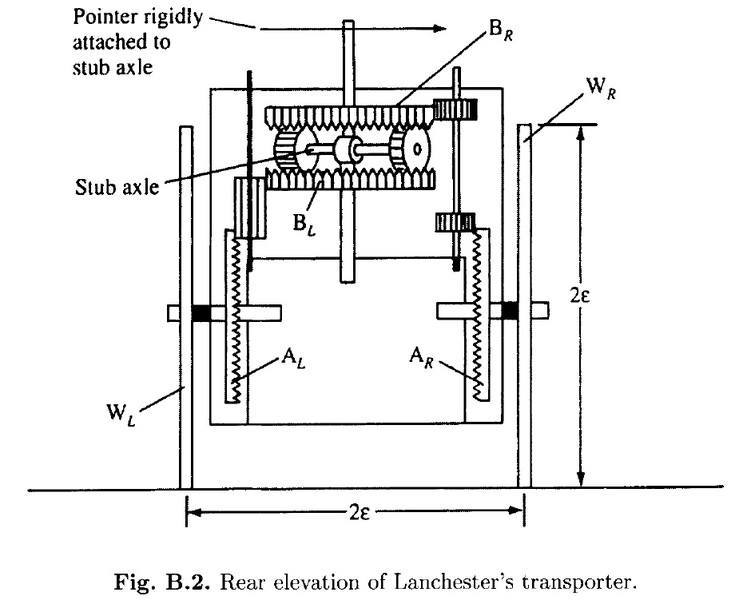
In A Short Course in General Relativity, Forster and Nightingale, page 236, it describes how the Lanchester's transporter operates.
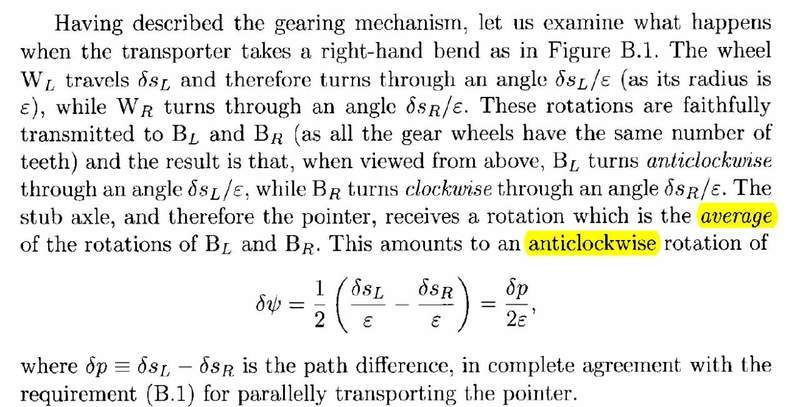
content of the question.jpg

lanchester's transporter.jpg

According to the diagram, I think the pointer would turn clockwise when the Lanchester's transporter travels a right-hand bend, however, the paragraph said it rotates anticlockwise.
Second, why is there a one half in the expression of the angle of rotation? Is it because there are "two" pinions?

Any help would be appreciated!
 
Physics news on Phys.org
If the "transporter" is turning to the right, its outer wheel, on the left turns faster which means that the lower of the two horizontal cogs turns faster. It, and so the pointer, will turn counterclockwise. And, yes, the "1/2" is there because of there are two wheels- the turning of the pointer is, as shown, the average of the two wheels.

By, the way, I see that this is from a book general relativity, but does this "transporter, itself, have anything to do with "relativity"?
 
If it helps any, the pointer stub axle is fixed to the central horizontal stub axle, although that is not immediately apparent from the diagram. I assume the purpose of the device is to accurately parallel transport a vector over a curved manifold?
 

Similar threads

  • · Replies 9 ·
Replies
9
Views
3K
  • · Replies 12 ·
Replies
12
Views
3K
  • · Replies 32 ·
2
Replies
32
Views
3K
  • · Replies 5 ·
Replies
5
Views
4K
  • · Replies 2 ·
Replies
2
Views
3K
Replies
1
Views
2K
  • · Replies 5 ·
Replies
5
Views
2K
  • · Replies 1 ·
Replies
1
Views
3K
  • · Replies 15 ·
Replies
15
Views
4K
  • · Replies 2 ·
Replies
2
Views
4K