Discussion Overview
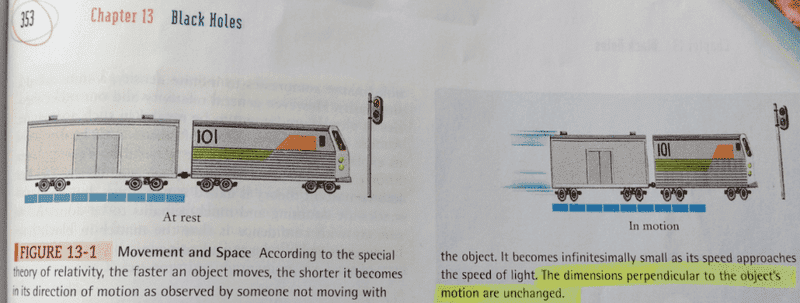
The discussion centers on the implications of length contraction on the rotation of train wheels when traveling at speeds approaching the speed of light. Participants explore the theoretical aspects of relativity, particularly how length contraction affects physical objects and their mechanical functions.
Discussion Character
- Exploratory
- Technical explanation
- Debate/contested
Main Points Raised
- Some participants note that length contraction occurs only in the horizontal direction for objects moving at relativistic speeds, raising questions about the mechanics of rotating wheels.
- One participant emphasizes that all motion is relative, suggesting that length contraction is not absolute and depends on the observer's frame of reference.
- Another point raised is that length contraction does not imply deformation of the object; the train operates normally from its own perspective, regardless of its speed relative to an observer.
- Concerns are expressed about the mechanical feasibility of a train moving at near light speed, with one participant stating that such a scenario presents a mechanical impossibility.
- Participants discuss the implications of rigid rotation at relativistic speeds, noting that traditional concepts may not apply.
Areas of Agreement / Disagreement
Participants express differing views on the mechanical implications of length contraction and the feasibility of trains moving at relativistic speeds. No consensus is reached regarding the practical effects on wheel rotation.
Contextual Notes
Participants acknowledge limitations in understanding the mechanics of objects at relativistic speeds, particularly regarding the concept of rigid rotation and the nature of length contraction.