How Does Lenz's Law Apply to Induction Motors?

Click For Summary

Discussion Overview

The discussion revolves around the application of Lenz's Law in the context of squirrel cage induction motors, specifically focusing on the interaction between the magnetic fields of the stator and rotor. Participants explore the dynamics of induced currents and magnetic fields, as well as the phase relationships between various electrical quantities in the motor.

Discussion Character

  • Exploratory
  • Technical explanation
  • Conceptual clarification
  • Debate/contested
  • Mathematical reasoning

Main Points Raised

  • One participant expresses confusion about how the induced magnetic field in the rotor bar opposes the rotating magnetic field of the stator, seeking clarification on this interaction.
  • Another participant suggests visualizing the positions of the stator's magnetic poles to understand the relationship between the stator and rotor fields, proposing the use of the right-hand rule for direction determination.
  • A later reply emphasizes that induction machines operate asynchronously, meaning the rotor does not synchronize with the stator's rotating field, and that this difference in speed is essential for torque production.
  • One participant shares a personal anecdote about a demonstration of induction principles using a simple setup with coils and an aluminum can, illustrating the practical application of the concepts discussed.
  • Another participant raises questions about the phase relationship between bar currents, voltages, and the flux density wave, specifically noting a potential lead of currents and voltages over the flux density wave.
  • There is a query regarding the representation of rotor currents in a plot and the lagging behavior of the magnetomotive force wave relative to the flux density wave.
  • One participant suggests that animated visualizations may aid in understanding the concepts better.

Areas of Agreement / Disagreement

Participants express various viewpoints and questions regarding the application of Lenz's Law and the behavior of induction motors, indicating that multiple competing views and uncertainties remain in the discussion.

Contextual Notes

Participants highlight assumptions about the phase relationships between electrical quantities and the dynamics of the rotor and stator fields, but these assumptions are not universally agreed upon and remain unresolved.

PainterGuy
Messages
938
Reaction score
73
TL;DR
I was reading on squirrel cage induction motor and couldn't understand how Lenz's law comes into play in this scenario.
Hi,

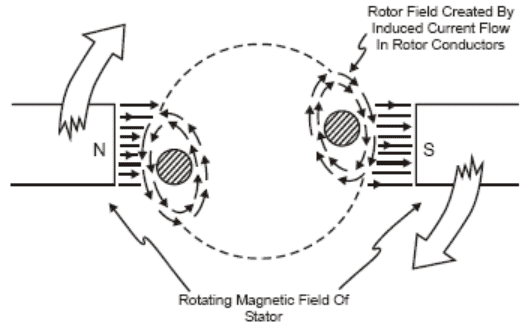
The shown below, Figure 1, is an interaction of magnetic fields of stator and rotor of a squirrel cage induction motor.
1576045637197.png

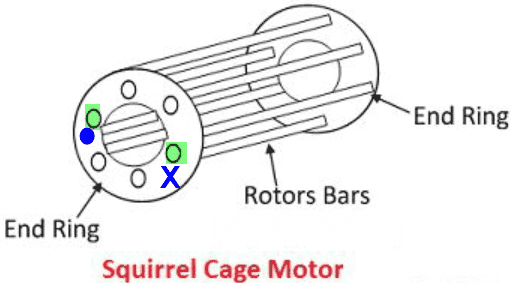
I believe the current is coming out of the squirrel cage bar on the left and entering on the right as is shown below, Figure 2. I have assumed that the bars highlighted in green are shown in Figure 1 and "x" represents current entering the bar and "." shows current coming out of bar.
1576047198453.png


Lenz's law states that the direction of the current induced in a conductor by a changing magnetic field is such that the magnetic field created by the induced current opposes the initial changing magnetic field.

I don't understand how the induced magnetic field in rotor bar opposes the initial rotating magnetic field of stator. Could you please help me with it?

Thank you!
 
Engineering news on Phys.org
It's hard to see it what is happening due to motion when right next to the rotor bar. Imagine when the N stator has moved to the 10 o'clock position, and the S stator has moved to 4 o'clock position. If you draw the magnetic lines all the way across, are the cage's fields working with the stator or against it?

You can also use the right hand rule to figure out the direction of force due to the external field and the induced current.
 
  • Like
Likes   Reactions: PainterGuy
Thank you!

scottdave said:
It's hard to see it what is happening due to motion when right next to the rotor bar. Imagine when the N stator has moved to the 10 o'clock position, and the S stator has moved to 4 o'clock position. If you draw the magnetic lines all the way across, are the cage's fields working with the stator or against it?

This would assume that the induced magnetic field of rotor bar lags behind the rotating magnetic field of stator. Anyway, please have a look on the attachment. I understand that the attached drawing is really bad but I hope it captures what you said.
 

Attachments

  • lenz_induction_motor.jpg
    lenz_induction_motor.jpg
    16.3 KB · Views: 388
PainterGuy said:
Thank you!
This would assume that the induced magnetic field of rotor bar lags behind the rotating magnetic field of stator. Anyway, please have a look on the attachment. I understand that the attached drawing is really bad but I hope it captures what you said.

This is precisely how induction machines work. They are "asynchronous", which means the rotor is NOT synchronized with the rotating stator field.

For an induction machine to produce torque, the rotor must spin slower (or faster if generating) than the stator field rotating speed, this difference in speed means the rotor bars are seeing a changing field which induces a voltage across the bars, and since the DC resistance is low this will cause currents to flow which cause the rotor to interact with the stator field and produce torque.
 
  • Like
Likes   Reactions: PainterGuy
Back in high school we had a really inventive physics teacher. In order to demonstrate such a machine, he drew a circle on a piece of plywood, mounted three coils equidistant along the circle and stuck a knitting needle through the center of the circle. He then took an empty aluminum can, punched a hole in the center and pushed it onto the knitting needle. When he connected the coils to a three-phase mains, the can spun like crazy!
 
  • Like
Likes   Reactions: PainterGuy and zoki85
Famous demonstration of the same principle:
 
  • Like
Likes   Reactions: PainterGuy and anorlunda
Hi,

I have been struggling to understand the plot shown below for a squirrel cage induction motor. I'd really appreciate if you could help me with it. At the moment I don't understand what's going on.

Flux density wave is resulting from stator's windings and it produces bar currents and voltages. Are bar currents and voltages in phase with flux density wave? I'm not sure if they are in phase. Look at the point marked "K" which represents the peak of flux density wave. Doesn't it look that bar currents and voltages are actually leading the flux density wave by a small margin?

Do those 'circles' under the horizontal axis show rotor currents?

Why is magnetomotive force wave lagging the flux density wave?

Here is another related animation: http://people.ece.umn.edu/users/riaz/animations/sqmovies.html

induction_squirrel.jpg

Source: http://people.ece.umn.edu/users/riaz/animations/squirrelcage.html
 
Sometimes only animated 3D visualization helps. Have a look at the following video starting at about 3:00.

 
  • Like
  • Informative
Likes   Reactions: PainterGuy and scottdave

Similar threads

  • · Replies 3 ·
Replies
3
Views
2K
  • · Replies 4 ·
Replies
4
Views
3K
  • · Replies 7 ·
Replies
7
Views
2K
  • · Replies 3 ·
Replies
3
Views
2K
  • · Replies 18 ·
Replies
18
Views
4K
  • · Replies 14 ·
Replies
14
Views
5K
  • · Replies 9 ·
Replies
9
Views
3K
  • · Replies 13 ·
Replies
13
Views
4K
Replies
8
Views
4K
  • · Replies 11 ·
Replies
11
Views
4K