How does rotating a magnet affect the magnetic field?

Click For Summary
SUMMARY

The discussion centers on the impact of rotating a rare Earth magnet on the magnetic field and the resulting voltage generated in a solenoid coil. It confirms that the magnetic field pattern rotates with the magnet, leading to a variable magnetic induction over time. According to Faraday's law, this variation induces current in the coil, which is explained through the presence of an electric field. The experiment is likened to electric motor design, suggesting that principles from motor analysis can be applied to understand the experiment's outcomes.

PREREQUISITES
  • Understanding of Faraday's law of electromagnetic induction
  • Familiarity with solenoid coil construction and function
  • Knowledge of electric motor design principles
  • Basic concepts of magnetic fields and their behavior
NEXT STEPS
  • Research the principles of Faraday's law in detail
  • Explore the design and operation of solenoid coils
  • Study electric motor design and its applications
  • Investigate the behavior of magnetic fields in rotating systems
USEFUL FOR

Students and researchers in physics, electrical engineers, and anyone conducting experiments related to electromagnetism and electric motor design.

kvyn
Messages
1
Reaction score
0
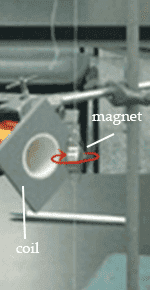
I'm doing an experiment on the effect of the speed of rotation of a rare Earth magnet on the voltage generated in a solenoid coil. I was wondering, how does rotating the magnet affect the magnetic field?

The experiment setup is similar to the one below:
Untitled_4.png
 
Physics news on Phys.org
kvyn said:
I'm doing an experiment on the effect of the speed of rotation of a rare Earth magnet on the voltage generated in a solenoid coil. I was wondering, how does rotating the magnet affect the magnetic field?

The experiment setup is similar to the one below:
Untitled_4.png

The magnetic field pattern will rotate with the magnet, thus making the magnetic induction variable in time. From Faraday's law, we expect current to be induced in the coil. We explain this current as due to electric field. So we think of variable magnetic field to be necessarily accompanied with electric field.
 
Your experiment sounds like a form of electric motor. Analyses of electric motor design should be adaptable to describe your experiment.
 

Similar threads

  • · Replies 5 ·
Replies
5
Views
2K
  • · Replies 5 ·
Replies
5
Views
989
  • · Replies 12 ·
Replies
12
Views
1K
  • · Replies 7 ·
Replies
7
Views
3K
  • · Replies 6 ·
Replies
6
Views
2K
  • · Replies 14 ·
Replies
14
Views
2K
  • · Replies 7 ·
Replies
7
Views
2K
  • · Replies 42 ·
2
Replies
42
Views
4K
  • · Replies 2 ·
Replies
2
Views
2K
  • · Replies 4 ·
Replies
4
Views
2K