How Does Rotational Momentum Apply in a Combined Linear and Angular System?

Click For Summary
The discussion focuses on applying rotational momentum in a system involving both linear and angular motion. Participants analyze the conservation of energy and momentum principles to derive equations for the velocity and rotational speed of a box and cylinder system. There is confusion regarding the initial conditions, particularly whether the cylinder rotates while the box is lifted and how the string's tension affects the system. Clarifications reveal that the cylinder remains stationary while the box is lifted, leading to a focus on momentum conservation during the inelastic collision when the string becomes taut. The conversation emphasizes the complexities of analyzing simultaneous impacts and the distinction between energy and momentum in the context of this system.
freshcoast
Messages
185
Reaction score
1
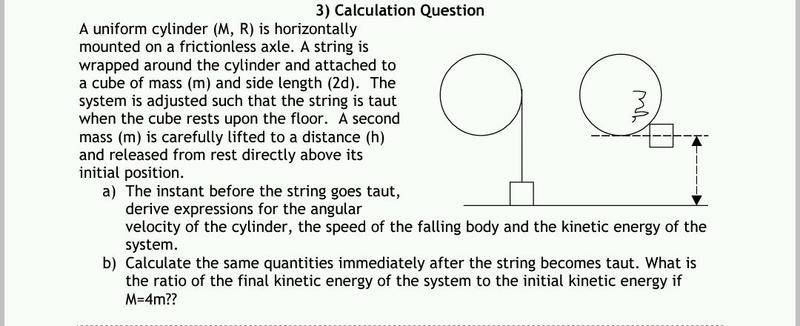
1. Problem statement
11htkbo.jpg


2. Related equations
I = bmr^2
Energy equations (linear and rotational)

3. Attempt

Part a)
I know that the distance or height traveled by the box is [h - d] because center of the mass of box is just d. Initial kinetic energy of the box and cylinder is 0 and if only conservative forces are at play, I applied the conservation of energy laws and I am just left with potential energy = KF[translational] KF[rotational]. I also know that v = rw. So substituting in the correct variables i have come up with the general solution for the velocity of the box as its dropping, the rotational speed of the cylinder and the energy of the system.
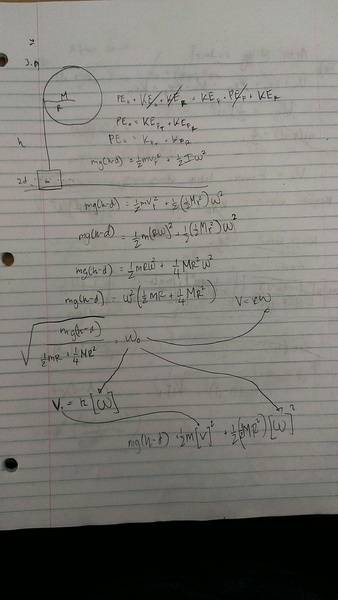
288p0l3.jpg


Part b)

Assuming if part a is correct, and knowing that the system is a perfectly inelastic collision I can find the new rotational speed (wf) by using conservation of momentum which looks like

Mbvb + Iwo = Iwf

For the initial conditions, I can just use the (wo) from part a.

And so to compare the ratio from initial to final I just used energy conservation laws again but the kinetic final for box is 0 since it is at rest and I just used kinetic rotational over potential energy. But the answer is messy so before I try all that I just want to make sure I'm on the right path.
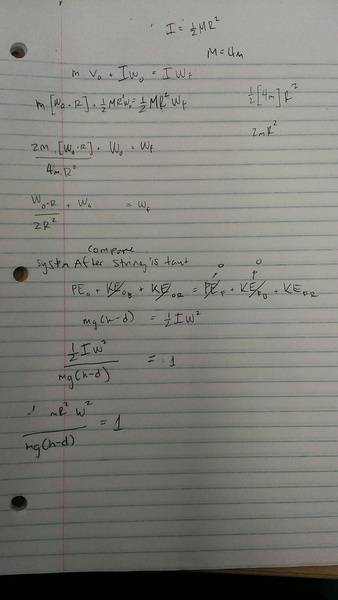
63r32b.jpg
 
Physics news on Phys.org
How is this second mass attached? Telling us it is raised such and such a distance above its initial position isn't very useful since we're not told its initial position. I assume it should be referring to the same mass m.
How is the mass lifted? You seem to have assumed it was by rotating the cylinder, so that as the mass descends the cylinder rotates. But in that case, the string would be taut as soon as the system is released. I suspect they mean the mass is lifted directly, so the string goes slack.
But the leaves a conundrum for what happens when the string goes taut again. There will be two impacts, apparently at the same time: the string going taut and the mass m hitting the table. That makes it impossible to determine anything. I suppose you have to assume the string goes taut first.
 
I was confused at that part too, the cube is the second mass which is m, I am not clear whether or not the cylinder rotates when the cube is being lifted in a way which is negligible since it is not stated? If I assume when the cube is being lifted, the cylinder does not rotate and that the string goes slack? does that mean there is no rotational energy in the system?

but then if my assumption is correct where it rotates when the cube is being lifted, would my calculations be correct?
 
As I said, if the cylinder is rotated to raise the cube then the string will go taut before anything moves. This makes part a trivial. There's a squiggle on the right hand picture which I suspect is supposed to be the slack string - it's got a bit displaced.
 
Ok I asked my professor for clarification, he confirmed that the cylinder stays still and that when the cube is being lifted the string is slack,

which I am confused on.. how am I to derive an angular velocity expression if the cylinder does not rotate?
 
freshcoast said:
Ok I asked my professor for clarification, he confirmed that the cylinder stays still and that when the cube is being lifted the string is slack,

which I am confused on.. how am I to derive an angular velocity expression if the cylinder does not rotate?
I would think that makes it extremely easy :wink:.
For part b, as I posted before, I think you have to assume that the string goes taut an instant before the cube hits the table. In other words, treat it as though the table is no longer there.
 
Oh, ha. For part a there is no angular velocity for the cylinder? so I'm just solving for the speed of the falling body and kinetic energy of the system.

For part b, is there a rotational speed for the cylinder then? I'm thinking since the string is taut the mass is pulling the cylinder and causes it to rotate?..So apply conservation of energy laws but include the new mass and a rotational kinetic energy?? would the box have no kinetic energy since it's just at rest when the string becomes taut?
 
freshcoast said:
Oh, ha. For part a there is no angular velocity for the cylinder? so I'm just solving for the speed of the falling body and kinetic energy of the system.
Yes.
For part b, is there a rotational speed for the cylinder then? I'm thinking since the string is taut the mass is pulling the cylinder and causes it to rotate?..So apply conservation of energy laws but include the new mass and a rotational kinetic energy?
No, be careful here. An inelastic string becoming taut is an impact event. Work will not be conserved. So what can you use instead?
 
I can use momentum conservation, inelastic since the cube will be resting on the surface? do I only use rotational momentum?

so the change in kinetic energy of the system = change in angular momentum?
 
  • #10
freshcoast said:
I can use momentum conservation,
Yes, but it's not quite straightforward. There is more than one sudden impulse involved (at the same time). See what you can come up with on this.
inelastic since the cube will be resting on the surface?
No, don't worry about the surface. It won't enter into the analysis. Pretend it is no longer there.
do I only use rotational momentum?
Yes, that is indeed the right approach. But about what point?
so the change in kinetic energy of the system = change in angular momentum?
No! Energy and momentum and angular momentum are all different dimensionally. The change in one cannot be equated to the change in another.
 

Similar threads

Replies
2
Views
1K
Replies
17
Views
2K
Replies
27
Views
1K
Replies
6
Views
1K
Replies
11
Views
2K
  • · Replies 2 ·
Replies
2
Views
3K
Replies
30
Views
3K
Replies
1
Views
1K
Replies
2
Views
2K
  • · Replies 32 ·
2
Replies
32
Views
3K