How Does Snell's Law Help Calculate Distance Between Parallel Lines?

Click For Summary

Homework Help Overview

The discussion revolves around applying Snell's Law to calculate the distance between two parallel lines. Participants are exploring the geometric relationships and angles involved in the context of right triangles formed by the incident and refracted rays.

Discussion Character

  • Exploratory, Mathematical reasoning, Assumption checking

Approaches and Questions Raised

  • Participants discuss the need to identify all relevant triangles and angles, particularly focusing on the relationships dictated by Snell's Law. There is an emphasis on expressing the problem in terms of the angle of incidence and the height of the triangles involved.

Discussion Status

The conversation is ongoing, with participants offering suggestions on how to approach the problem. There is recognition of the need to clarify the desired outcome and to establish relationships between the angles and triangles involved. No consensus has been reached yet, but there are productive directions being explored.

Contextual Notes

Participants note the importance of explicitly stating the proof they are attempting to achieve and the necessity of considering all angles and triangles in the setup. There is an acknowledgment that some angles are interconnected through Snell's Law, which may influence the approach taken.

Shaun97
Messages
5
Reaction score
0
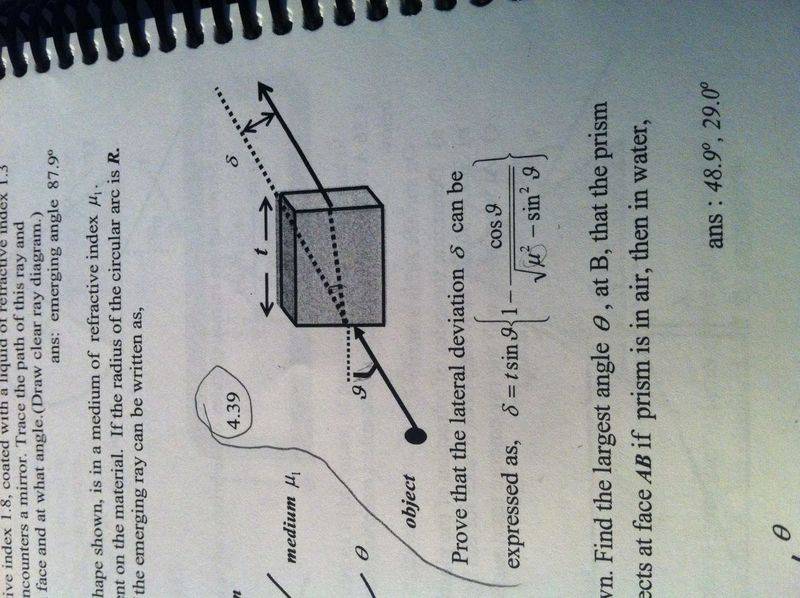
I can't seem to find the proof for the distance between the two parallel lines.
VUJb7oV.jpg


Homework Equations

: Snells law: μ1sinθ1=μ2sinθ2
Sin (A+B)= sinAcosB + sinBcosA[/B]

The Attempt at a Solution

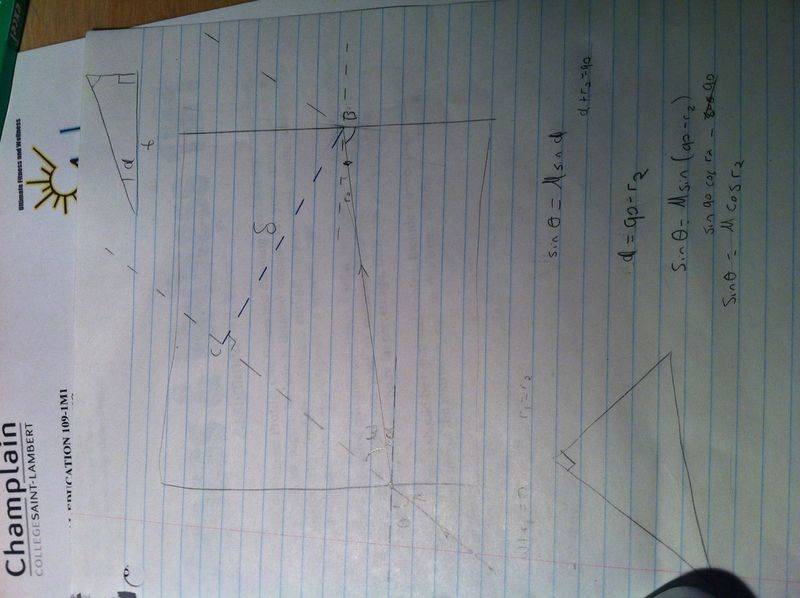
: tried using the parallel lines to get a result in terms of the initial angle of incidence ϑ, as the lateral deviation creates a right angle triangle.
eO5oLwc.jpg
[/B]
 
Physics news on Phys.org
Thats a good start... you need the other angles too.
There's another rt angled triangle that may be useful in there.
It also helps to explicitly state exactly what you want to prove.
 
there's the rt angled triangle with alpha (α) as one of the angles and with t as the height of it, and as the answer is also in terms of t I assume it's necessary to do something with this triangle but at the same time the answer only contains one angle, ϑ.
 
You have to start by writing down relations involving the different triangles ... then you can think about how you can use them to get the relation you need to prove.

Clearly you need to find a way to get rid of the terms that are not in the final form. Don't forget that some of the angles are related through Snell's Law. Make sure you have identified all the triangles ...
 
Last edited:

Similar threads

Replies
12
Views
2K
Replies
5
Views
1K
  • · Replies 3 ·
Replies
3
Views
3K
  • · Replies 8 ·
Replies
8
Views
6K
  • · Replies 2 ·
Replies
2
Views
2K
  • · Replies 3 ·
Replies
3
Views
6K
  • · Replies 1 ·
Replies
1
Views
2K
  • · Replies 3 ·
Replies
3
Views
2K
Replies
10
Views
8K
  • · Replies 7 ·
Replies
7
Views
7K