How Does Surface Tension Affect Water Levels in Capillaries?

Click For Summary

Discussion Overview

The discussion centers around the effects of surface tension on water levels in capillaries, specifically examining how different materials influence the behavior of water in tubes of uniform diameter. Participants explore theoretical aspects, practical implications, and the geometry of meniscuses formed in various scenarios.

Discussion Character

  • Exploratory
  • Technical explanation
  • Conceptual clarification
  • Debate/contested

Main Points Raised

  • Some participants suggest that water will occupy the same volume in each tube, though there is confusion regarding the behavior in the paraffin wax tube.
  • One participant questions the mechanics of water rising in the glass tube and the significance of the contact angle between water and different materials, such as glass and paraffin wax.
  • There is a query about the behavior of water when it is sucked up the tube and then released, with speculation that the end result may mirror the initial rise but in reverse.
  • Another participant expresses confusion about the relevance of the contact angle when the water rises above the paraffin wax, suggesting that the wax's position may not affect the water level.

Areas of Agreement / Disagreement

Participants express varying levels of understanding and confusion regarding the mechanics of water rising in capillaries, particularly in relation to different materials. There is no consensus on the implications of the contact angle or the final water levels after suction.

Contextual Notes

Participants have not fully resolved the implications of surface tension and contact angles on water behavior in capillaries, and there are assumptions about the geometry of meniscuses that remain unexamined.

zircons
Messages
10
Reaction score
0
The figures below represent capillaries of varying construction and arrangement. The diameter of the capillary portion is the same in each case, and all of the capillaries are constructed of glass, except where otherwise indicated. The equilibrium rise for water is shown at the left. Draw meniscuses in each figure to correspond to (a) the level reached by water rising up the clean, dry tube and (b) the level to which the water would recede after having been sucked up to the end of the capillary. The meniscuses in the capillary may be assumed to be hemispherical in shape. Pay attention to curvatures of meniscus as well.
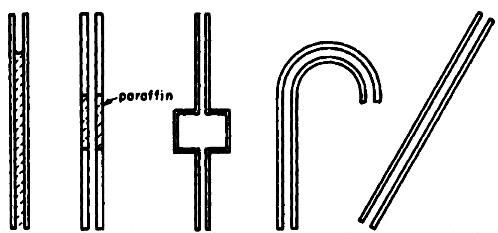
assign3.gif


a) I think that they the water would just take up the same amount of volume in each tube? I'm confused about the paraffin one though.

b) I don't get this at all.
 
Physics news on Phys.org
First do you understand why the water goes up the left hand tube?

If you do then see

http://simple.wikipedia.org/wiki/Surface_tension

and compare the contact angle for various materials such a water and glass (0 degrees) and water and paraffin wax (107 degrees).

What happens to the surface tension when the water rising up the glass tube reaches the paraffin wax?

a) Asks about water rising up the tubes. How far does it go? What does the meniscus look like when it stops?
b) Asks what happens if you suck water up the tube and then stop sucking. Clearly the water will sink back down but how far and is the end result the same as in a)? What does the meniscus look like then?

So the answer will be two sets of drawings. Each showing the curve of the meniscus.
 
But where I'm confused is that, for example, the water rises up through the paraffin wax tube. But the amount of water makes the paraffin wax contact angle irrelevant because of the wax's location in the middle of the tube. The water rises above it.

Is my reasoning wrong?

For b, I feel like the end result will be the same as in a except opposite (from the other direction).
 
But where I'm confused is that, for example, the water rises up through the paraffin wax tube.

Does it? Best start at the beginning..

What makes the water rise up the plain glass tube on the far left at all?
Why does it only rise to that point and no higher?
 

Similar threads

Replies
1
Views
2K
  • · Replies 1 ·
Replies
1
Views
4K
Replies
2
Views
2K
  • · Replies 7 ·
Replies
7
Views
14K
  • · Replies 10 ·
Replies
10
Views
3K
  • · Replies 8 ·
Replies
8
Views
4K
  • · Replies 3 ·
Replies
3
Views
2K
  • · Replies 42 ·
2
Replies
42
Views
8K
  • · Replies 2 ·
Replies
2
Views
2K
  • · Replies 12 ·
Replies
12
Views
2K