How does the force of wind come from?

  • Context: High School 
  • Thread starter Thread starter KFC
  • Start date Start date
  • Tags Tags
    Force Wind
Join the discussion
Ask a follow-up here, or get your own question answered by working scientists, mathematicians and engineers — people, not an autocomplete.
Real named experts · corrections over time · the nuance an AI answer skips
3 replies · 3K views
KFC
Messages
477
Reaction score
4
Hi there,
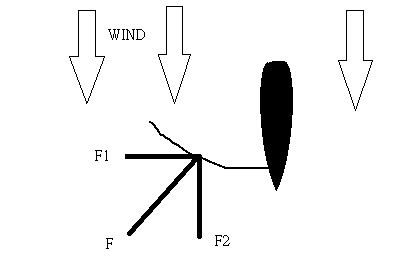
There is a question of text about a sailing boat and the force of wind. Suppose the boat is directed downwind as shown in the image.
or2jag.png


I think for fluid, the interaction force on a smooth surface is along the direction perpendicular to surface. Hence, force F is result from the wind, right? If that's true, then it is the component F2 of F to drive the boat forward, is that correct?
 
Physics news on Phys.org
It's not generally perpendicular to the surface, but yes, there is going to be an F1 and F2 component.

Though, it's still a little more complicated than that. F1 component doesn't just go away. There are more forces due to the keel in the water. The boat is going to be turned slightly away from F1, so the keel will generate a hydrodynamic lift force in direction opposite to F1, canceling it, and a drag force opposite F2, but significantly smaller than it. So the net force is going to be in direction of F2, and that's where the boat will travel, but the actual orientation of the boat will be at a slight angle to it.

That's if you want to be complete in the description. It's also the only way you are going to get proper description if the sailboat is doing anything other than running downwind.
 
The force of the wind comes from the change of momentum of air molecules striking the sail. That's the answer to the question posed in your title.

The question in the body of your post is a bit more complicated. When the wind strikes the sail, it imparts a force equal to the component of "momentum change" that is perpendicular to the sail at that point. Since the sail is curved, that is very complcated to calculuate but the sail can be approximated by a plane.

So the first force, your "F", is the projection of the wind's momentum vector on the vector perpendicular to the sail. But in order that the boat not simply go in that direction, rather that the direction we want to go, we have a keel that prevents motion in the direction perpendicular to the boat. The actual force moving the boat is the projection of vector F on a vector in the direction of the boat itself. That is your "F2".